Can young Guyanese use technology to help build a greener, stronger Guyana? STEMGuyana believes they can — and its newest programme is giving young people the opportunity to turn that belief into action.
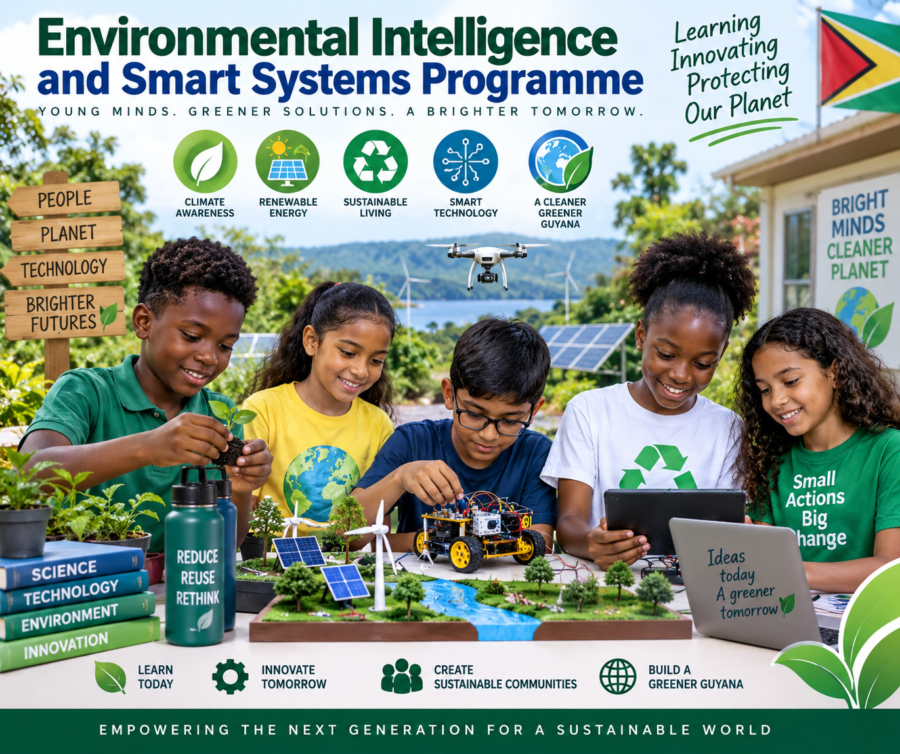
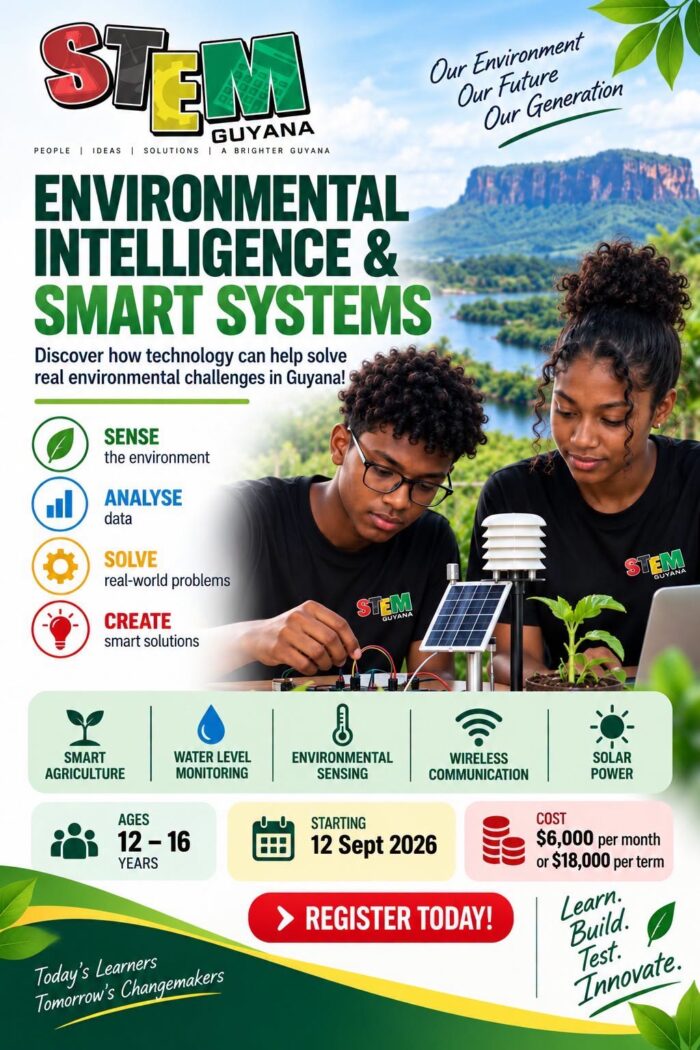
STEMGuyana is introducing Environmental Intelligence & Smart Systems, a hands-on programme where students will explore how sensors, data, artificial intelligence and smart technology can help solve real environmental challenges.
Beginning September 12, the programme is open to students ages 12 to 16 and will expose them to smart agriculture, water-level monitoring, environmental sensing, wireless communication and solar power. Children can register by clicking on this link here.
The programme’s philosophy is simple: Learn. Build. Test. Innovate.
Behind that philosophy is Dr. Karen Abrams, Founder and Executive Director of STEMGuyana, whose pioneering work has focused on introducing school-age children in Guyana to practical science, technology, engineering and mathematics education.
Abrams’ mission extends beyond teaching children how to use computers or build robots. It is about preparing Guyanese children to compete in a rapidly changing 21st-century world where artificial intelligence, robotics, automation, data science and other technologies are transforming education, employment and entire industries.
“We founded STEMGuyana because we believe that talent is universal, but opportunity is not. Every child in Guyana deserves access to the tools, mentorship, and inspiration to imagine and build their future with confidence.”
What is STEM?
STEM stands for Science, Technology, Engineering and Mathematics. More importantly, STEM education teaches young people how to apply knowledge from these fields to real-world problems.
Students learn to investigate, experiment, design, test, fail, rethink and try again. Those skills can build critical thinking, creativity, problem-solving, teamwork and confidence — abilities that are increasingly valuable in the modern economy.
For Guyana, the importance is even greater as the country expands into energy, agriculture, construction, telecommunications, environmental management and digital technology.
Teaching children to build, not simply consume
STEMGuyana has expanded its programmes to include robotics, coding, artificial intelligence, machine learning, data science, web development, mobile applications, cloud computing and the Internet of Things.
Its AI programmes introduce young students to concepts such as machine learning, pattern recognition, data training and chatbot development. Students can progress from introductory programming to more advanced applications.
The goal is not simply to teach children how to use AI.
It is to help them understand it, question it and build with it.
That distinction is critical for a generation entering a workforce where technology will increasingly determine how people work, communicate and solve problems.
Turning Guyana’s challenges into opportunities
Environmental Intelligence & Smart Systems brings this philosophy directly into the classroom.
A student working with water-level sensors can begin to understand how technology can be used to monitor environmental conditions. Another working on smart agriculture can explore how data and technology could improve farming. Solar-power projects can introduce young people to technologies with applications in Guyana’s energy future.
STEMGuyana has already demonstrated this approach through projects such as a solar-panel cleaning robot prototype, showing students that robotics can be used to address practical problems.
The lesson is powerful: Guyana’s problems can become opportunities for Guyanese children to invent solutions.
Taking Guyanese talent to the world
STEMGuyana students have also demonstrated that young Guyanese can compete internationally when given the opportunity and preparation.
Students have represented Guyana in international robotics and STEM competitions, competing against teams from around the world.
One example is 14-year-old On Beaton, who joined a STEMGuyana club at age seven. He went on to compete on three national junior robotics teams, earning silver and bronze medals, and is now training to mentor younger students in robotics, drones and game programming.
His journey demonstrates the potential of early exposure to STEM: a child who begins by learning can eventually become a competitor, creator and mentor.
An investment in Guyana’s future
The benefits of STEM education extend far beyond a possible career in engineering or computer science.
Children who learn to build and solve problems develop skills that can serve them in virtually every profession. They learn that failure is not necessarily defeat, but part of the process of innovation.
For parents, that makes STEM education an investment not simply in a child’s academic performance, but in their ability to adapt to a world that is changing rapidly.
Environmental Intelligence & Smart Systems costs $6,000 monthly or $18,000 per term, with limited spaces available.
But the larger opportunity is difficult to measure.
Guyana’s future will require young people who can do more than consume technology developed elsewhere. It will need innovators capable of creating solutions suited to Guyana’s own challenges.
That is the opportunity STEMGuyana is placing before its students — and the vision that continues to drive Abrams’ commitment to ensuring Guyanese children are equipped to learn, compete and succeed in the 21st century.
The children who learn to build tomorrow’s technology today could ultimately become the people who build Guyana’s tomorrow.