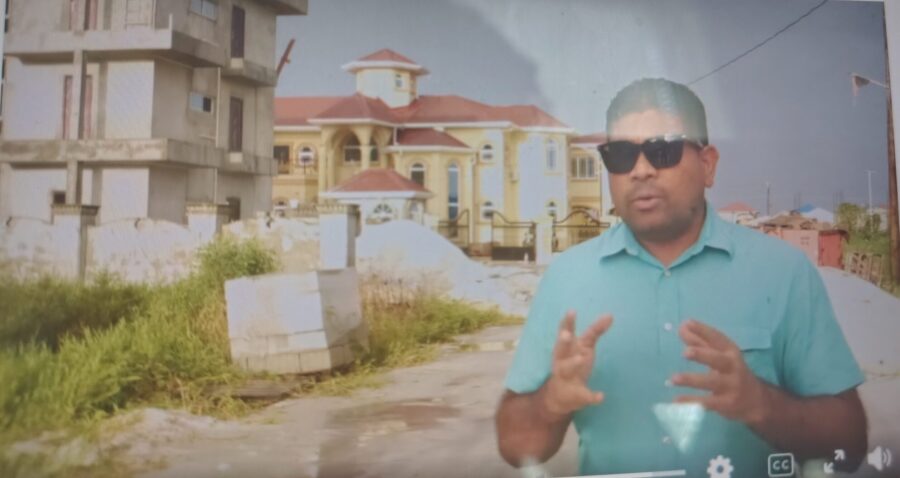
Opposition Leader Azruddin Mohamed has intensified his scrutiny of Agriculture Minister Zulfikar Mustapha, questioning the apparent accumulation of wealth by the minister’s family and demanding answers about a massive newly constructed mansion reportedly linked to one of Mustapha’s sons in Providence.
Standing near the property, Mohamed said the mansion sits on three lots of prime residential land—a striking contrast, he argued, to the thousands of Guyanese who continue to struggle to acquire house lots.
“Behind me is a massive newly constructed mansion on a sprawling plot of prime land in Providence, belonging to one of the sons of the Minister of Agriculture, Zulfikar Mustapha.”
Mohamed identified the minister’s 30-year-old son, Javed Mustapha, as the reported owner and questioned how the property and lifestyle associated with him could have been financed.
Javed Mustapha is a medical doctor, Mohamed said, but claimed that he has never practiced medicine.
“Javed Mustapha is a medical doctor, yet he has never practiced, even for one hour in his life.”
Mohamed then levelled broader allegations of corruption against the Ministry of Agriculture, claiming that billions of dollars are being funnelled through shell companies while farmers, fisherfolk and others in the agricultural sector continue to struggle.
Those allegations remain claims by the Opposition Leader and would require documentary evidence and independent investigation to establish.
From a Modest Berbice Home to a Providence Mansion
Mohamed’s central argument was the contrast between what he described as the Mustapha family’s circumstances in 2020 and the scale of the Providence property today.
He recalled personally visiting the family’s home in Bloomfield, Berbice, which he described as a simple wooden house measuring approximately 20 by 30 feet.
“This 30-year-old son of Minister Zulfikar came from very humble beginnings, where the minister and his family lived in a 20 by 30 simple wooden house in Bloomfield, Berbice.”
Mohamed said the dramatic change in circumstances over less than five years raises questions about the source of the family’s wealth.
The minister has denied that the family’s accumulation of wealth was acquired fraudulently and has rejected accusations levelled against him and his family. However, Mohamed argues that the denials do not, by themselves, resolve questions surrounding the family’s apparent acquisition of substantial assets.
The Opposition Leader contends that the minister should be able to demonstrate, through legitimate income, financial records and other documentary evidence, how such acquisitions could have been financed.
“Where Did the Money Come From?”
At the heart of Mohamed’s allegations is a straightforward demand for transparency.
“Where did the money come from? How was the property financed? Who owns it legally? What companies or business interests are connected to the owner?”
Those questions take on added significance because Mustapha is a senior government minister overseeing a sector through which substantial public expenditure is channelled.
Owning an expensive home is not, in itself, evidence of wrongdoing. Likewise, a dramatic improvement in a family’s financial circumstances does not automatically establish corruption.
But Mohamed argues that the scale of the Providence property, combined with his allegations concerning government contracts and the Ministry of Agriculture, warrants greater public scrutiny.
Guyana’s unprecedented oil revenues have dramatically expanded government spending, placing increased emphasis on transparency, public procurement and accountability involving politically exposed persons.
For Mohamed, the Providence mansion has therefore become more than a luxury residence. It is a symbol of what he describes as the widening gap between those close to political power and ordinary Guyanese still waiting for access to land, housing and economic opportunity.
The question he is pressing is ultimately one of accountability: How was the transformation from a modest 20-by-30-foot wooden home to substantial private wealth financed—and can the money trail withstand public scrutiny?