Nima Flue-Bess, a physical education teacher and Member of Parliament for A Partnership for National Unity (APNU), has directly challenged Sports Minister Charles Ramson Jr. over what she described as the worsening state of swimming in Guyana, calling for urgent intervention to rehabilitate the National Aquatic Centre’s 50-metre pool, a facility built at a cost of approximately $581.3 million.
In a strongly worded public statement, Flue-Bess said the closure and non-functionality of the country’s premier swimming facility have created a crisis for athletes preparing for regional and international competition.
“This situation calls for urgent intervention. Charles Ramson Jr. and the Ministry must prioritize the rehabilitation of the Aquatic Centre pool and ensure it is accessible to athletes and clubs. The investment in infrastructure is not optional—it is essential for national development in sport,” Flue-Bess said.
Her criticism comes at a time when the Government has allocated $6 billion in the 2026 National Budget for sports development, with Ramson maintaining that the funds would strengthen infrastructure, athlete development and grassroots programmes. But Flue-Bess questioned how such significant funding could coexist with the neglect of one of the country’s most important sports facilities.
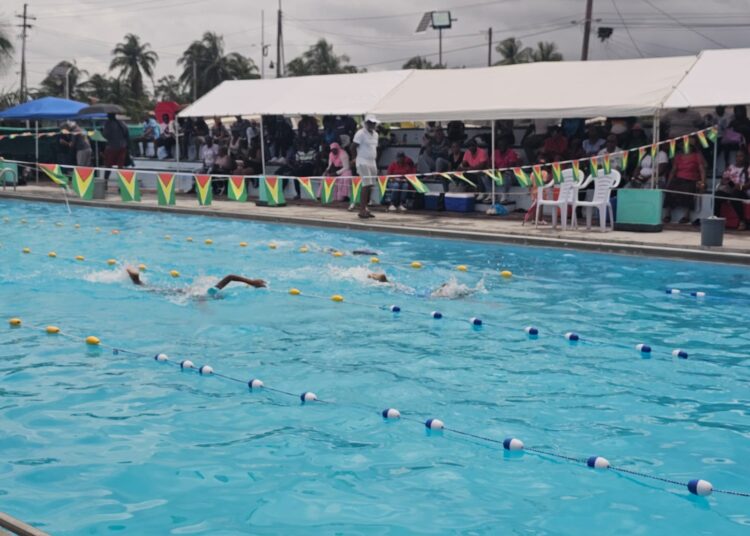
The $581.3 million National Aquatic Centre’s 50-metre pool
“Swimming in Guyana is facing a troubling reality—one that threatens the growth and competitiveness of our athletes on the regional and international stage,” she said.
Flue-Bess noted that Guyana relies heavily on the National Aquatic Centre as its primary training base for swimmers, but argued that the system is failing those it was designed to serve.
“The 50-metre pool at the National Aquatic Centre, a critical training ground for elite and developing swimmers alike, is currently nonfunctional and inaccessible to clubs and athletes. This has left swimmers without the standard facility required to train effectively for high-level competition,” she stated.
The APNU parliamentarian warned that the lack of access to a regulation-standard pool is undermining Guyana’s ability to prepare athletes for competitions such as the CARIFTA Games, Goodwill Games and South American Championships.
She also raised concern over the suspension of the National Schools Swimming Championship, which she said has not been held for the past two years.
“This event was once a cornerstone of swimming development in Guyana, bringing together young athletes from across all regions. It served as a vital platform for talent identification, competition, and national unity through sport. Its removal has created a significant gap in the competitive calendar,” Flue-Bess said.
According to her, the absence of both a functioning national pool and regular competitions has compounded the challenges facing swimmers.
“The lack of consistent competitions further compounds the problem. Without regular exposure to competitive environments, swimmers are left underprepared and disadvantaged when representing Guyana internationally,” she said.
She posed what she described as the pressing question facing the sport: “How will our athletes be adequately prepared for upcoming events? Or worse, are we heading toward a future where Guyana is unable to field swimmers at all?”
Flue-Bess also pointed to what she described as contradictions in the Government’s sports policy, particularly the Ministry’s grassroots “Learn to Swim” programme.
“Ironically, while there are efforts such as the Ministry of Culture, Youth and Sport’s ‘Learn to Swim’ programme aimed at developing grassroots talent, there is a glaring disconnect. Teaching children to swim is only the first step—without proper facilities and structured competition, that talent cannot be nurtured into excellence,” she said.
In one of the sharpest parts of her statement, Flue-Bess highlighted the visible deterioration at the National Aquatic Centre.
“The image of frogs occupying a national pool intended for athletes is both symbolic and unacceptable,” she declared.
She argued that for a country investing billions in sport and positioning itself as a regional sporting force, the neglect of a $581.3 million national aquatic facility sends the wrong signal about priorities and accountability.
“With timely action and commitment, the pool can be restored, competitions reinstated, and athletes given a fair chance to excel. The future of swimming in Guyana depends on it,” Flue-Bess said.
Her intervention is likely to intensify scrutiny on Ramson and the Government over whether record spending on sports is translating into meaningful improvements for athletes or merely expanding programmes without safeguarding critical infrastructure.