The Guyana Trades Union Congress on Monday strongly condemned the dismissal of all ten Regional Executive Officers (REOs) and the appointment of their replacements, warning that the move deepens public concerns over political interference, patronage, and the erosion of professionalism within Guyana’s public service.
In a statement issued on May 18, GTUC General Secretary Lincoln Lewis said the manner in which the dismissals and appointments were carried out creates “the unmistakable appearance of political patronage and partisan control of the public service.”

Regional Executive Officers are among the most senior administrative officials within Guyana’s regional democratic system and are responsible for overseeing the implementation of government policies, regional administration, and public services across the country’s ten administrative regions.
Although appointed by Central Government, the positions have long attracted controversy because of allegations that successive administrations use them as instruments of political influence and party control at the regional level.
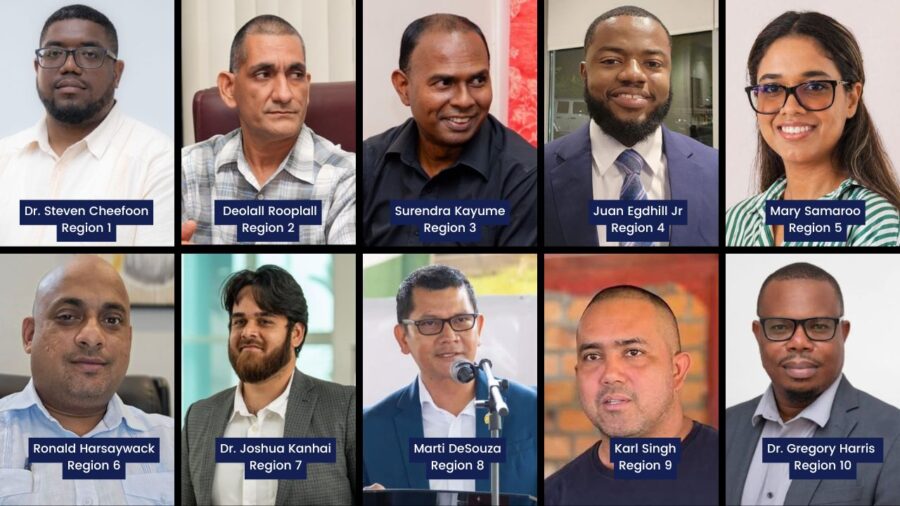
The controversy intensified after the government announced Sunday the appointment of ten new REOs across the country’s administrative regions:
- Region One (Barima-Waini): Dr. Steven Cheefoon
- Region Two (Pomeroon-Supenaam): Mr. Deolall Rooplall
- Region Three (Essequibo Islands-West Demerara): Mr. Surendra Kayume
- Region Four (Demerara-Mahaica): Mr. Juan Edghill Jr.
- Region Five (Mahaica-Berbice): Ms. Mary Samaroo
- Region Six (East Berbice-Corentyne): Mr. Ronald Harsaywack
- Region Seven (Cuyuni-Mazaruni): Dr. Josh Kanhai
- Region Eight (Potaro-Siparuni): Mr. Marti DeSouza
- Region Nine (Upper Takutu-Upper Essequibo): Mr. Karl Singh
- Region Ten (Upper Demerara-Berbice): Dr. Gregory Harris
Several of the appointments are already generating public scrutiny because of alleged political affiliations to the People’s Progressive Party/Civic administration.
Among the appointments drawing widespread attention is that of Juan Edghill Jr., son of Public Works Minister Juan Edghill, as REO for Region Four, the country’s most populous administrative region and a politically strategic electoral district.
Lewis argued that the developments reinforce growing fears that political loyalty is increasingly being prioritised above competence, fairness, and merit in state appointments.
“For years, the issue of Regional Executive Officers has impacted not only workers, but citizens at large,” Lewis said. “One would have expected that whatever is being done would be done consistent with international standards and time-honoured principles.”
The GTUC said it was particularly troubling that political parties which criticised such practices while in opposition now appear willing to perpetuate the same system after assuming office.
“I cannot understand why governments over the years, when in opposition, demanded these conditions, but when they are in position they do the very things they once condemned,” Lewis declared.
The labour federated body argued that the wholesale removal of the REOs creates the impression that public officers are being made scapegoats for broader administrative and political failures.
“Today what is being done is an opportunity to say to the world that the problem has not been with the ministers, but with the individuals who were given the task to execute,” Lewis stated.
Guyana’s public service system has for decades faced criticism from trade unions, opposition parties, and civil society groups over allegations of political victimisation, uneven hiring practices, and the weakening of institutional independence. Concerns have frequently intensified during election cycles and periods of heightened political tension between the country’s two major political blocs.
The GTUC warned that the latest appointments risk further undermining public trust in the neutrality and credibility of state institutions.
“At a time when qualified Guyanese continue to seek equal opportunity in public service, these appointments deepen public suspicion that political and family connections now carry greater weight than competence and professionalism,” the Congress stated.
“These things need to be brought to an end,” Lewis warned. “Many persons now brought to the fore either have political links in the organisation or have responsibilities to discharge for operatives in the organisation.”
The GTUC called for sweeping reforms to the appointment process for REOs and other senior public officials, including transparent advertising of vacancies, independent review of applicants, and merit-based selection systems insulated from political interference.
“To do otherwise is to abrogate the government would be abrogating its responsibility to workers,” Lewis said, “and using the opportunity not to expedite on behalf of the people, but against the interests of the people.”
Lewis added that Guyana must fundamentally rethink how it builds and manages public institutions if confidence in governance and public administration is to be restored.
“The time has come for Guyana to start all over again and look at how we move forward” in building impartial, professional, and credible public institutions that serve all Guyanese rather than political interests, he said.