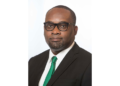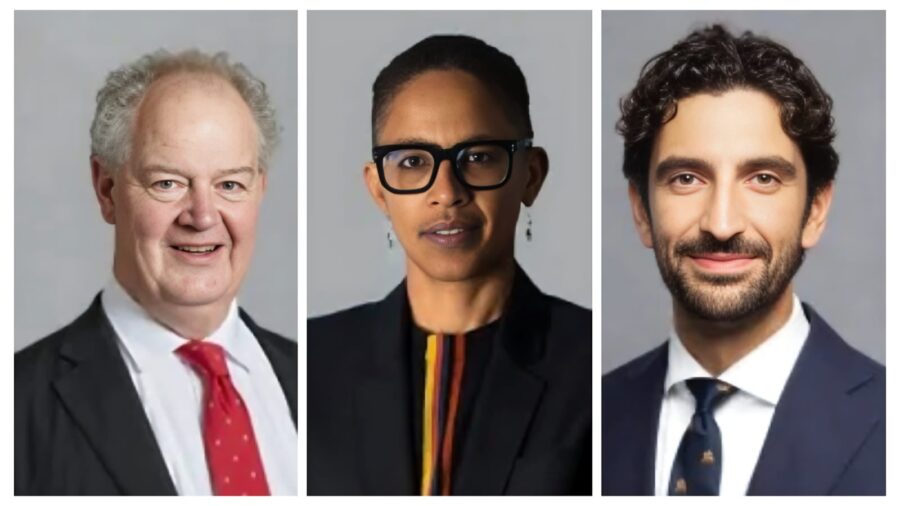
Ulele Burnham, daughter of Guyana’s late Prime Minister and first Executive President Forbes Burnham, is among three lawyers representing Jamaica in a historic legal effort to have Britain’s responsibility for transatlantic slavery examined through the Judicial Committee of the Privy Council.
The Jamaican Government filed the petition with King Charles III on September 7, asking him, as Jamaica’s Head of State, to refer three fundamental questions concerning the legality of the seizure, transportation and enslavement of Africans to the Judicial Committee.
Burnham is working alongside Edward Fitzgerald KC and Harj Narulla. The three lawyers represent Jamaica’s Attorney General and were instructed by Lawrence Cartier of Keystone Law. Doughty Street Chambers described the filing as “an unprecedented and historic moment in the global fight for reparatory justice.”
The petition asks whether the seizure of Africans, their forced transportation to Jamaica and enslavement as chattel were lawful under English law; whether those acts constituted breaches of international law; and whether the United Kingdom has a legal obligation to provide a reparatory remedy to the people of Jamaica.
Jamaica has stressed that the petition itself is not a demand for monetary compensation, but an attempt to obtain legal clarification on the historical and continuing consequences of slavery.
A Father-Daughter Legal Legacy
Burnham’s involvement carries an additional historical significance because her father was himself a lawyer before becoming one of the defining political figures in Guyana’s modern history.

Forbes Burnham was awarded the British Guiana Scholarship in 1942 and subsequently pursued higher education in Britain. He obtained a Bachelor of Arts degree through the University of London in 1944 and a Bachelor of Laws with honours from the University of London in 1947.
In 1948, he was admitted to the Bar of the Honourable Society of Gray’s Inn in London. He returned to British Guiana in 1949, was admitted to the local Bar and entered private legal practice. By 1959, he had become president of the Guyana Bar Association.
The elder Burnham went on to become Premier in 1964, led Guyana to independence in 1966 and became the country’s first Executive President in 1980, serving until his death in 1985.
His daughter has established her own legal career in Britain. Ulele Burnham is joint leader of Doughty Street Chambers’ Court of Protection and Mental Health Team and has significant experience in equality and anti-discrimination law. She is ranked Band 1 by Chambers and Partners for Court of Protection: Health & Welfare work.
Caribbean-Wide Reparations Campaign
The Jamaican petition has received the endorsement of CARICOM heads of government, while Ghanaian President John Dramani Mahama has also expressed support.
The legal initiative comes amid renewed international attention to reparatory justice. In March, the United Nations General Assembly adopted a resolution describing transatlantic chattel slavery as the “gravest crime against humanity.” The UN Committee on the Elimination of Racial Discrimination subsequently issued General Recommendation No. 40 addressing reparatory justice for the continuing consequences of colonialism, the trafficking of enslaved Africans and racialised chattel slavery.
The Judicial Committee of the Privy Council advises the monarch on legal matters and remains the final court of appeal for Jamaica and several other Commonwealth jurisdictions. Section 4 of the Judicial Committee Act 1833 provides the mechanism Jamaica is invoking to seek a referral of questions of legal and constitutional importance.
The Palace has confirmed that the petition has been received and that the appropriate process is being followed. Jamaica’s representatives are also expected to hold discussions with Britain’s Foreign, Commonwealth and Development Office.
The petition now places Jamaica’s longstanding political campaign for reparatory justice before an institution rooted in the same colonial legal system whose historical legacy the Caribbean country is asking it to examine.