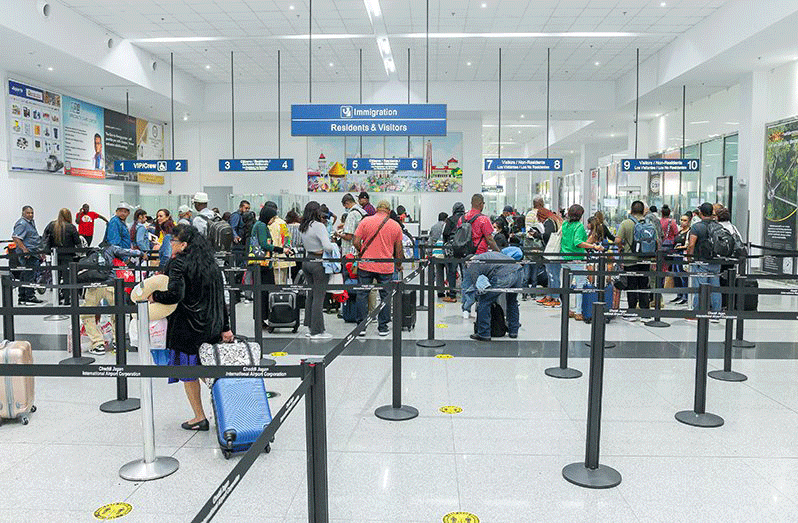
Guyana is on course to welcome more than 500,000 visitors this year, marking another major milestone for a tourism sector being transformed by growing international interest and increased investment. The Ministry of Tourism, Industry and Commerce said Guyana recorded 48,582 visitor arrivals in August, a 5.6 per cent increase over August 2025.
Visitor arrivals from January through August were 11 per cent higher than during the corresponding period last year. Leisure travel accounted for 62 per cent of arrivals, followed by business travel at 14 per cent and other categories at 24 per cent. The United States remained the largest source market, accounting for 39 per cent of visitors, while the Caribbean contributed 33 per cent. Latin America accounted for nine per cent, Canada seven per cent and Europe five per cent.
The figures reflect the growing importance of tourism to Guyana’s emerging economy. The country has increasingly promoted its rainforests, wildlife, rivers, Indigenous communities and cultural experiences as attractions capable of distinguishing Guyana from traditional Caribbean destinations.
Sport is also becoming part of the tourism strategy. The Ministry said the Global Super League cricket tournament, which extended into early August, contributed to visitor arrivals by bringing international teams and fans to Guyana. Diaspora travel during the August vacation period also boosted numbers.
But the projected half-million visitors also raises a more difficult question.
Is Guyana prepared for them?
Tourism growth places demands on airports, roads, hotels, restaurants, taxis, tour operators, public spaces, waste management and other services.
The Government has recognised the need for a broader framework. Earlier this year, the Ministry said it was developing a National Tourism Policy and Strategic Action Plan intended to guide investment, governance, sustainability and public-private cooperation. At that time, the Government projected approximately 550,000 visitors for 2026.
The challenge is ensuring that visitor growth produces broad economic benefits rather than concentrating opportunities among a relatively small number of businesses.
Small hotels, restaurants, craft producers, taxi operators, tour guides, farmers and communities all have a stake in the expansion of the industry.
There is also the question of sustainability.
Guyana’s principal tourism assets include environmentally sensitive forests, wetlands, rivers and Indigenous territories. Increased visitation must therefore be accompanied by responsible management if the very attractions drawing visitors are to be protected.
The projected 500,000-plus arrivals could nevertheless represent a major economic opportunity.
A country seeking to diversify beyond oil and gas can use tourism to create employment and foreign-exchange opportunities while supporting agriculture, transportation, hospitality, culture and small businesses.
The numbers show that international interest is growing. The next test is whether Guyana can convert that interest into a sustainable tourism industry that benefits communities, protects its natural assets and provides visitors with the infrastructure and services needed to encourage them to return.