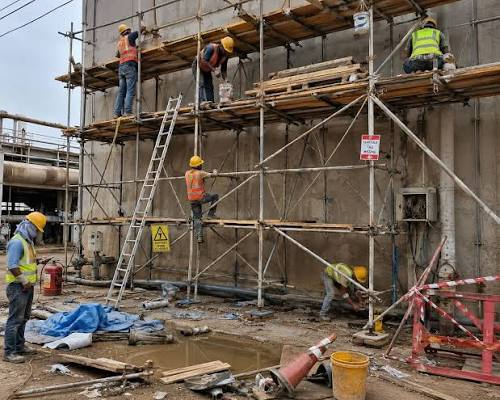
By Mark DaCosta- A construction site in Houston turned deadly on September 1 when scaffolding reportedly came into contact with live power lines, killing one worker and leaving at least two others critically injured.
The tragedy once again exposes the potentially lethal dangers workers face when construction activity takes place near live electrical infrastructure and raises urgent questions about whether adequate safety precautions were in place.
Guyana Power and Light Inc. (GPL) is urging contractors, workers and the public to exercise extreme caution around electrical infrastructure following a fatal accident in New Houston. GPL said scaffolding reportedly rolled from a building and struck a 13.8 kV power line, killing one person and injuring at least two others. The company expressed condolences to the deceased’s family and wished the injured a full recovery.
The workers reportedly suffered severe electrical shocks after the scaffolding made contact with the power lines. One worker died, while at least two others were rushed for emergency medical treatment in critical condition.
What began as another day of work ended with a life lost, workers fighting to survive and families confronting an unimaginable tragedy. The incident is also a grim reminder that electrical hazards at construction sites can become deadly within seconds, particularly when metal scaffolding, equipment or other conductive materials are being used near overhead power lines.
At Village Voice News, our thoughts are with the family of the worker who lost his life and with the injured workers and their families during this difficult time. But condolences cannot be where the response ends.
This latest tragedy demands serious scrutiny of construction-site safety, compliance with electrical safety requirements and the precautions taken when workers are required to operate near live power lines. No worker should leave home to earn a living and never return because preventable safety measures were overlooked.
Unfortunately, this is not an isolated incident. Our country’s construction landscape has witnessed similar accidents that raise serious concerns regarding safety protocols. Just earlier this year, in February, a harrowing episode took place on Regent Street in Georgetown, where a metal scaffold was involved in a severe accident.
During the ambitious construction of a multi-storey building, a worker named Leon Turnip suffered grave injuries after inadvertently coming into contact with a live high-voltage wire. The electrical shock he sustained resulted in extensive burns, yet he survived due to timely medical intervention.
Turnip’s misfortune is a stark reflection of the recurring dangers that pervade the construction environment. This incident was not just an individual tragedy; it highlighted systemic flaws within safety practices that have been the cause of many similar occurrences. Workers, particularly those operating scaffolds made of conductive materials, find themselves exposed to serious risks when working near live overhead lines.
Moreover, there have been numerous documented cases where workers tragically lost their lives due to electrocution after coming into contact with power lines. Authorities, including the Guyana Power and Light Company, have consistently urged construction firms and the general public to prioritise safety measures and adhere to regulations intended to safeguard workers from preventable accidents.
The concerning trend of incidents involving construction workers and electrical hazards prompts a broader discussion about workplace safety. As construction projects proliferate and our infrastructure continues to expand, ensuring the well-being of workers must remain a paramount priority. According to one analyst, safety training, comprehensive risk assessments, and the installation of adequate warning systems near power lines are essential steps to prevent future tragedies from occurring.
With the construction sector playing a pivotal role in development, we must ensure that safety is not merely an afterthought but a fundamental aspect of our approach to building.