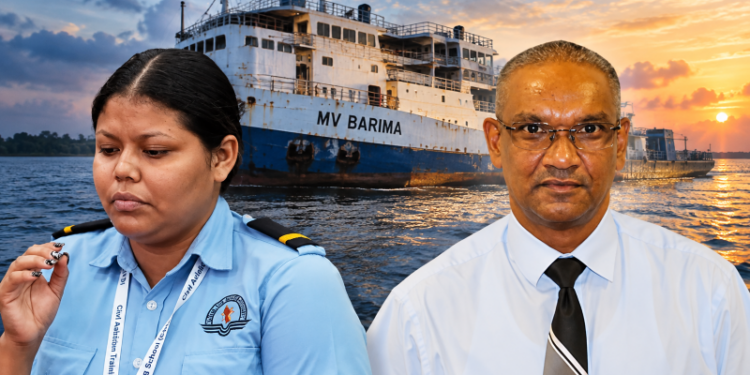
By Mark DaCosta- The ongoing delay in the Commission of Inquiry into the MV Barima ferry disaster has raised serious concerns about the prioritisation of maritime safety in Guyana. The Forward Guyana Movement, led by Amanza Walton-Desir, has issued a press statement highlighting the troubling absence of progress, with 33 days passing since the Commission’s formation without any hearings. The statement underscores a stark contrast to the Commission of Inquiry into the 2020 General and Regional Elections, which moved swiftly to its objectives.
The pressing theme of the Forward Guyana Movement’s report revolves around the apparent lack of commitment to ensuring that the Barima Commission meets its critical deadlines. Originally constituted on July 30, 2026, this Commission has yet to commence any investigative hearings, a concerning stagnation considering the tragedy that unfolded. With a looming two-month deadline for submitting its report, which is fast approaching on September 30, the critical question arises: why has there been no significant advancement in the inquiry?
The information presented in the press release makes it clear that Secretary Javed Shadick’s updates have consistently highlighted the Commission’s administrative delays. “No commencement date had been fixed, and the overseas based commissioners had not indicated when they would arrive in Guyana,” Shadick mentioned. This lack of urgency – the statement implies – in responding to such a serious incident is alarming and raises suspicions about the prioritisation of safety within our ferry operations.
The 2020 Elections Commission of Inquiry serves as a glaring benchmark for comparison. Within a mere 35 days, it swiftly mobilised its efforts, staffing the Secretariat and inviting the public to come forward as witnesses. The Barima Commission, however, appears to have slipped significantly in momentum, with Shadick admitting that “no witnesses had yet been approached” and the “administrative arrangements remained incomplete.” This continued inertia is unacceptable when lives are at stake, and it underscores a troubling institutional complacency.
According to the statement, those at the helm of the Barima Commission, Justice Godfrey Phillip Smith and Shadick, both have the experience to ensure a thorough and prompt inquiry. They were instrumental in the rapid mobilisation of the previous Commission, which gathered testimonies from 39 individuals, but now they seem to be stalling. The Forward Guyana Movement insists that “the machinery that moved promptly for an inquiry into an election has been allowed to idle following the deadliest maritime disaster in Guyana’s history.”
In the press statement, the movement raises an essential point regarding the legal framework under which the Barima Commission operates, asserting that physical presence of all commissioners is not strictly necessary for proceedings to begin. The Commission can operate in a variety of formats: “physical, virtual and hybrid proceedings” are all permissible. The current situation, therefore, cannot be dismissed as a logistical challenge; it reflects broader concerns about regulatory commitment and resourcing.
Moreover, the issue of continuing maritime safety is paramount. Delays in the Commission’s work mean that “defects in vessel inspection, maintenance, loading, passenger manifests, crew supervision” could remain unaddressed, exposing current and future passengers to unacceptable risks. This issue is underscored by the acknowledgement that “the condition that caused one catastrophe may still exist and may cause another.” The Forward Guyana Movement contends that interim safety recommendations can and should be issued before the final report is completed, an indication that the Commission is legally empowered to act without waiting for administrative delays to be resolved.
It remains unclear whether any preliminary assessments have been conducted regarding ongoing risks, which the government has not made public. The commission’s silence on this front raises additional questions regarding the seriousness and urgency with which the Barima Commission is treating its responsibilities. The need for transparency and communication is critical, especially in light of such a tragic incident. If the Commission has indeed identified risks, the public deserves to know the nature of these threats and the actions taken to mitigate them.
Furthermore, said the statement, there has been no indication from the government regarding a separate marine safety investigation, which is typically a vital component of ensuring maritime safety. Such an investigation should not be intertwined with the Commission’s efforts but should be independent and focused solely on securing the safety of our nation’s waterways. As highlighted by the press statement, “the purpose of investigating this catastrophe is not only to explain how people died but to prevent more people from dying.”
This situation calls for immediate action to address potential safety hazards within our ferry systems, which have been notably ignored amidst the lengthy inquiries. The public has a right to clarity and effective oversight to prevent future tragedies. The Forward Guyana Movement’s call for accountability and transparency within the inquiry has significant implications for how we protect our citizens.
The Forward Guyana Movement contends, it is high time for Justice Godfrey Phillip Smith and Secretary Javed Shadick to provide a thorough explanation for the lack of progress, and for our leaders to prioritise the safety of our nation’s maritime systems. Our country cannot afford to wait any longer; the time for action is now. The tragic lessons of the past must not be lost in bureaucratic delays.