Guyana has opened a new school year with a stark contradiction. While the Government has allocated $183.6 billion to education in 2026 and continues to tout major investments in schools, children in several hinterland communities are reportedly entering classrooms without classrooms, desks, chairs and, in one case, even adequate shelter from the rain.
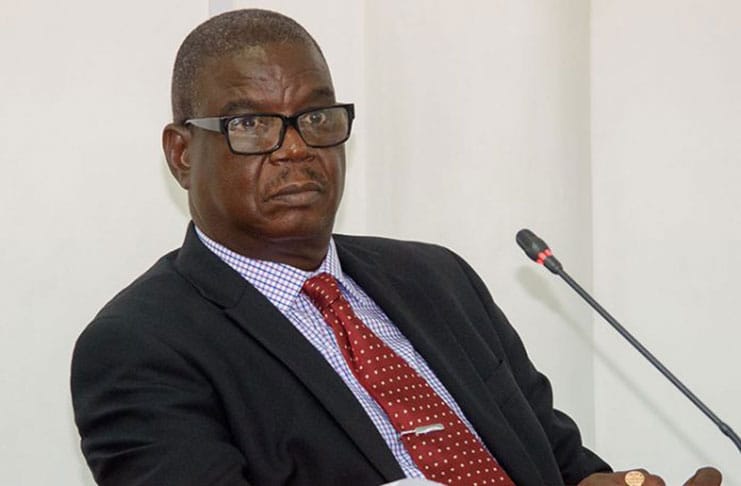
Leader of the Opposition Azruddin Mohamed has brought the conditions to national attention, posting photographs and accounts from schools in Port Kaituma, Manawarin, North West and Santa Rosa as the new academic year began on Monday.
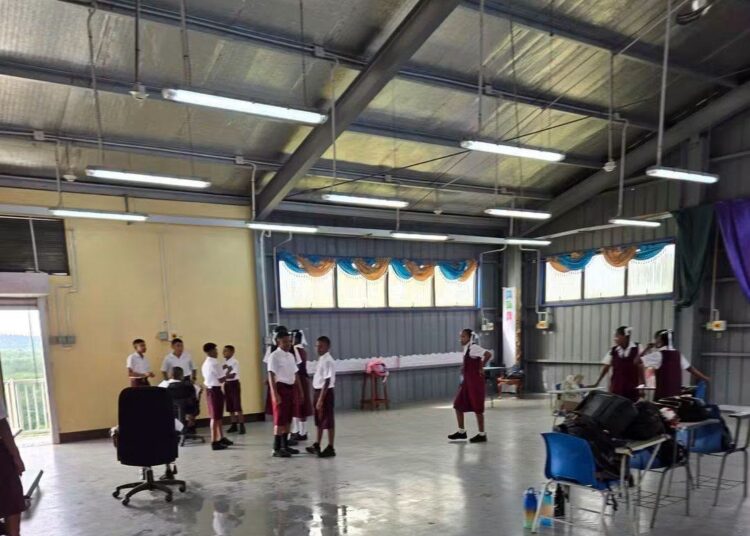
At Port Kaituma Secondary School, Mohamed said approximately 200 students entering Grade 7 have no classroom or furniture. Instead, they are reportedly being told they will be temporarily accommodated at the recreational ground at the Fitzburg ball field while work on a new building is completed and furniture becomes available.
“This is not an acceptable learning environment for our children. These children deserve better.”
Mohamed said students should not be forced to begin secondary school in an open recreational space simply because classrooms and basic furniture were not ready.
“Students should not have to sit in an open recreational space because there are no classrooms ready for them. They should not have to begin secondary school without desks, chairs, and a proper space to learn.”
He called on Education Minister Sonia Parag and the Ministry of Education to intervene immediately.
“Minister Parag and the Ministry of Education must urgently address this situation and provide these students with a safe, suitable, and properly furnished learning environment.”
The situation is particularly difficult to reconcile with the Government’s substantial education allocation for 2026. The $183.6 billion budget for the Ministry of Education includes billions for school construction, rehabilitation, textbooks, learning materials and school grants.
The Government has repeatedly presented education infrastructure as a central pillar of Guyana’s development agenda, with Minister Parag also declaring that the country was moving toward universal access to secondary education.
Ahead of the reopening of schools, the Ministry conducted readiness inspections across the country, with officials using checklists and physical assessments to identify outstanding problems.
Parag was unequivocal about the expected standard of readiness.
“We must not have any complaints when schools are reopened.”
But the reports emerging from several hinterland schools on the first two days of the academic year suggest that, for some students, the promised readiness has not materialised.
53 students under a shed
In Manawarin, the situation is even more troubling.
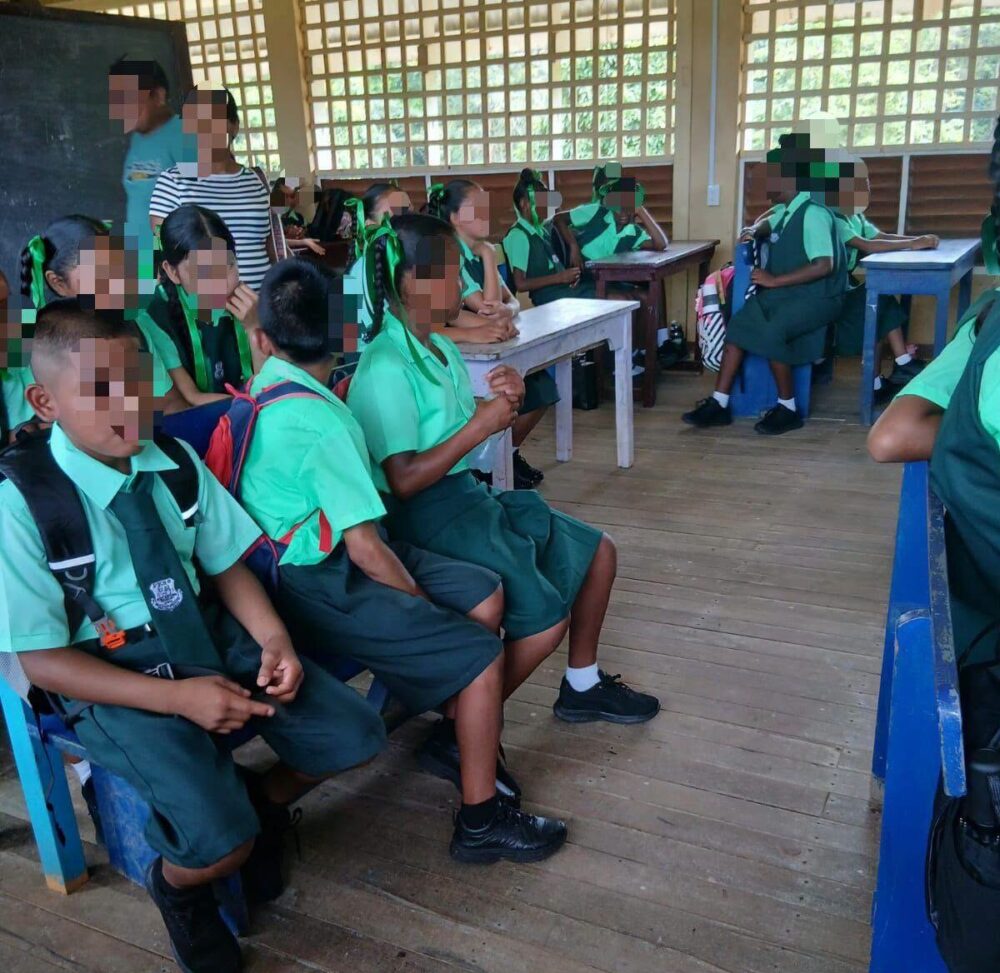
Mohamed said 53 secondary students were forced to attend school under a shed constructed by the Parent-Teacher Association, while the school building struggles to accommodate both primary and secondary students.
His Tuesday post stated:
“53 Secondary students forced to attend school in the rain under a PTA built shed in the world’s fastest growing economy, after cramped for space in school building.”
The situation is not new.
On August 19, 2025, the Ministry of Education announced that construction of Manawarin’s first secondary school was expected to begin in October of that year. The proposed school was expected to accommodate 250 students.
One year later, Mohamed said construction has still not begun.
Instead, 195 secondary students are reportedly being accommodated alongside primary students at St. Nicholas Primary School and its extension. Mohamed said the classrooms are cramped, the heat is unbearable and noise from neighbouring classes makes concentration difficult.
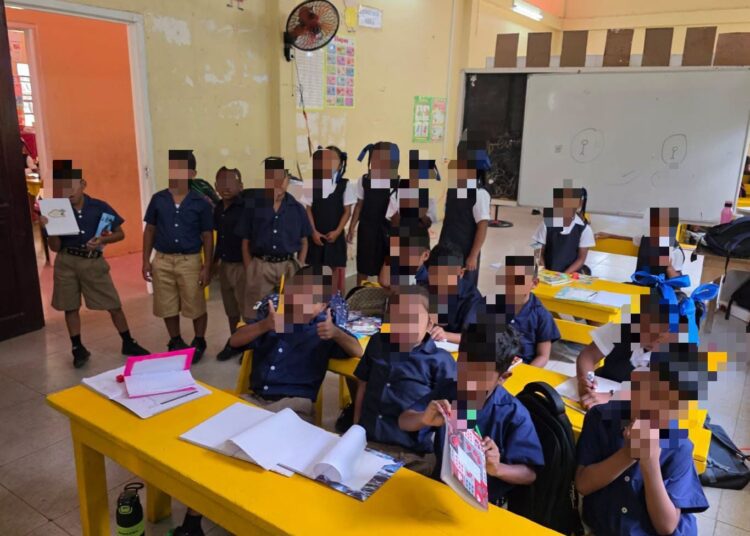
The PTA-built shed is now reportedly accommodating 53 secondary students and 19 primary students, while another 14 students are using the village ICT Hub because there is simply not enough space at the school.
Mohamed said repeated complaints were made to the Education Minister, Minister of Amerindian Affairs Sarah Browne and the Regional Education Office, but the situation remained unresolved.
He also pointed to the conditions facing teachers, saying there is no staff room, with some teachers eating in their classrooms and senior teachers without classrooms being forced to use a storeroom.
As Amerindian Heritage Month begins, Mohamed directed particular criticism at the treatment of Indigenous children.
“This is not the standard of education our Indigenous children deserve. They deserve proper classrooms, proper facilities, and a safe, dignified learning environment.”
Parents take children home
At North West Secondary School, Mohamed reported another basic failure at the start of the school year—students returning without furniture.
He said leaking classrooms have compounded the problem and that conditions became so unacceptable that one parent took his son back home rather than leave him at the school.
“Asking for decent classrooms is not asking for much.”
Mohamed called on Parag to act quickly to provide the furniture and repairs required.
At Santa Rosa Primary School, he said two Grade 3 classes—Grade 3E and Grade 3F, each with 22 students—also began the school term without basic classroom furniture.
According to Mohamed, the classrooms have no cupboards, book racks, teacher’s chair, desks or tables for students.
“Our children should not have to begin another school term without furniture. Education cannot be treated as a priority only in speeches. The classrooms where our children spend their days must be properly equipped.”
The reports put the spotlight squarely on the gap between Guyana’s enormous education spending and the conditions confronting some of the country’s most vulnerable students.
The Government has the resources to build schools, furnish classrooms and improve facilities. The 2026 budget provides substantial funding for precisely those purposes.
Yet for children in Port Kaituma and Manawarin, the beginning of the new school year has reportedly meant makeshift accommodation, overcrowding and inadequate facilities.
The issue is therefore no longer simply about the size of the education budget.
It is whether the billions being allocated are reaching the children who need them most—and whether Guyana’s much-promised education transformation is being felt inside the classroom, rather than only announced from the podium