On August 1, 1838, freedom finally became a legal reality for thousands of Africans in British Guiana after centuries of enslavement. But emancipation did not come with land, wealth or economic security. Freedom had to be built.
Across Demerara, formerly enslaved Africans responded with remarkable determination. They pooled their savings, purchased plantations and parcels of land, established homes and farms, and created villages that became the foundation of independent African communities. This was the African Village Movement, one of the most powerful expressions of economic self-determination in Guyana’s history.
The distinction between 1834 and 1838 is important. Emancipation was proclaimed in 1834, but the formerly enslaved population entered a four-year apprenticeship system. Full emancipation came on August 1, 1838, when apprenticeship ended. In the years that followed, Africans who had endured generations of plantation slavery began pursuing another kind of freedom, one grounded in land ownership and economic independence.
Among the most celebrated examples was Victoria, on the East Coast of Demerara.
On November 7, 1839, 83 formerly enslaved Africans pooled their resources to purchase approximately 500 acres of Plantation Northbrook. They reportedly took about 30,000 guilders to the Public Buildings in Georgetown for the initial payment.
These were not wealthy investors.
They were people who had only recently emerged from a system that had denied them the right to own property and accumulate wealth. Their greatest asset was collective determination. They saved together, trusted one another and made a purchase that would become a defining moment in Guyana’s post-emancipation history. They named their new community Victoria, after Queen Victoria.
Victoria is commonly recognised as the first major communal African village purchase in British Guiana. Historical evidence, however, makes the chronology more complex. A petition concerning Den Amstel records that 60 lots were individually purchased by freed Africans in October 1838, before the Victoria purchase.
Rather than diminishing Victoria’s importance, that evidence shows how rapidly the desire for land ownership was spreading among newly freed Africans. The village movement was already taking shape.
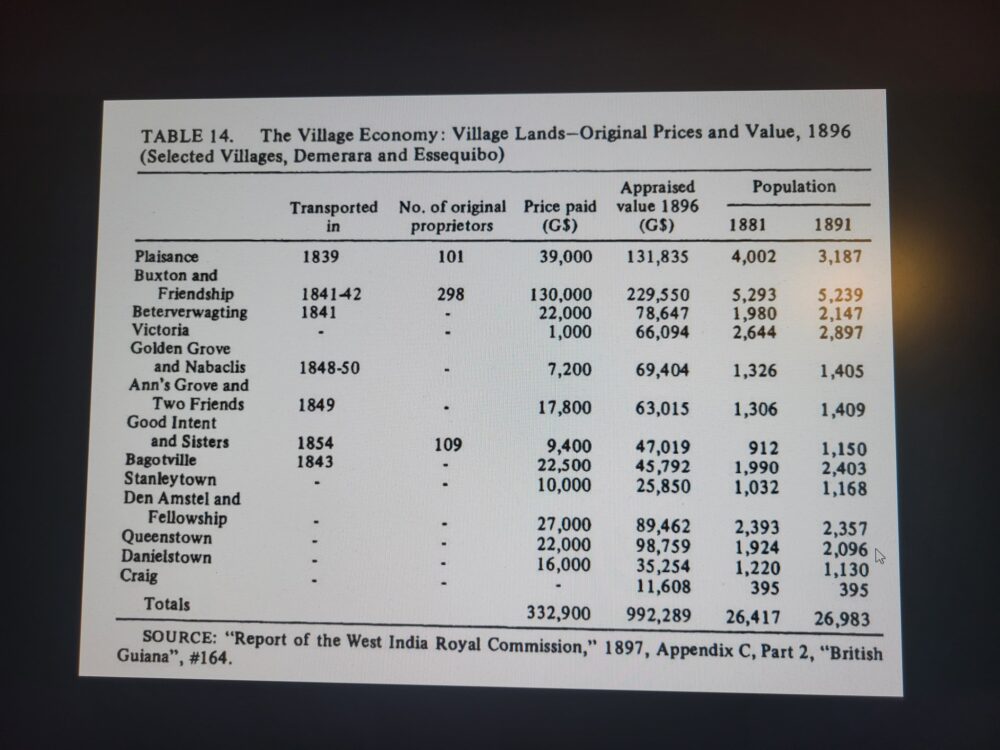
In 1840, 128 formerly enslaved Africans pooled their resources to purchase approximately 500 acres of New Orange Nassau for $50,000. They renamed the community Buxton, honouring British abolitionist Thomas Fowell Buxton. The following year, 168 former slaves purchased Friendship Plantation for $80,000. Buxton and Friendship would eventually form the historic community known as Buxton-Friendship, one of Guyana’s most important African communities.
The movement continued across the East Coast. Beterverwagting was acquired by about 145 labourers for approximately $22,000, while Plaisance was purchased in 1842 by 65 freed Africans for $39,000. These were extraordinary sums for people emerging from slavery.
And the movement was not confined to the East Coast. On the East Bank of the Demerara River, Africans acquired or established communities including Peter’s Hall, Farm and Garden of Eden. In Agricola, formerly enslaved Africans purchased 177 individual plots along the southern boundary of Plantation Rome, creating another enduring African community.
Other settlements associated with African land acquisition included Providence, Craig, Supply, Brickery, Sans Souci, Studley Park, Good Hope, Ruby and Den Amstel.
The methods differed. Some communities were created through collective purchases, with groups pooling their savings to acquire entire plantations. Others developed through individual purchases of lots, with freed Africans gradually establishing homes and communities.
The objective, however, remained remarkably consistent: Land meant independence. For people whose labour and bodies had been treated as property, becoming landowners carried enormous significance.
Government historical records indicate that between 1839 and 1852, freed Africans purchased 25 villages for more than $1 million. Other historical accounts record more than 2,000 freehold properties acquired by Africans by 1852.
Behind those figures were thousands of individual sacrifices. People with little accumulated wealth saved what they could. Families pooled resources. Neighbours joined together. Communities invested in land rather than allowing their newly acquired freedom to remain entirely dependent on plantation employment.
Then they built. They built houses, farms, churches, schools, roads and drainage systems. They transformed former plantation spaces into communities where African families could establish roots, raise children and exercise greater control over their economic lives.
The village was therefore more than a place to live. It was a declaration of independence. The former plantation labourer was declaring: I can own. The former slave was declaring: I can build. The newly freed family was declaring: Our children will inherit something. And the community was declaring: We can do this together.
The consequences reached beyond the villages themselves. Plantation owners had once exercised enormous control over the labour force. Land-owning villagers had alternatives. A person who owned a house, cultivated crops and possessed his own land was not entirely dependent upon the plantation for survival.
The African Village Movement therefore became an important economic dimension of emancipation.
Political freedom came in 1838. Land ownership gave that freedom a foundation.
The transformation was not without difficulties. Poverty remained widespread, plantation owners retained substantial economic influence, and many villagers continued to work on sugar estates. Colonial policies and economic pressures also challenged the independence of the new communities.
Still, the land purchases accomplished something profound. They created a material inheritance.
The people who acquired these lands understood that freedom could remain fragile without economic security. They converted savings into land, land into homes, homes into communities and communities into a legacy.
More than 180 years later, villages such as Victoria, Buxton, Friendship, Plaisance and Beterverwagting remain living reminders of that determination. Their story is ultimately about more than villages.
It is about a generation that emerged from slavery with little wealth but refused to remain economically powerless. They did not wait for someone else to build their future. They bought the land. They built their homes. They established their communities. And they created institutions.
Emancipation did not end when the chains came off. For thousands of Africans in Demerara, emancipation continued when they pooled their hard-earned money, purchased land and claimed something slavery had systematically denied them — a place they could call their own. From that land, they built villages. From those villages, they built communities. And from those communities, they helped build Guyana.