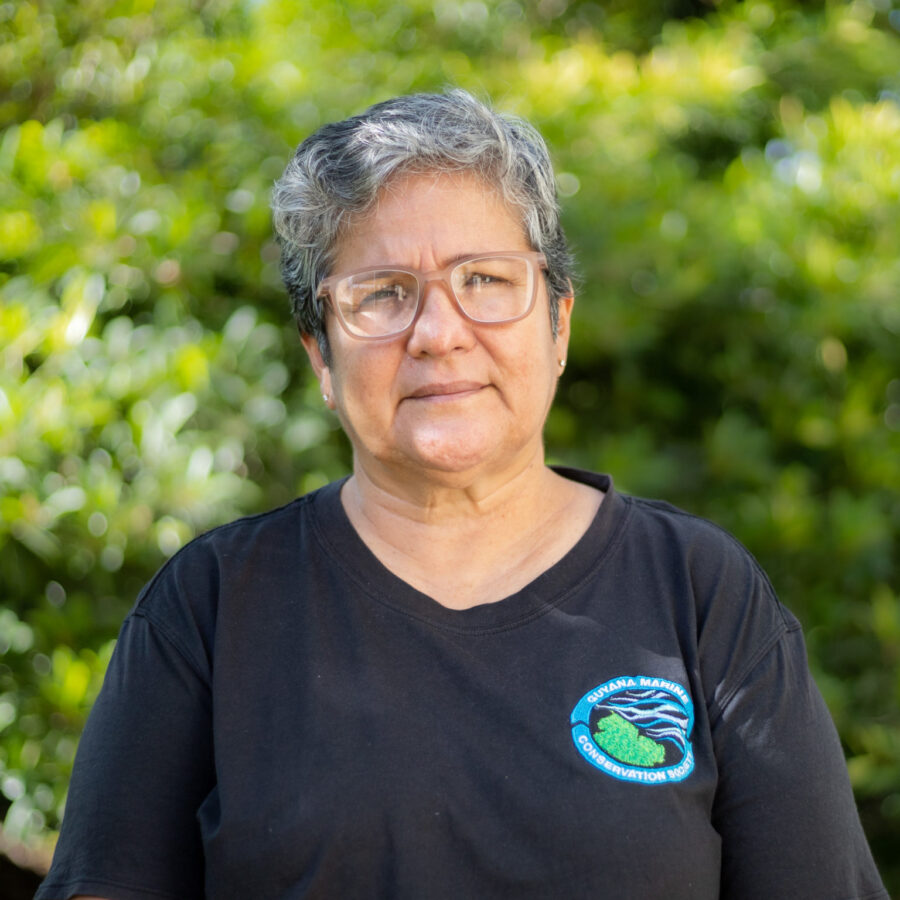
By Mark DaCosta- In the heart of our nation’s northwestern coastline lies Shell Beach, a once-troubled haven for four endangered species of marine turtles — the Leatherback, Green, Hawksbill, and Olive Ridley. Stretching over 120 kilometres, this vital ecosystem is where the indefatigable spirit of local communities now intertwines with conservation efforts to protect our marine biodiversity. Annette Arjoon-Martins has emerged as a beacon of hope, transforming the narrative of turtle conservation through an innovative approach that sees local poachers become guardians of the very creatures they once threatened.
The plight of marine turtles in our coastal waters has historically been dire. For many years, poaching was rampant. Local communities, predominantly made up of indigenous Arawak, Warrau, and Carib peoples, relied on the turtles and their eggs for sustenance and income, leading to drastic declines in turtle populations. Early recognition of the area’s ecological value came from sea turtle biologist Dr. Peter Pritchard in the 1980s, yet traditional methods of conservation, which primarily involved legal enforcement, failed to take into account the economic realities of these communities.
The narrative began to shift when Annette Arjoon-Martins took to the sky as a commercial pilot, permitting her to witness the perilous situation from above. Having established an ecotourism venture in the area by 1992, her passion for the environment was ignited, and it became evident that merely prohibiting hunting was not enough.
Arjoon-Martins recognised that successful conservation could only come from collaboration. Her strategy aimed to transform those within the community most reliant on the turtle populations into stewards of their environment. “At Shell Beach, we got the communities to see the turtles as being of more value alive than dead,” she remarked, illustrating her shift from confrontation to collaboration.
The initiative required empathy and a deep understanding of the locals’ dire economic conditions. This foundational philosophy led to her pivotal role in formally establishing the Guyana Marine Turtle Conservation Society (GMTCS) in 2000, which expanded its mandate and rebranded as the Guyana Marine Conservation Society (GMCS) in 2014.
By engaging with previous poachers, the resulting Turtle Guardians programme not only provided employment but also utilised the extensive knowledge these individuals had of the beaches and turtle nesting behaviours. As Arjoon-Martins explained, “I created North West Organic products to look at the needs of the community which had six and eight children to feed; who would have had to kill the turtles out of necessity for their subsistence had there not been an alternative source of income.”. Replacing poaching with paid conservation efforts became a cornerstone of the initiative.
The rangers, now known as Turtle Guardians, ventured onto the beaches at night, meticulously tagging nesting turtles and relocating vulnerable eggs to safer environments away from erosion and predation. This change in career not only alleviated the economic pressures that had led to poaching but provided a sense of pride and identity that galvanised the community around a shared purpose. Thousands of hatchlings now make their way to the Atlantic each year, underscoring the success of the programme.
The broader community was also uplifted, with efforts directed towards promoting alternative livelihoods, particularly for women. The production of traditional crabwood oil, organic cocoa, and the famous Moruca embroidery has flourished, linking sustainability with economic empowerment. Arjoon-Martins’s approach has proven that the protection of our environment does not have to come at the expense of social justice. Instead, it can be a catalyst for widespread change and improvement in community livelihoods.
The environmental gains achieved at Shell Beach are significant. The declaration of the 123,055-hectare area as a Protected Zone by the Government of Guyana in 2011, a culmination of relentless advocacy from Arjoon and her team, ensures the safeguarding of this vital nesting ground from future exploitation. “Walking these beaches and seeing the erosion — it impacts me personally. In a few years, there might be no beach left to patrol,” remarked Dion Turnhill, a ranger, highlighting the ongoing challenges of climate change and coastal erosion that pose existential threats even to successful conservation areas.
Arjoon-Martins’s vision transcends mere conservation; she has established a blueprint for a modern model of environmentalism, where local stewardship is central to the success of ecological initiatives. The transformation of former hunters into conservation champions exemplifies a revolutionary approach, one that fosters an intrinsic connection between community prosperity and environmental health. “Nearly all sea turtle biologists, sooner or later, become turtle conservationists,” noted Dr. Peter Pritchard, speaking to the inevitable transition that many in the field face, yet few embody that change as effectively as Arjoon-Martins.
Her legacy will resonate far beyond the shores of Shell Beach. It challenges civil society to rethink conservation by compelling a thorough consideration of the social dimensions of environmental issues, especially in our national context where livelihoods depend heavily on the bounties of our natural world. Annette Arjoon-Martins stands as a testament to the power of community-driven initiatives, and her example is a vital standard for equitable, sustainable governance over our precious wildlife.