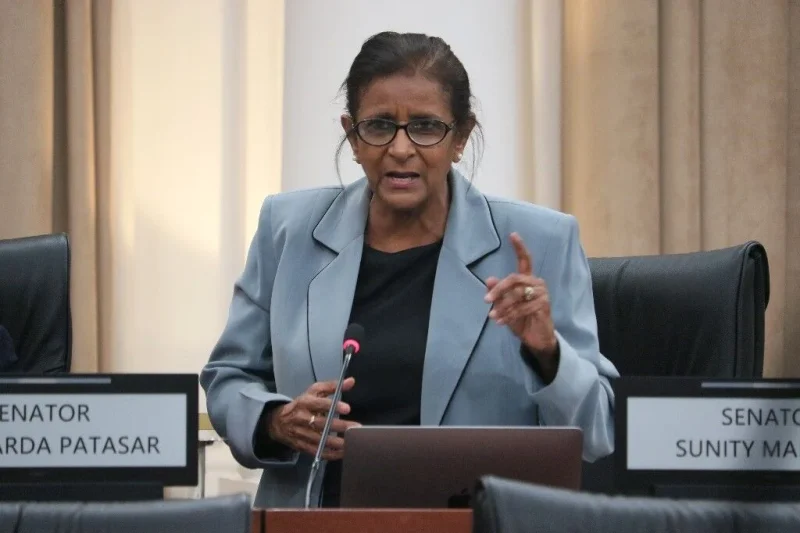
FORMER Independent senator and head of the Lloyd Best Institute of the Caribbean, Sunity Maharaj, says political strategy using ethnicity is being used to promote division in the society.
She added that while this involving race and class, it was not racism. She said that with people being paid to promote this discord, it indicated that the strategy is ‘coming from above’.
Maharaj was yesterday responding to the Express regarding questions about the fuelling of a racist agenda in the nation.
On Saturday, president of the National Council of Indian Culture, Surujdeo Mangaroo, called on Prime Minister Kamla Persad-Bissessar to reinstate the Race Relations Committee, which he said would foster stronger race relations across the nation. Speaking during the NCIC’s Independence Rainbow Dance Festival at the NCIC Nagar, Mangaroo said the committee would function as an act of national responsibility, and would operate as an independent and accessible entity, free from partisan influence.
He pointed to recent comments from politicians that he said chose to ‘stimulate division rather than unity’, as they believe separation would serve ‘their best political interest’.
He urged leaders to refrain from such comments, and called on the society to avoid fuelling racial division.
In a WhatsApp message, Maharaj noted that divide and rule is the oldest trick in politics.
“What we are seeing is not racism but political strategy using ethnicity, which would include race and class. The fact that people are being paid to promote this division indicates that it’s coming from above,” she added.
However, she asserted that, as indicated by history, this agenda often backfired against the lived reality of the multi-ethnic nation.
“For all its noise, social media is not reality. If we were to close our phones and laptops and walk out into the society and engage each other in-person, we will discover how far the real T&T is from the manufactured and curated unreality of social media,” she continued.
Maharaj pointed to the Equal Opportunity Commission and Section 7 (1) of the Equal Opportunity Act, which she said had a Constitutional mandate to address matters of racist crimes.
She added that the NCIC played a significant role in effecting change.
“I do believe, however, that there is a powerful leadership role for the NCIC in changing the trajectory of race relations in T&T, but I see that role more in terms of the quality of leadership it brings to the challenge of social harmony based on knowledge, engagement and understanding, and less on law,” she said.
Work on the ground
Historian Dr Jerome Teelucksingh argued that addressing a problem through a racial lens required understanding how it was linked to class and religion.
“We wouldn’t solve a race problem just looking at race lens; we have to also look to see how race is linked to other sections in society,” he added, during a phone interview yesterday.
He said these socio-economic factors also helped in promoting the political agenda of divide and rule. He pointed to the political landscape, which he said was based on race. However, he said, it was necessary to understand that this strategy hindered the progress of a nation.
“The problem of racism is that it is an obstacle to solving social problems like crime and poverty,” he continued.
Teelucksingh said that while he supports the call for the reinstatement of the Race Relations Committee, there were several factors that required consideration. These, he said, included a committee that represented each section of the community, included ethnic minorities; an indication of whether committee members would be paid for their services; and the duration of the committee. However, he noted that while a committee had benefits, he believed work ‘on the ground’ was necessary.
“We should be doing something on an everyday basis,” he explained, adding that the issue also needed to be tackled through social media to reach all sections of the society.
“We need things on social media. We need content creators who have this huge following to come on board to improve race relations. A committee would be a selected group of people, who might be educated and have a vision, but it might not reach the masses, the grassroots. If you want to really improve race relations, nobody is going to listen to a committee,” he continued.
Trinidad Express