More than four decades after Forbes Burnham placed self-reliance and “Buy Local” at the centre of his economic programme, Guyana is reviving many of the same objectives, this time under a People’s Progressive Party/Civic (PPP/C) administration that once strongly criticised the approach.
The political irony is difficult to miss. Burnham’s drive to reduce dependence on imports and expand domestic production became one of the most controversial aspects of his administration. The PPP was among the principal opponents of the policies, particularly as import restrictions and shortages became associated with the global economic crisies of the late 1970s and 1980s.
Today, however, the PPP/C Government is again promoting greater domestic production as part of an effort to reduce the food import bill and strengthen food security.
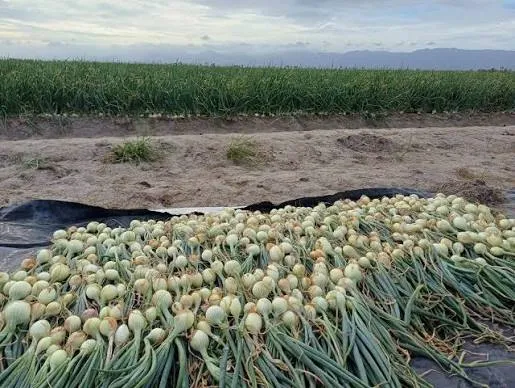
Agriculture Minister Zulfikar Mustapha said Friday that Guyana is on track for its first large-scale onion harvest by the end of the year, with 300 acres now under cultivation in Region Nine following a successful pilot project.
“300 acres of onions will satisfy the demands in Guyana, but at the same time we want to be a net exporter, and we are building a food hub along the Linden/Soesdyke highway,” Mustapha said.
The onion initiative comes as Guyana continues to spend millions of dollars on imported vegetables. In 2025, Guyana imported about US$1.16 million worth of onions, shallots, garlic and leeks from the United States alone. Historical trade figures have placed Guyana’s annual onion import bill at about US$1.46 million, although comprehensive global data for the full 2025 calendar year are still being finalised.
The wider import picture is considerably larger. In 2024, Guyana imported about US$9.09 million worth of fresh or chilled onions, shallots, garlic, leeks and related vegetables.
Mustapha said onions are part of a wider diversification programme targeting corn, soya, broccoli, cauliflower, carrots and lettuce, with production intended to supply local consumers, the hospitality and tourism sectors and eventually export markets.
From import substitution to exports
The Government’s strategy echoes the central objective of Burnham’s self-sufficiency drive: reduce Guyana’s dependence on overseas suppliers by producing more food domestically. Guyana is also testing whether another major import can be produced locally—wheat.
Mustapha said a wheat trial is already under way and discussions with Zimbabwe could provide access to specialists with experience in tropical wheat cultivation. If successful, he said, Guyana could eventually produce wheat on a commercial scale for domestic consumption and potentially supply other Caribbean markets.
The initiatives are being linked to CARICOM’s 25 by 2025 Plus 5 food-security programme, which seeks to cut the region’s food import bill by 25 per cent. Guyana has positioned itself as a potential major supplier in that regional effort.
The test is production, not rhetoric
The return to self-sufficiency raises an old question: can Guyana produce enough, at the right quality and price, to compete with imports?
The current onion programme will therefore be judged not simply by acreage planted but by yield, storage, distribution, pricing and consistency of supply.
Farmers will need adequate irrigation, technical support and reliable markets. The proposed food hub along the Soesdyke-Linden corridor could become important in reducing post-harvest losses and improving distribution.
For Guyana, the ambition is now considerably larger than replacing imported onions.
The Government wants to turn food production into an engine of import substitution, food security and regional trade.
The irony is that a policy once fiercely criticised by the PPP is now being revived under its own administration.
The real test will be whether Guyana can achieve what Burnham envisioned, but with a different formula: self-reliance built on productivity, competitiveness and exports—not scarcity and isolation.