President Irfaan Ali has signalled that his administration is considering tougher legal measures against social media users, warning that Guyana may amend its laws to address what he described as the growing misuse of online platforms.
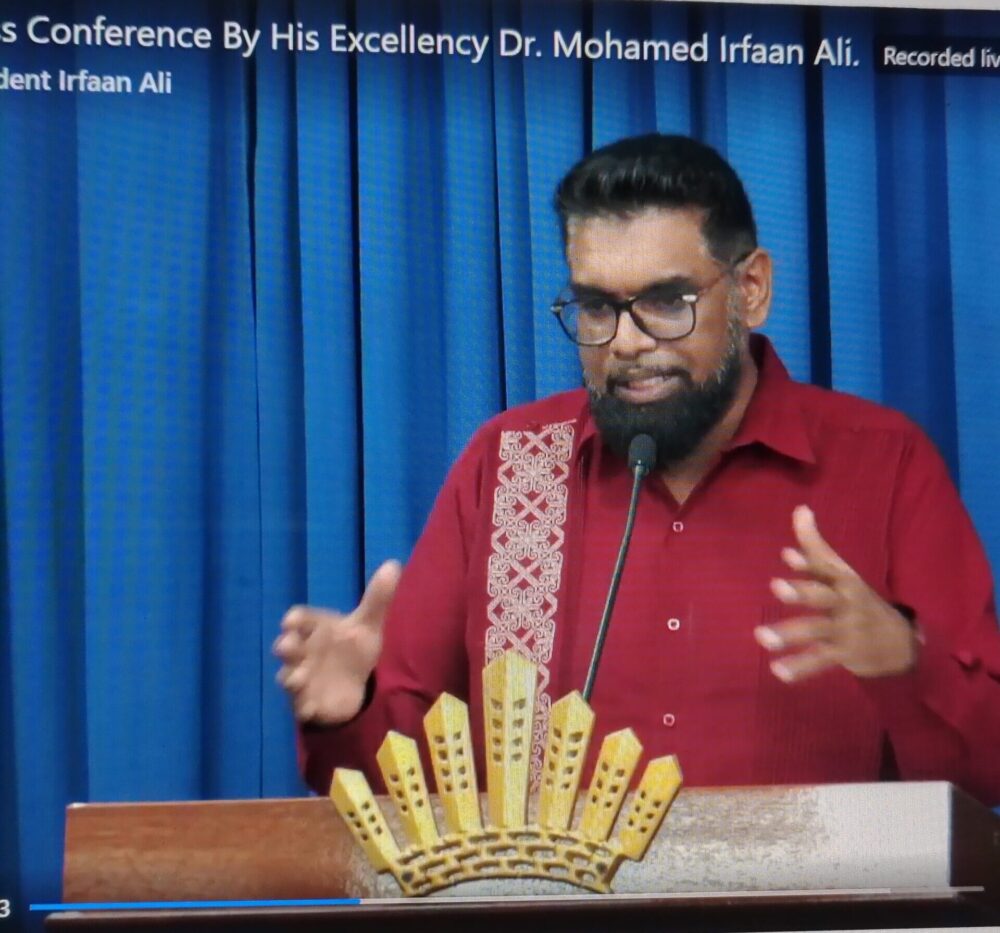
Ali made the remarks at his press conference on Tuesday in response to questions about misinformation and harmful material circulating on social media.
The President rejected the idea that misinformation should be treated simply as opinion or casual online commentary, arguing that false information can be deliberately created to influence people or produce a particular outcome.
“Misinformation is always calculated information.”
“It is very unfortunate that we can misuse social media in such a way,” he said.
Ali said people who believe they have been targeted by misinformation should use existing legal avenues to establish the facts and pursue accountability.
“People have to take action. They have to utilise the legal mechanism so that the facts can be established,” the President said.
He also disclosed that Government is examining possible amendments to existing legislation to address concerns surrounding social media.
“We too are looking at how we can amend our laws to address the very concerns that you have raised.”
The comments come as the Government is already pursuing consultations on the regulation of social media, although the initial focus was presented as the protection of children from harmful online content.
Earlier this year, Attorney General Anil Nandlall said the Government’s consultations were intended to examine issues including children’s exposure to harmful material online and rejected suggestions that the initiative was aimed at censoring social media.
Ali’s latest remarks broaden that discussion, placing misinformation and the conduct of social media users more generally within the Government’s consideration of possible legislative changes.
The President pointed to the publication and circulation of photographs following the MV Barima tragedy as an example of what he regarded as unacceptable use of social media.
The July 2026 disaster, in which the MV Barima capsized off Guyana’s northwest coast, resulted in dozens of deaths and generated intense public debate, criticism and competing accounts about the tragedy and the Government’s response.
Ali said the legal system should be used where persons deliberately circulate false or harmful information, while also urging citizens to exercise greater responsibility in what they publish and share.
The Government’s interest in regulating online activity also comes amid an increasingly influential social media environment in Guyana, where citizens, political parties, activists and media organisations routinely use platforms such as Facebook to disseminate information, allegations and political commentary.
Government has already been involved in legal proceedings involving Meta, the parent company of Facebook. Attorney General Nandlall said in June that orders had been issued by Guyanese courts involving the technology company, arguing that major international platforms are not beyond the reach of local law.
However, Government has not yet detailed the specific laws it intends to amend, the conduct that could attract penalties or how any new measures would distinguish between deliberate misinformation, legitimate criticism, political commentary and protected freedom of expression.
Ali’s warning nevertheless signals a significant expansion of the Government’s social-media agenda. What began as a stated effort to protect children from harmful online content could now extend to the broader population, putting social media users on notice that their online activity could face greater scrutiny and possible legal consequences.
The prospect of new laws has also raised an important question for public debate: how will Government tackle genuinely harmful misinformation without creating a legal framework that could be used to silence legitimate criticism or dissent?