A revolt born from slavery itself
At 6:30 p.m. on August 18, 1823, the sound of a plantation bell carried across Demerara. Jack Gladstone had rung it—not as a routine call to labour, but as the signal for an uprising that would shake the foundations of British slavery in the colony.
The revolt, which erupted across plantations along the East Coast of Demerara, drew thousands of enslaved people into open resistance. Historians estimate that between 9,000 and 13,000 enslaved people became involved, making it one of the largest slave rebellions in the British Caribbean up to that time.
The uprising had not been improvised. Resistance had been building, and planning was reportedly underway by August 17 at Plantation Success, before the rebellion erupted the following evening.
Among the central figures were Quamina, an enslaved carpenter, and his son Jack Gladstone, who were connected to the Bethel Chapel of missionary John Smith. Jack was enslaved on the plantation of John Gladstone, a wealthy British planter whose son, William Ewart Gladstone, would later become Prime Minister of Britain.
The events of August 1823 exposed the brutal contradictions of a society built on slavery while also demonstrating the determination of enslaved Guyanese to challenge their condition.
What began with the deliberate ringing of a plantation bell became a mass act of resistance—one that would reverberate far beyond the plantations of Demerara and become an enduring part of Guyana’s history.
The immediate circumstances included growing expectations that Britain was moving toward reforms of slavery and rumours that orders relating to improved conditions or emancipation had reached the colony but were being withheld.
But historians caution against reducing the revolt to a misunderstanding over an emancipation order. Cambridge historians Trevor Burnard and Kit Candlin describe the rebellion as the product of “many contradictory historical forces,” while noting that enslaved people needed no special incentive beyond the fact of enslavement itself.
The rebellion was also significant because many participants initially sought to resist through collective refusal to work rather than indiscriminate violence. Historian David Brion Davis and other scholars have noted that the Demerara revolt helped strengthen metropolitan abolitionism precisely because enslaved people attempted to negotiate and resist before the colonial authorities responded with overwhelming force.
The massacre at Bachelor’s Adventure
The colonial response was devastating.
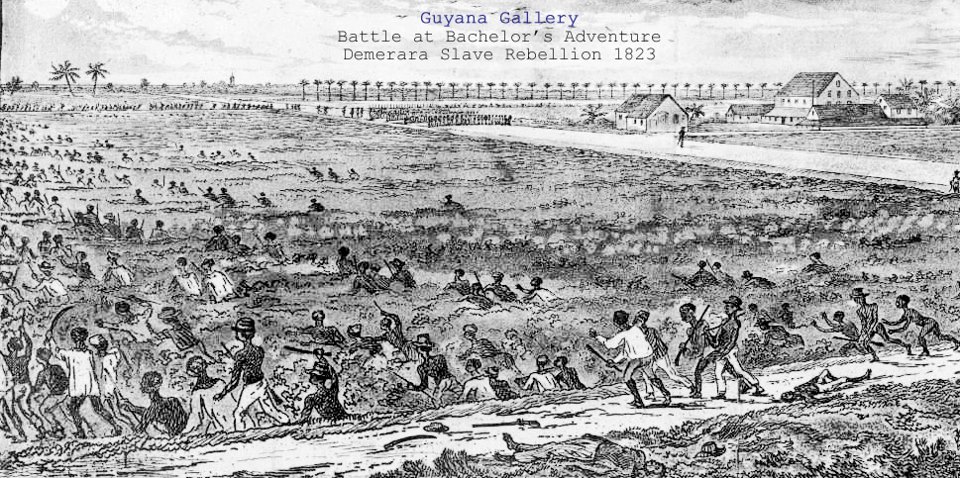
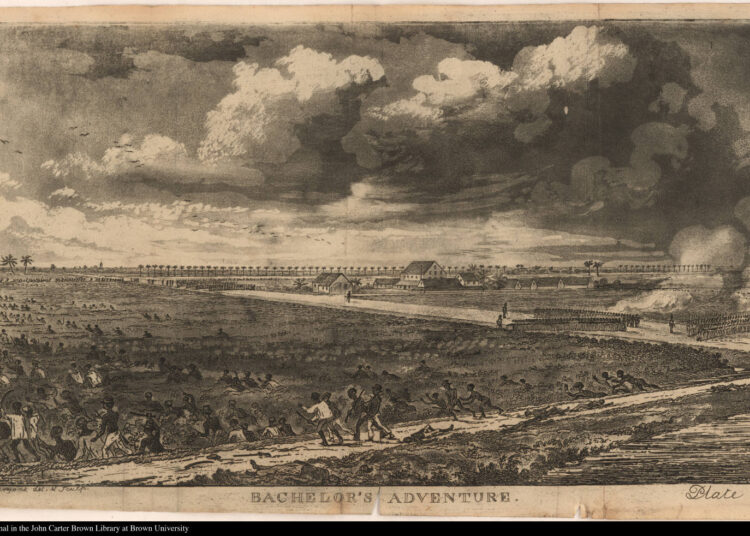
On August 20, a large group of rebels gathered at Bachelor’s Adventure on the East Coast. Colonial troops confronted them, and when the confrontation escalated, soldiers opened fire.
A contemporary account cited by Guyanese authorities records the horror:
“The soldiers poured in volley after volley.”
By noon, about 200 enslaved people had been killed at the site.
The violence did not end there.
Troops moved from plantation to plantation in pursuit of rebels. Some captured Africans were subjected to summary “drum-head” trials lasting only minutes. Those convicted were tied to trees and shot. Bodies were mutilated, displayed and placed along public roads as warnings to others.
The repression was intended not merely to punish the rebels but to terrorise the enslaved population back into submission.
Where the hangings took place
Formal court martial proceedings began in Georgetown on August 25, 1823.
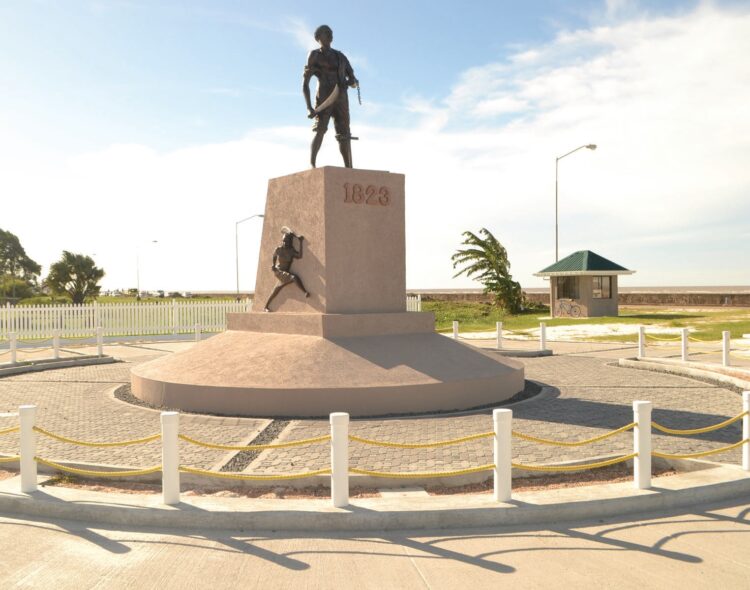
The Militia Parade Ground in Cummingsburg—today Independence Park—became the site of public executions. Condemned rebels were hanged there, while others had already been executed following summary trials on the plantations. Their bodies were subsequently displayed in chains or otherwise mutilated.
Quamina escaped into the backlands but was eventually found and killed on September 16. His body was returned and hung in chains outside Plantation Success.
John Smith: the missionary who became a British cause célèbre
The rebellion also ensnared John Smith, the British missionary whose ministry had attracted many enslaved Africans.
Smith was convicted by court martial and sentenced to death for allegedly encouraging rebellion. He was never hanged. He died in prison in February 1824 while awaiting the outcome of an appeal to Britain.
His death caused an uproar in Britain and became a powerful weapon for abolitionists arguing that colonial slavery was fundamentally incompatible with justice and Christianity.
But modern scholarship has increasingly challenged histories that place Smith at the centre of the rebellion while diminishing the enslaved Africans themselves.
The revolt was their revolt.
Why it shook Britain
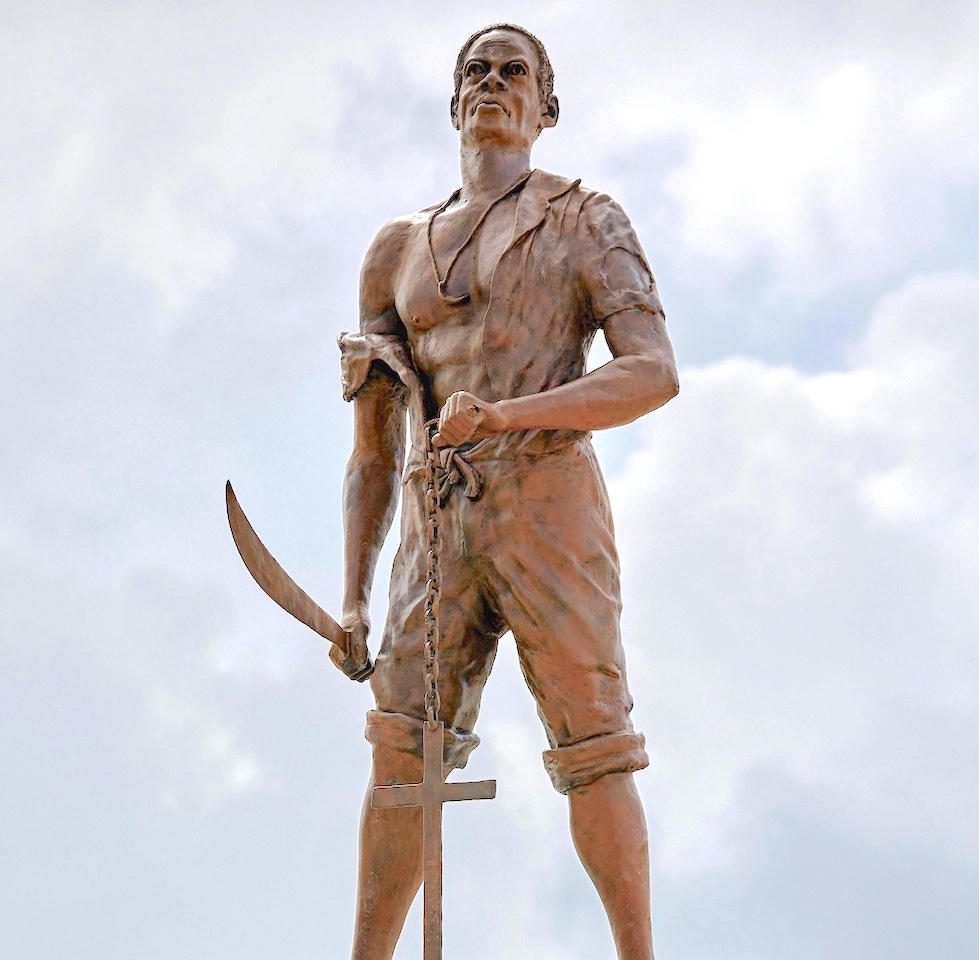
The news of the killings, executions and Smith’s death triggered fierce debate in Britain. The rebellion embarrassed slaveholders and undermined claims that slavery could simply be made “humane” through gradual reform.
Cambridge historians Burnard and Candlin note that the rebellion, centred on John Gladstone’s estates, had a profound effect on metropolitan attitudes toward slavery and demonstrated the contradictions of attempting to preserve slavery through “amelioration.”
The revolt also came at a critical moment. Britain had abolished its participation in the transatlantic slave trade in 1807, but slavery itself remained legal. In 1823, the British Government was pursuing an “amelioration” policy aimed at reforming slavery rather than immediately abolishing it. By 1833, that approach had collapsed.
Former Guyanese President David Granger described the Demerara Rebellion as “perhaps, the single most significant event to hasten the abolition of slavery in the British colonies.”
The Slavery Abolition Act was passed in 1833, taking effect in the British colonies in 1834. Full freedom was delayed by the apprenticeship system until 1838.
Why it matters in Emancipation Month
The lesson of 1823 is uncomfortable but essential: emancipation was not simply a gift bestowed by Britain.
It was the product of decades of resistance, abolitionist campaigning, political struggle and, above all, the determination of enslaved people to challenge the system that held them in bondage.
The Demerara rebels lost the immediate battle. Hundreds lost their lives. Some were hanged at what is now Independence Park; others were shot, mutilated or publicly displayed.
But their resistance helped make slavery’s continuation increasingly indefensible.
During Emancipation Month, their story should therefore be told not only as one of suffering, but of agency, courage and resistance.
The rebellion was suppressed.
Its demand for freedom was not.