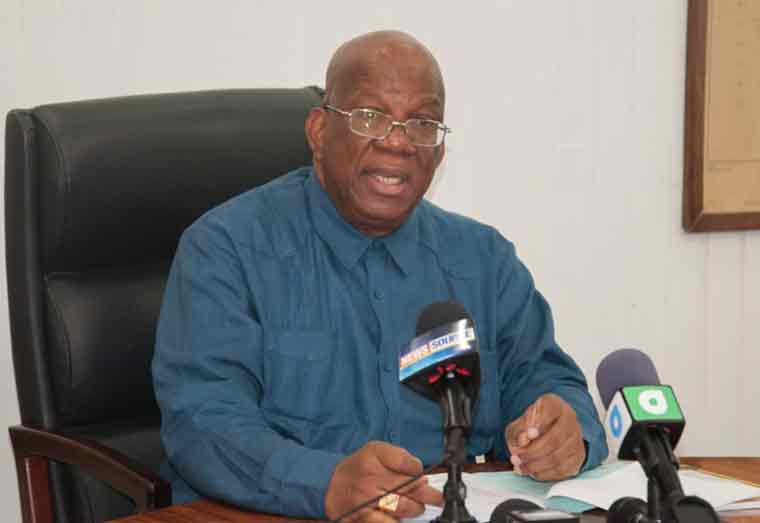
A Partnership for National Unity (APNU) Member of Parliament K. Sharma Solomon is demanding that President Irfaan Ali’s government open its books on Guyana’s oil revenues, challenging the administration to show exactly how it arrived at the newly announced 39.8% share of crude production from the ExxonMobil-led Stabroek Block.
Ali announced on Tuesday, August 18, that Guyana is now entitled to 39.8% of crude production from the block after the consortium reportedly recovered approximately US$55 billion in project costs.
While the announcement represents a major increase in Guyana’s share of production, Solomon argues that the headline figure is meaningless without the underlying numbers showing how much oil has been produced and sold, how much has been claimed for cost recovery and, ultimately, how much money will reach the Guyanese treasury.
Writing directly to Ali, Solomon said:
“An announcement of this magnitude cannot end with a percentage. Guyanese are entitled to know what that percentage means in actual production, revenue, and money received by Guyana.”
Solomon, APNU’s representative for Natural Resources, said the government’s presentation of the 39.8% figure failed to answer fundamental questions about the country’s oil accounting.
He wants the government to disclose the volume of crude produced and sold, the costs claimed by the ExxonMobil-led consortium, the costs accepted or rejected by Guyana, outstanding disputes and the precise calculations used to determine that Guyana has reached the 39.8% entitlement.
“The questions are simple. What has been produced and sold? What costs have been declared for recovery? What costs has Guyana accepted or rejected? What remains under dispute? And how did your government accounting arrive at 39.8%?”
The demand takes on added significance given the history of disputed costs claimed by the Stabroek Block partners.
Government-commissioned audits have already identified significant expenditures requiring challenge or further scrutiny. The audit covering 1999 to 2017 identified approximately US$214.4 million in disputed expenses. A subsequent audit covering 2018 to 2020 examined approximately US$7.2 billion in declared expenses and identified US$65.1 million that was not accepted by the government. A third audit, covering 2021 to 2023 and involving approximately US$19.6 billion in declared expenses, has also been under review.
For Solomon, those findings make it impossible for Guyanese to simply take the consortium’s cost-recovery figures at face value.
“Against this background, Guyanese cannot simply be asked to accept ExxonMobil’s declaration of what has been spent and recovered. ExxonMobil has a commercial interest in its accounts. Your government has a national duty to verify them.”
Under the Production Sharing Agreement governing the Stabroek Block, the contractor is entitled to recover allowable petroleum costs from production before profit oil is divided between the contractor and Guyana. Consequently, the amount of expenditure accepted as recoverable has a direct bearing on when Guyana receives a larger share of production and how much revenue flows to the state.
The issue of cost verification has therefore become increasingly important as production has expanded and Guyana’s oil revenues have grown dramatically.
Solomon rejected any suggestion that his call for greater scrutiny is an attack on ExxonMobil or foreign investment.
“This is not anti-investment, and it is not anti-ExxonMobil. It is about protecting Guyana’s interest.”
He said the government has both the authority and responsibility to audit and verify costs claimed under the Production Sharing Agreement and must exercise that responsibility with the seriousness warranted by the scale of Guyana’s natural-resource wealth.
Solomon’s challenge to Ali is straightforward: publish the evidence behind the 39.8% figure.
“Therefore, President Ali, show the audits. Show the disputed costs. Show what has been accepted and rejected. Show the calculation that produces 39.8%. Show the production, sales, cost-recovery, and revenue figures. Most importantly, tell the nation what Guyana will actually receive.”
The reported recovery of approximately US$55 billion in project costs marks a significant milestone for the Stabroek Block. It also means that the transition to a larger Guyanese share of production will increasingly affect the country’s direct petroleum revenues.
But Solomon argues that Guyana’s growing oil wealth cannot be judged merely by the size of announcements or percentages.
“Oil has transformed the scale of Guyana’s economy, but it must not lower the standard of accountability.”
He said the real measure of Guyana’s oil wealth should be what can be independently verified, transparently accounted for and ultimately delivered to citizens.
“The country’s wealth cannot be measured only by what is announced from a podium. It must be measured by what is independently verified, transparently accounted for, and ultimately delivered to the people.”
Solomon ended his letter with a direct call for disclosure, saying the political spectacle surrounding the announcement must now give way to detailed public accounting.
“The lights and cameras have now gone. What remains is the responsibility of your Government to the Guyanese people.”
“The people are entitled to the figures, the documents, and the accounting. Make them available.”
“The oil belongs to Guyana. Guyanese have a right to know exactly what is theirs.”