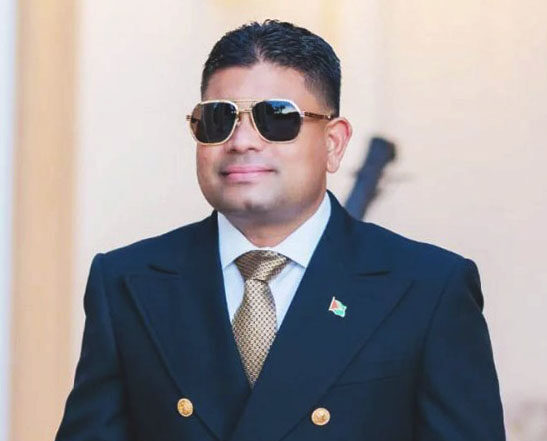
In a social media post and subsequent interview, Mohamed said 23-year-old Lance Corporal Shamar Calder, was shot while escorting civilian vessels along the Cuyuni-Mazaruni border, near Black Water, while travelling from Macapa to Ebang.
“A Soldier was shot by Venezuelan troops on May 24, just two days before Independence Day, while carrying on duty at Black Water, along the Cuyuni-Mazaruni border, while escorting civilian vessels from Macapa to Ebang.”
Mohamed said the soldier suffered a gunshot wound to his leg, with the projectile remaining lodged there until he eventually required surgery. He further claimed that the soldier had received no meaningful assistance from the GDF, President Irfaan Ali or the PPP/C Government.
“While Venezuelan troops continue to threaten our territorial integrity, the very soldiers standing on the frontline are being left to fend for themselves.”
He added:
“A government that asks our soldiers to defend Guyana must also stand behind them when they are injured in the line of duty.”
GDF disputes allegations
The GDF has rejected Mohamed’s account, describing publicly circulated claims about the serviceman’s treatment as inaccurate and saying they undermine both the injured rank and the wider force serving Guyana.
The Force’s account also differs from Mohamed’s regarding the date of the incident. While Mohamed said the shooting occurred on May 24, the GDF states that the rank was injured during an attack on May 29, 2026, while performing operational duties along Guyana’s western border.
Following the incident, the GDF said the soldier was medically evacuated to the Georgetown Public Hospital Corporation (GPHC), where he received immediate treatment and was admitted for observation.
He was subsequently placed under medical supervision and specialist follow-up through both the GPHC and the GDF Medical Corps, according to the Force.
The soldier was readmitted to GPHC on August 1, when doctors surgically removed the projectile that had remained lodged in his leg since the May incident. He was discharged on August 3 and is currently on authorised sick leave.
The GDF also pushed back against any suggestion that its responsibility ended with the soldier’s medical treatment.
According to the Force, the serviceman continues to receive psychological support through the GDF Medical Corps, while administrative matters relating to his welfare and that of his family are being addressed.
Border tensions
The incident occurred amid heightened security concerns along Guyana’s western frontier, particularly in the Cuyuni-Mazaruni area, where Guyanese military personnel have come under fire from the Venezuelan side.
Reports at the time said a GDF patrol escorting civilian commuters along the Cuyuni River came under gunfire from the Venezuelan shore, with one soldier wounded and subsequently evacuated to Georgetown.
The security situation has particular significance given the longstanding Guyana-Venezuela territorial controversy, including Venezuela’s claim to Guyana’s Essequibo region and the ongoing proceedings before the International Court of Justice.
Soldiers stationed in remote border areas face welfare and access-to-medical-care challenges that are matters of critical operational importance, not merely administrative concerns. These personnel face significant risks while safeguarding Guyana’s territorial integrity and protecting civilians who rely on river transportation.
The dispute between Mohamed and the GDF ultimately turns on the adequacy of the support provided to the wounded serviceman, rather than whether he was injured—the Force acknowledges that he was.
Mohamed’s allegation is that a soldier wounded while defending Guyana was not adequately supported by the State. The GDF says the opposite: that the soldier received immediate medical evacuation, subsequent specialist care, surgery, psychological assistance and continuing administrative support.
With the two accounts differing significantly, the dispute has renewed scrutiny of the Government’s responsibility to ensure that servicemen and women injured while protecting the country receive timely, comprehensive and sustained support.