Saturday, September 5, 2026
Village Voice News
[adning id="37476"]
ADVERTISEMENT
  • Home
  • News
  • Sports
  • Editorial
  • Letters
  • Global
  • Columns
    • Eye On Guyana
    • Hindsight
    • Lincoln Lewis Speaks
    • Future Notes
    • Blackout
    • From The Desk of Roysdale Forde SC
    • Diplomatic Speak
    • Mark’s Take
    • In the village
    • Mind Your Business
    • Bad & Bold
    • The Voice of Labour
    • The Herbal Section
    • Politics 101 with Dr. David Hinds
    • Talking Dollars & Making Sense
    • Book Review 
  • Education & Technology
  • E-Paper
  • Contact Us
No Result
View All Result
  • Home
  • News
  • Sports
  • Editorial
  • Letters
  • Global
  • Columns
    • Eye On Guyana
    • Hindsight
    • Lincoln Lewis Speaks
    • Future Notes
    • Blackout
    • From The Desk of Roysdale Forde SC
    • Diplomatic Speak
    • Mark’s Take
    • In the village
    • Mind Your Business
    • Bad & Bold
    • The Voice of Labour
    • The Herbal Section
    • Politics 101 with Dr. David Hinds
    • Talking Dollars & Making Sense
    • Book Review 
  • Education & Technology
  • E-Paper
  • Contact Us
No Result
View All Result
Village Voice News
No Result
View All Result
Home Columns Diplomatic Speak

Kuwait DIWANIYAS gain UNESCO Heritage Status; Captain Peter Ramsaroop in Kuwait LIBERATION; ASEAN Day 59 th. Anniversary: and Elon Musk SAID, “money will stop mattering by 2036

Admin by Admin
August 15, 2026
in Diplomatic Speak
0
SHARES
0
VIEWS
Share on FacebookShare on Twitter

Kuwait DIWANIYAS gain UNESCO Heritage Status, Highlights Tradition of Dialogue;  GUYANESE Born USA AIR FORCE OFFICER Captain Peter R. Ramsaroop SERVED for the KUWAIT LIBERATION during AUGUST 2nd.1990- FEBRUARY 28th, 1991; ASEAN DAY 59 th. Anniversary on 8th August 2026; and Elon Musk “money will stop mattering by 2036”

The UNESCO inscription of Kuwait’s DIWANIYAS  on its Intangible Cultural Heritage list underscores the institution’s enduring role as a forum for dialogue, civic engagement, and cultural preservation, while spotlighting its contribution to the country’s social and political development.

READ ALSO

Islamic financing in Guyana and Suriname, Ally’s memoirs at the Library of Congress, and Guyana’s mineral and water wealth

Guyana Integrity Commission From 2017 With Seven Nolan Principles; Swot Guyana 2026 Vs. Nolan; And History Of Nolan Principles (Uk) By Lord Michael Nolan In 1994

The Diwaniya (also spelled diwaniyah) is a fundamental PILLAR  of Kuwaiti social life, functioning both as a physical reception space and as the daily or weekly social gathering itself. It serves as a localized hub for networking, community building, and political discourse, deeply embedded in Kuwait’s cultural identity.

A typical Diwaniya operates with specific cultural norms and practices

The Space: It is often a large, purpose-built room or detached annex separate from the main family residence, designed for hosting guests.

The Routine: Hosts (usually male heads of households) open their Diwaniya on scheduled days or even on a daily basis. Guests arrive to socialize, discuss current events, talk politics, or play games.

Hospitality: Hosts serve traditional Arabic coffee (gahwa) poured from ornate pots (dallah), dates, tea, and sometimes full meals

Women’s Diwaniyas: While historically male-centric, the tradition has evolved. Today, many women run their own Diwaniyas, establishing autonomous spaces for civic engagement and networking.

Social Hub: Neighbors and friends meet to relax, chat, and drink tea or coffee.

Political Forum: Candidates campaign here, and citizens debate policies and vote choices.

Business Network: Professionals gather to pitch ideas, find partners, and close deals.

Conflict Resolution: Families use the space to solve private disputes and settle arguments

Location : A separate annex or large ground-floor room with an independent street entrance.

Seating: U-shaped seating wraps around the walls, using low sofas or traditional floor cushions.

Focus Point: The center of the room remains completely open to allow easy viewing and cross-room conversation.

Traditional Etiquette Greeting. Guests always greet the host first, then move counterclockwise around the room.

Dress Code: Attendees typically wear formal national dress, the thobe (or dishdasha) and ghutra.

Status: Seating is democratic, though elders and guests of honor often sit near the host.

Kuwait’s diwaniya tradition has gained international recognition following its inscription on UNESCO’s Representative List of the Intangible Cultural Heritage of Humanity, a milestone that cultural experts say reflects the institution’s enduring role in shaping the country’s social fabric and national identity.

Long regarded as a cornerstone of Kuwaiti society, the diwaniya serves as a gathering place where citizens meet to discuss community affairs, exchange ideas, and debate social, cultural, and political issues. Over time, it has evolved from a traditional meeting space into a platform that fosters dialogue, civic participation, and the transmission of values across generations.

Officials say the UNESCO recognition acknowledges the diwaniya’s contribution to preserving social cohesion, promoting tolerance, and strengthening community ties at a time when many societies are grappling with the challenges of rapid social and technological change.

Mohammad bin Redha, Acting Assistant Secretary-General for Antiquities and Museums at the National Council for Culture, Arts and Letters, described the inscription as a significant national achievement that reflects Kuwait’s commitment to safeguarding its living heritage.

“The recognition confirms the DIWANIYA’S importance as a CULTURAL and SOCIAL practice that promotes DIALOGUE, TOLERANCE and the exchange of KNOWLEDGE  and VALUES between GENERATIONS” he said.

According to cultural historians, the influence of diwaniyas extends far beyond social gatherings. Many of Kuwait’s key educational, cultural and reform initiatives were first discussed within their walls, the Kuwait News Agency reports.

Among the most notable examples was the establishment of Al-Mubarakiya School in 1911, Kuwait’s first formal educational institution, which originated from discussions held in the diwaniya of educator Yusuf bin Isa Al-Qina’i. Similarly, the concept of the country’s first literary club emerged in the diwaniya of Sheikh Abdullah Al-Jaber Al-Sabah before its establishment in 1924.

Professor of Modern and Contemporary History Ayed Al-Juraid said several landmark national projects, including early reform initiatives and proposals related to civic participation, were first conceived in diwaniyas.

The institution has also played a critical role during times of hardship. Historical records show that diwaniyas provided community support during economic crises and periods of famine. In 1868, for example, many opened their food stores to assist families affected by severe shortages.

Beyond their social and charitable functions, DIWANIYAS have traditionally served as a bridge between citizens and the country’s leadership. The longstanding practice of rulers visiting diwaniyas created a direct channel for public dialogue, allowing community concerns and ideas to be discussed in an informal setting.

In recent decades, the institution has evolved to reflect broader societal changes, including the rise of women’s diwaniyas. These forums have expanded opportunities for cultural exchange, social engagement, and public discussion among women.

Writer and academic Souad Al-Mejel said women’s diwaniyas emerged from the historical role Kuwaiti women played in supporting families and communities, particularly during the era of pearl diving and maritime trade. She noted that pioneering women’s gatherings later became platforms for discussing social issues, education, and women’s rights.

Examples include the diwaniya of Lulwa Al-Qatami, which focused on advancing women’s causes, and that of Dr. Souad Al-Sabah, which developed into a prominent intellectual and cultural forum.

Experts believe UNESCO recognition will encourage further research, documentation and educational initiatives aimed at preserving the diwaniya tradition while introducing it to new generations.

As Kuwait modernizes and embraces digital transformation, the UNESCO listing highlights the continued relevance of an institution that has helped shape the country’s cultural, educational, and political landscape for generations, ensuring that the spirit of dialogue and community remains at the heart of Kuwaiti society.
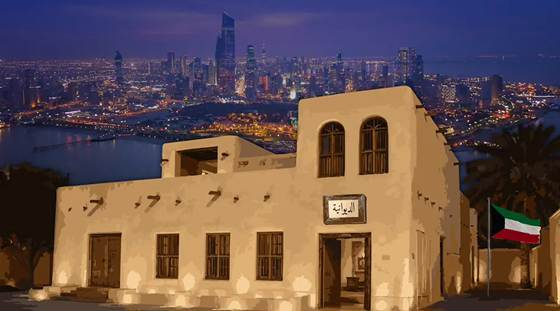
KUWAITI DIWANIY
Kuwaiti diwaniyas gain UNESCO heritage status, highlights tradition of dialogue – Times Kuwait
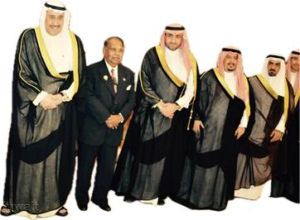
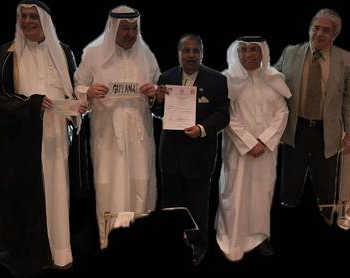
June 7, 2018.  At Dr. Mustafa Behbehani DIWANIYA.  Amb.  Dr. Shamir Ally, promoting “ Guyana BRAND with Show, Tell & Know”  ONE PAGE FLIER, and Announcement of the “ Kuwait-Guyana Friendship Association.”
L to R:  Dr Mustafa Yacoub Behbehani Chairman Kuwaiti Gulf Group. President C, Peru & Guyana Friendship Association; Sheikh Duaij Jaber Al-Ali Abu Naser AL-Sabah Esq. (Boston Law. USA); Amb. Dr. Shamir Ally; Al Hajj Jassem Mohammad AL Baghli ; and Cuban Amb. José Luis Noriega Sánchez.
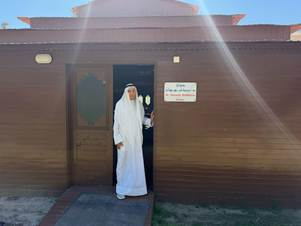
GUYANA at the DIWANIYA of His Excellency Sheikh Faisal AL-Humoud AL-Sabah, GOVERNOR Farwaniya Governate
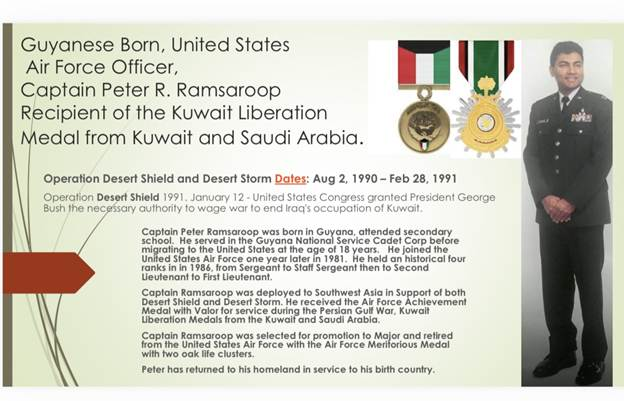
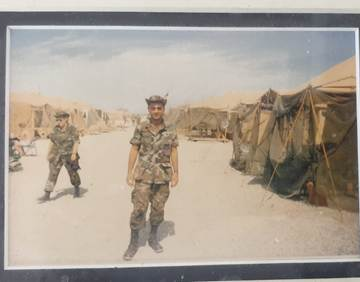
Guyana Embassy in Kuwait, 1st Floor, 2018: GUYANESE Born USA AIR FORCE OFFICER Captain Peter R. Ramsaroop SERVED for the KUWAIT LIBERATION during AUGUST 2nd, 1990 – FEBRUARY 28, 1991.
                 

Guyana Embassy in Kuwait, 1st Floor, 2018: GUYANESE Born USA AIR FORCE OFFICER Captain Peter R. Ramsaroop SERVED for the KUWAIT LIBERATION during
AUGUST 2nd, 1990 – FEBRUARY 28, 1991.
 
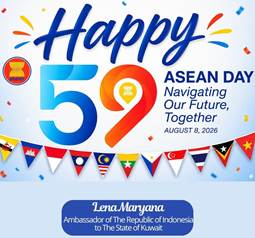
ASEAN DAY 59 th. Anniversary — 8th August 2026
One Vision, One Identity, One Community
On the 8th of August 2026, we join the Association of Southeast Asian Nations (ASEAN) in celebrating its 59th Anniversary, commemorating the signing of the Bangkok Declaration on 8th August 1967.
We extend our warmest CONGRATULATIONS to the GOVERNMENTS and PEOPLES of ALL  ASEAN Member STATES: Brunei Darussalam, Cambodia, Indonesia, Lao PDR, Malaysia, Myanmar, Philippines, Singapore, Thailand, Viet Nam, and Timor-Leste — our newest member of the ASEAN family.
 
For nearly SIX DECADES ASEAN has been a remarkable model of regional peace, dialogue, and prosperity. From five founding members — Indonesia, Malaysia, Philippines, Singapore, and Thailand — to an inclusive community of eleven nations, ASEAN has proven that diversity is strength and that neighbours can build a community based on mutual respect, non-interference, consensus, and shared prosperity.
We celebrate ASEAN’s THREE pillars — the Political-Security Community, Economic Community, and Socio-Cultural Community — which have delivered PEACE in a once-divided region, created the World’s 5th LARGEST economy, and UPLIFTED the LIVES of over 680 MILLION people.
We commend ASEAN’s vital role as a BRIDGE-BUILDER — through the East Asia Summit, ASEAN Regional Forum, and ASEAN Plus Three — and its principled commitment to Peace, Multilateralism, and International Law, including the Treaty of Amity and Cooperation.
To our ASEAN friends GLOBALLY,  including  GUYANA and in the GLOBAL DIASPORA — Your PRINCIPLES of UNITY in DIVERSITY resonate deeply with THE WORLD’S VISION, DREAM and HOPE.
 
As Guyana and CARICOM deepen our South-South PARTNERSHIP with ASEAN, we look forward to greater Cooperation in CLIMATE RESILENCE, FOOD SECURITY, ENERGY, EDUCATION, and PEOPLE-TO-PEOPLE TIES.
 
BLESSED, ENJOYABLE and HAPPY ASEAN DAY! Selamat Hari ASEAN!
  Mabuhay ang ASEAN! Merdeka!


Official ASEAN Emblem:
The TEN bound RICE STALKS in the center represent the MEMBER COUNTRIES, bound together in FRIENDSHIP and SOLIDARITY in a BLUE circle representing PEACE and STABILITY. The RED BORDER is COURAGE and DYNAMISM.
 
https://asean.org


The idea that “money will stop mattering by 2036” stems from a late July 2026 interview given by Elon Musk to The Economist.
Musk argued that rapid advancements in artificial intelligence (AI) and humanoid robotics will create a post-scarcity economy. In his view, automated systems will produce an overabundance of food, shelter, and services, driving the cost of living down to near-zero and rendering traditional currency obsolete.
 
https://247wallst.com/investing/2026/08/05/elon-musk-predicts-money-wont-matter-in-2036-is-this-his-worst-prediction-yet-or-prophetic/
ShareTweetSendShareSend

Related Posts

Diplomatic Speak

Islamic financing in Guyana and Suriname, Ally’s memoirs at the Library of Congress, and Guyana’s mineral and water wealth

by Admin
August 29, 2026

ISLAMIC Financing in Guyana and Suriname; SWOT; ALLYS’ couple made HISTORY  as a Guyanese American HUSBAND  and WIFE  to have...

Read moreDetails
Diplomatic Speak

Guyana Integrity Commission From 2017 With Seven Nolan Principles; Swot Guyana 2026 Vs. Nolan; And History Of Nolan Principles (Uk) By Lord Michael Nolan In 1994

by Admin
August 22, 2026

GUYANA Government 2017 FOCUS CENTERED EXPLICITLY on the traditional SEVEN NOLAN Principles, Guyana’s modern statutory framework—ADMINISTERED by the GUYANA INTEGRITY...

Read moreDetails
Diplomatic Speak

Gouveia Honoured, Iraq-Kuwait Anniversary, Cashless Nations & NY Diamond Jubilee Awards

by Admin
August 8, 2026

Dr. (H. C.) Gerald Richard Gouveia, Sr. Honorary Doctorate; 36th. IRAQ invasion of KUWAIT August 1990; 5 Top CASHLESS COUNTRIES,...

Read moreDetails
Next Post

WORD OF THE DAY: CIRCUMSCRIBE


EDITOR'S PICK

Keisha Harrison, Project Officer at RISE Life Management Services, presents a true Jamaican Mahogany plant to Dr. Sylvia Mitchell of the UWI Biotechnological Centre. Dr. Mitchell also received the DNA analysis research findings.

Authentic Jamaican mahogany set for resurgence following DNA identification

March 1, 2024
Google Photo

Crab Oil (Andiroba)

August 7, 2022

CARICOM Heads of Government Confab set for Feb 25-28 in Georgetown

February 24, 2024
Ms. Juretha Fernandes MP

Government breaking down guardrails of democracy- Fernandes

April 6, 2023

© 2024 Village Voice

No Result
View All Result
  • Home
  • News
  • Sports
  • Editorial
  • Letters
  • Global
  • Columns
    • Eye On Guyana
    • Hindsight
    • Lincoln Lewis Speaks
    • Future Notes
    • Blackout
    • From The Desk of Roysdale Forde SC
    • Diplomatic Speak
    • Mark’s Take
    • In the village
    • Mind Your Business
    • Bad & Bold
    • The Voice of Labour
    • The Herbal Section
    • Politics 101 with Dr. David Hinds
    • Talking Dollars & Making Sense
    • Book Review 
  • Education & Technology
  • E-Paper
  • Contact Us

© 2024 Village Voice