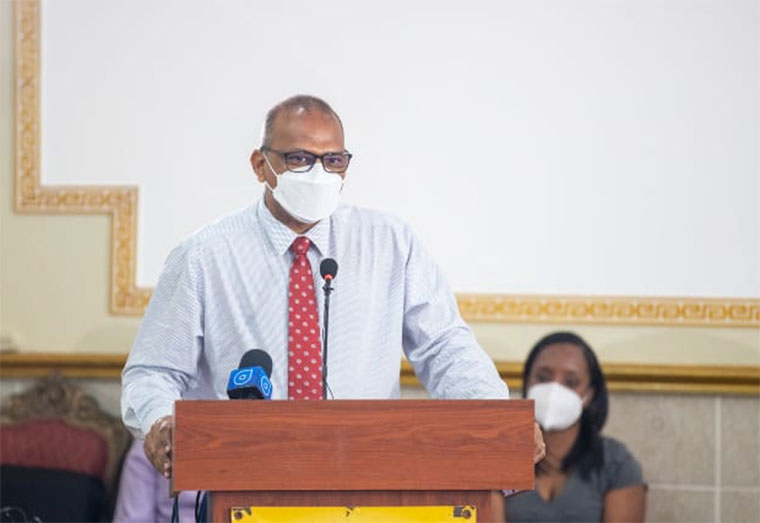
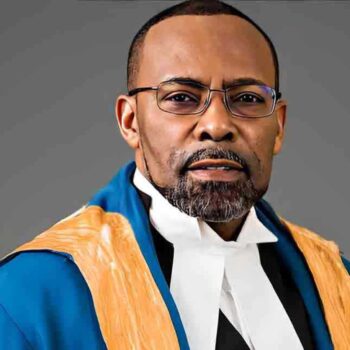
Attorney-at-law Nigel Hughes has thrown a legal challenge into the growing controversy surrounding Caribbean Court of Justice (CCJ) President Justice Winston Anderson, arguing that the Regional Judicial and Legal Services Commission (RJLSC) does not have the legal authority to investigate or discipline the president.
Hughes’ intervention comes after the RJLSC acknowledged the seriousness of allegations against Anderson and called for the matter to be addressed through the Court’s internal governance mechanisms and a “transparent and independent review.”
But Hughes contends that the Commission’s powers stop short of investigating the very person who chairs it.
The controversy follows the Trinidad Sunday Express’s August 9 report on leaked internal correspondence in which several CCJ judges reportedly accused Anderson of authoritarian and dictatorial leadership.
The allegations also included claims of “panel fixing,” attempts to influence case outcomes and disputes over the administration of the Court.
Hughes said the question now is not simply whether the RJLSC wants to investigate Anderson, but whether the treaty establishing the CCJ allows it to do so.
“The RJLSC does not have the legal power to do so.”
He pointed to a formal complaint filed against Anderson by the Caribbean Guyana Institute for Democracy (CGID) in December 2025, months before the current controversy. Hughes said the RJLSC responded on December 22, 2025, advising that it lacked jurisdiction over the CCJ president in relation to the matters raised.
The reason, Hughes argues, is embedded in the CCJ Agreement itself. Article V gives the RJLSC disciplinary authority over “Judges of the Court, other than the President.” Article XXXI similarly excludes the president from the Commission’s regulation-making authority concerning judges.
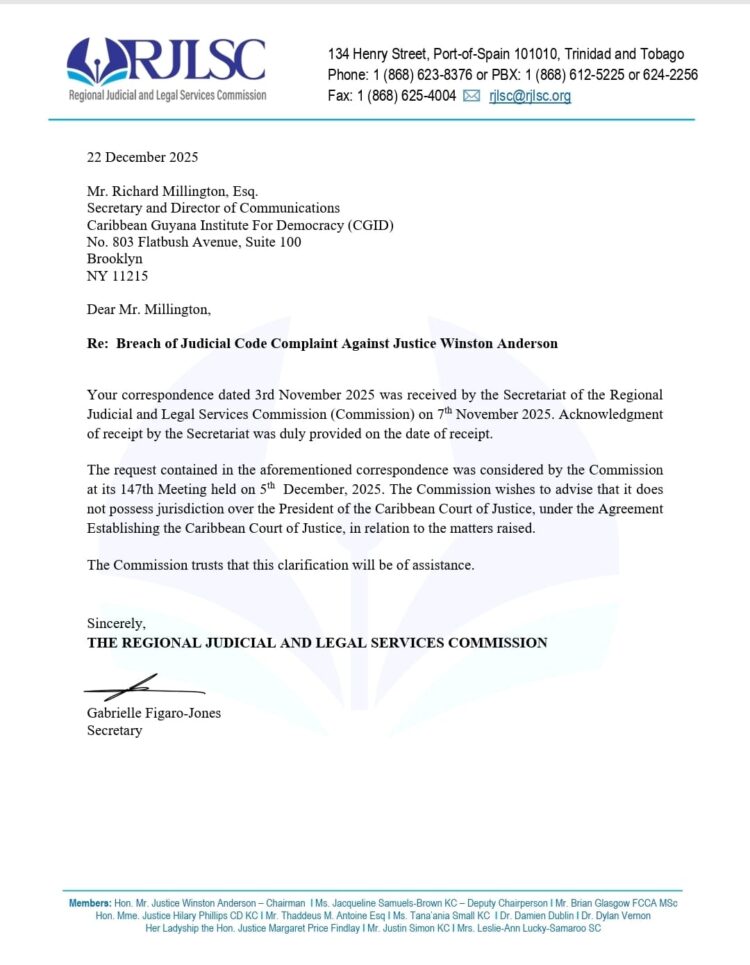
The distinction is significant because the CCJ president also serves as chairman of the RJLSC.
“Because the President also serves as the Chairman of the RJLSC. The treaty framers recognised that a body cannot fairly discipline its own Chairman.”
Hughes therefore says the RJLSC’s latest statement acknowledging the allegations does not amount to an admission that it has jurisdiction to investigate Anderson.
“The more recent RJLSC statement acknowledging ‘the seriousness of these matters’ and recommending they be ‘addressed through the established internal governance mechanisms of the Court and the Commission, and through a transparent and independent review’ is consistent with this position — the Commission can facilitate, but it cannot investigate or punish the President.”
So who can investigate the CCJ president?
Hughes points to Article IX of the CCJ Agreement, which provides a specific mechanism for removing the president.
Under that provision, at least three Heads of Government of the Contracting Parties must agree that the matter ought to be investigated. If that threshold is reached, an independent tribunal of at least three senior judges is appointed to investigate and make a recommendation on whether the president should be removed.
Hughes stresses that the grounds are limited.
The president may be removed for inability to perform the functions of office or misbehaviour.
The final decision rests with the Heads of Government, with removal requiring a three-quarters majority of the Contracting Parties. The Heads of Government can also suspend the president while the tribunal conducts its inquiry.
For Hughes, the elaborate procedure is intentional.
“The process is deliberately complex. It protects judicial independence by ensuring that no single government, no political faction, and no disgruntled litigant can remove the President of the Caribbean’s highest court.”
But he argues that institutional safeguards cannot become an excuse for inaction when credible allegations threaten the Court’s integrity.
“The allegations against the CCJ President are grave. If true, they go to the heart of the Court’s integrity.”
Anderson’s dual role creates another problem
Hughes also identified what he considers a potentially serious conflict of interest. Anderson is both the subject of the allegations and chairman of the RJLSC.
The treaty requires the RJLSC to transmit the tribunal’s recommendation to the Heads of Government, but Hughes said it does not expressly spell out what happens when the president is simultaneously the subject of the proceedings and chairman of the Commission.
He argues that basic principles of natural justice resolve that dilemma.
“Basic principles of fairness — the right not to be a judge in one’s own cause — clearly require the President to step aside from those deliberations.”
The controversy has therefore moved beyond the allegations themselves to a fundamental question of who has the authority to examine them.
Hughes says the answer lies not with the RJLSC acting alone, but with the treaty mechanism involving the Caribbean’s Heads of Government and an independent judicial tribunal.
“The Caribbean public is entitled to an independent tribunal inquiry conducted by senior judges, not to political posturing or institutional paralysis.”
He concluded:
“The CCJ belongs to the people of the Caribbean. Its credibility depends on the rule of law being applied to its leaders with the same rigour it is applied to everyone else.”