A haunting spoken-word performance by Linden youth Jamal Durant has struck a nerve across Guyana, triggering widespread debate on fear, freedom, and the price of speaking out in a society many say has grown increasingly cautious.
Durant’s piece, the “Cost of Silence,” has gone viral, amassing tens of thousands of views and sparking intense discussion both locally and in the diaspora. But it is not only the words that have captured attention—it is the imagery.
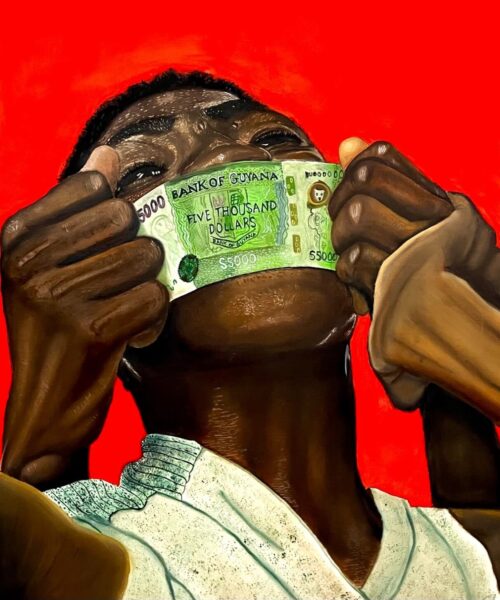
In the now widely circulated video, Durant appears with a $5,000 Guyana bill taped across his mouth, a stark symbol of what many interpret as the economic cost of dissent. Holding in his hand, a painting that mirrors the same theme: a people silenced not by lack of voice, but by fear of consequence.
From the opening lines, Durant dissects how silence is cultivated from childhood and reinforced into adulthood.
“Before we ever found our own voices, we were taught what was acceptable to say. At home, silence was framed as respect—authority went unquestioned, and difficult conversations were quietly avoided.”
He moves methodically through the institutions that shape society—home, school, workplace, and social media—arguing that each layer conditions individuals to suppress uncomfortable truths in exchange for acceptance and security.
“Then came the workplace. Be polite. Be professional. Clock in, clock out. Smile. Say thank you. Keep your opinions about politics, religion, injustice, and society to yourself. Protect your paycheck—protect that dollar, that dollar bill.”
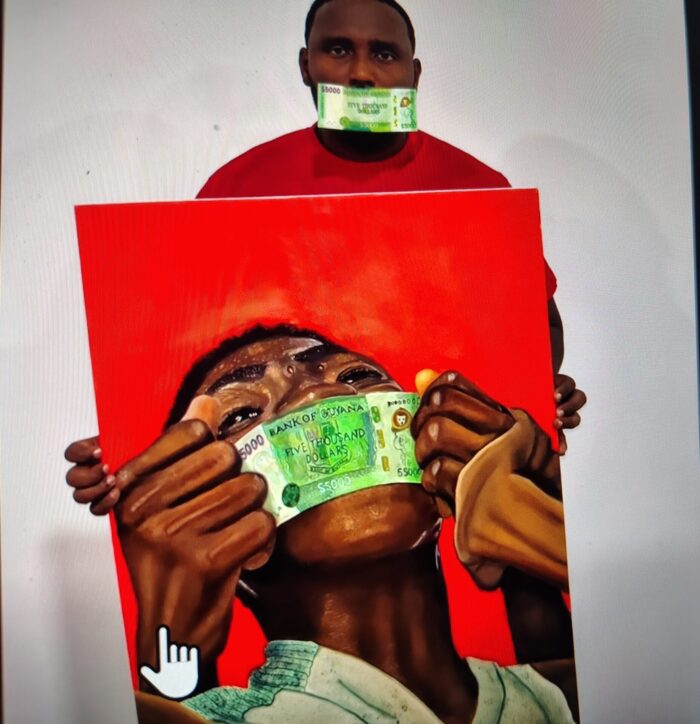
The symbolism has resonated powerfully in Guyana’s current climate, where concerns about political reprisals, economic marginalisation, and quiet exclusion from opportunity continue to circulate in public discourse. For many viewers, Durant’s performance captures a reality often discussed in private but rarely confronted publicly.
“Slowly, our voices became edited versions of ourselves—not because we have nothing to say, but because we have been conditioned to believe that silence is safer than truth.”
The performance builds toward a broader warning about the long-term consequences of collective silence, invoking civil rights leader Martin Luther King Jr. to underscore the stakes.
“A society that fears speaking the truth will eventually lose the ability to recognise it. As Martin Luther King Jr. warned, : ‘Our lives begin to end the day we become silent about the things that matter’.”
In a dramatic climax that has since become the defining image of the piece, Durant tears the $5,000 bill from his mouth and stares directly into the camera, issuing a blunt and urgent call:
“speak up, speak out and let your voice be heard.”
He leaves viewers with a question that has echoed widely across social media:
“Silence has a cost. It costs innovation. It costs justice. It costs identity. It costs courage. And ultimately, it costs generations… The question is: what has your silence cost you?”
The response has been immediate and far-reaching. The video has been shared across platforms, drawing praise from educators, youth leaders, and civil society voices who describe it as both timely and courageous. Others have called it a rare public articulation of fears many Guyanese quietly carry.
Coming from Linden—a town historically associated with protest and political resistance—Durant’s message carries added weight. His performance is already being seen as part of a broader cultural awakening among young Guyanese, one that challenges a deeply ingrained culture of caution.
In a country where speaking out can carry perceived risks, “Cost of Silence” has forced a national pause—pushing citizens to confront not only what is being said, but what remains deliberately unsaid.