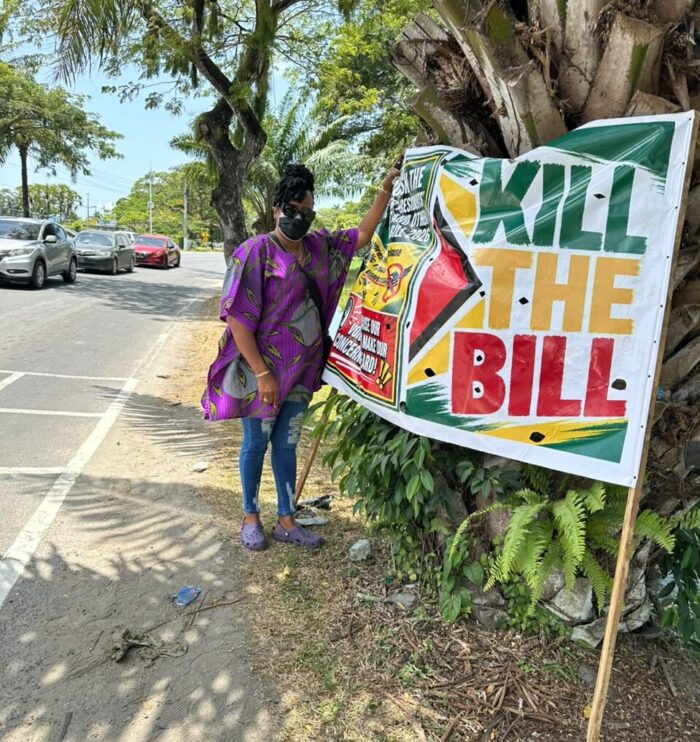
Former minister and former parliamentarian Annette Ferguson on Tuesday marked her eighth consecutive week of protest outside the Office of the President, sustaining her campaign against the Former Presidents Benefits Bill 2026, which she argues threatens to reintroduce unchecked financial obligations on the State.
Holding a banner reading “Kill The Bill,” Ferguson has used weekly demonstrations to draw attention to what she sees as a dangerous rollback of fiscal safeguards.
Speaking to Village Voice News, she emphasised both the consistency of her protest and its purpose:
“Tuesday marked my eighth consecutive week out there,” she said. “The objective is basically to sensitise, educate, and inform citizens about the implications this is likely to have on our treasury.”
She noted that her protests will pause temporarily with the impending recess of the National Assembly of Guyana:
“The National Assembly is expected to go into recess from Monday, August 10… so Tuesday was my last day out there until the National Assembly reconvenes,” she said. “Nothing has changed—only a pause until then.”
Return to an Uncapped System
At the centre of Ferguson’s concern is the bill’s move to restore an uncapped benefits structure—a system Guyana has grappled with before.
Guyana’s 2009 Former Presidents’ Benefits Act sparked significant public debate amid concerns that it created an open-ended system of state-funded benefits for former heads of state. The legislation allowed for uncapped spending on utilities, transportation, medical care, and staffing—raising questions about the financial burden on taxpayers and the absence of clear limits.
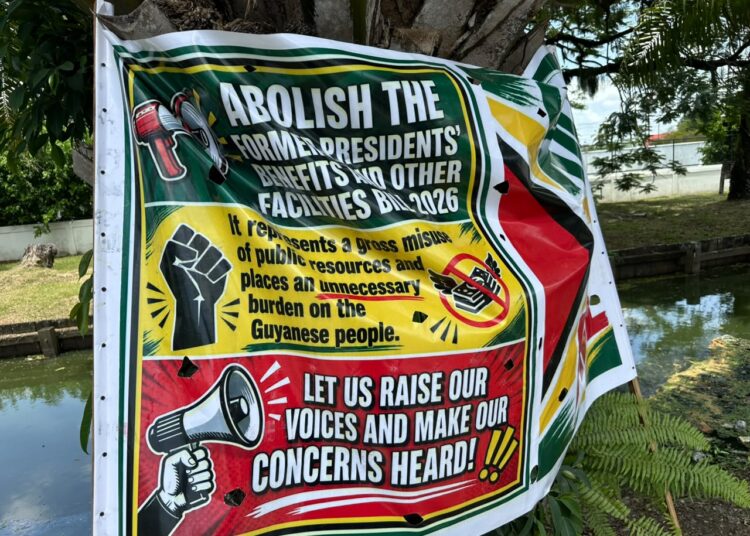
In response, amendments introduced in 2015 by the A Partnership for National Unity + Alliance for Change (APNU+AFC) imposed caps on these benefits, including limits on monthly utilities, staffing, and medical expenses—measures intended to introduce fiscal discipline and accountability.
However, the 2026 Bill seeks to repeal those restrictions and restore the original uncapped provisions, reigniting concerns about oversight and long-term sustainability.
Open-Ended Cost to the Treasury
Ferguson argues that removing caps effectively hands the State a blank cheque obligation, with no defined ceiling on spending tied to former presidents’ benefits.
“This is about placing an indefinite financial commitment on the treasury,” her position suggests, warning that costs could expand over time without legislative restraint.
Such an arrangement, critics say, exposes taxpayers to rising and potentially unpredictable expenditures, particularly when benefits—ranging from staffing to medical care—can scale without limit.
Protest and Policy Collision
Ferguson’s sustained protest reflects a broader national debate over governance priorities—whether expanding state-funded privileges for former leaders aligns with principles of equity and accountability.
While her demonstration pauses with Parliament’s recess, the issue itself remains unresolved. When lawmakers return, the clash between fiscal responsibility and political entitlement is expected to intensify, with Ferguson’s central message unchanged: the cost of this bill, she insists, is one the country cannot afford.