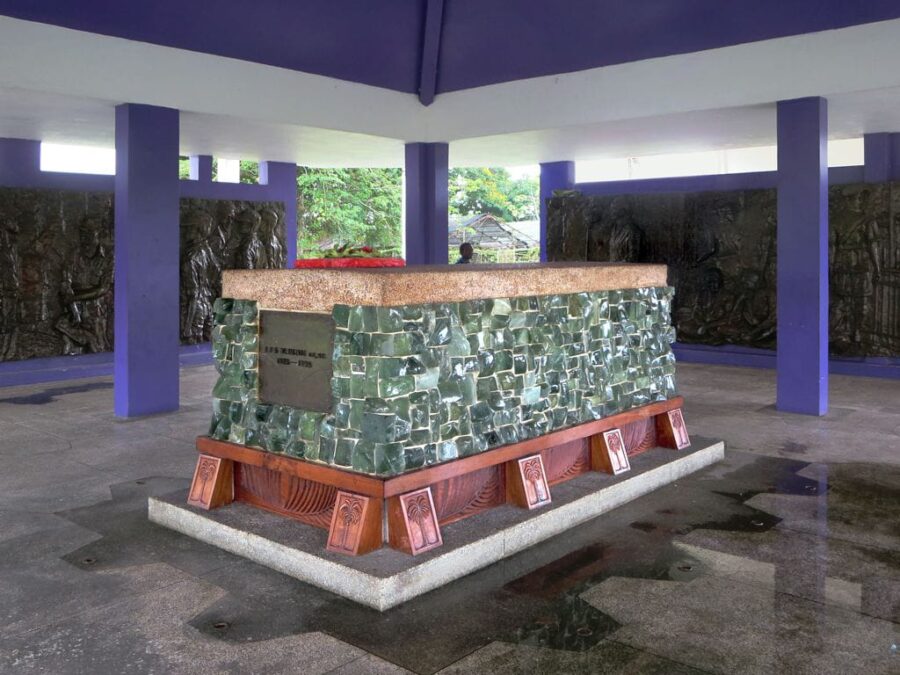
“This Government holds that all the people of this country are equally important, whether they belong to a large group or a small group. To us, the Amerindians are important. To us, the Chinese are important. To us, the Portuguese are important. To us, the Europeans are important. To us, the mixed races are important. To us, the Africans are important. To us, the Indians are important. In short, all Guianese are important and valued members of our community and we cherish them and consider that, as a Government, it is our duty and privilege to guard, protect and further the real interests of all.”
— Forbes Burnham, first national broadcast after becoming Premier of British Guiana, December 1964
Those words, delivered in Burnham’s first address to the nation after assuming office as Premier, have echoed through Guyana’s history for more than six decades. They were more than a political statement; they were a declaration of nationhood—a promise that every Guyanese, regardless of race, religion or social standing, belonged equally in the country that was about to emerge from colonial rule.
Today, Guyana observes the 41st anniversary of the death of Linden Forbes Sampson Burnham, the lawyer, freedom fighter, parliamentarian, statesman and nation-builder whose vision helped transform British Guiana into an independent republic and whose influence continues to permeate nearly every aspect of Guyanese life.
Born on February 20, 1923, Burnham died on August 6, 1985, while serving as Guyana’s first Executive President. More than four decades later, he remains one of the most consequential figures in the nation’s history—a leader whose achievements, ideas and legacy continue to inspire admiration, debate and reflection.
The Making of a National Leader
Burnham’s journey began in humble surroundings in Kitty, Georgetown.
A gifted student, he attended Kitty Methodist School and later Queen’s College, where his academic brilliance became evident. Awarded a scholarship to England, he studied at the University of London, earning degrees in the arts and law before being called to the Bar at Gray’s Inn, one of England’s historic Inns of Court.
Returning home in 1948, Burnham quickly established himself as one of British Guiana’s leading barristers. His courtroom skills, commanding intellect and extraordinary gift of oratory propelled him rapidly into politics.
He would serve successively as Member of the Legislative Assembly, Minister of Education, Mayor of Georgetown, Leader of the Opposition, Premier of British Guiana, Prime Minister of Independent Guyana, and ultimately the country’s first Executive President.
Yet Burnham’s greatest achievement was not the offices he occupied, but the nation he sought to build.

The Father of Independent Guyana
When Guyana attained Independence on May 26, 1966, Burnham stood at the centre of one of the defining moments in the country’s history.
For the first time in more than three centuries, Guyanese would govern themselves.
But Burnham understood that independence required more than lowering one flag and raising another. Political sovereignty had to be matched by psychological liberation, national pride and economic independence.
Four years later, on February 23, 1970, he declared Guyana the world’s first Co-operative Republic, a bold constitutional step intended to place the country’s development firmly in the hands of its people.
Under his leadership, Guyana also strengthened the institutions and symbols that define its national identity today.
The Golden Arrowhead, Coat of Arms, National Pledge, National Motto — “One People, One Nation, One Destiny” — the Canje Pheasant, the Victoria Regia Lily, and Mashramani as the Republic’s national celebration all became enduring expressions of Guyanese nationhood.

Among Burnham’s enduring contributions to nation-building was his commitment to fostering religious harmony in one of the world’s most diverse societies. Under his leadership, Guyana became one of the few countries in the Americas—and the Western Hemisphere—to officially recognise public holidays from Christianity, Hinduism and Islam, affirming the equal place of all faiths in the national life. Today, the country observes nine religious public holidays—four Christian, two Hindu and three Muslim—alongside national observances such as Republic Day, Independence Day, Emancipation Day, Labour Day and CARICOM Day. This inclusive policy reflected Burnham’s vision of “One People, One Nation, One Destiny,” reinforcing his belief that Guyana’s diversity was not a source of division but one of its greatest strengths.
Education Was the Great Equaliser
Few policies have left a more enduring impact than Burnham’s commitment to education.
Believing that knowledge was the pathway to freedom, his government introduced free education from nursery to university, opening doors that had long remained closed to thousands of Guyanese families.
Community High Schools, Multilateral Schools, technical institutes, teacher-training colleges and President’s College and expansion of the University of Guyana into a full campus emerged during this period. Co-education expanded opportunities, while education reached deeper into hinterland communities than ever before.
Burnham’s philosophy was captured in one of his most enduring declarations.
“Education is the cornerstone of equality and one of the chief instruments for the abolition of snobbery and the removal of discrimination.”
To Burnham, education was never simply about producing graduates. It was about creating citizens capable of thinking independently, defending democracy and building a nation.

Building a Self-Reliant Nation
Long before phrases such as “food security” entered the global vocabulary, Burnham challenged Guyanese to become producers rather than consumers.
His call to “Feed, Clothe and House the Nation“ became one of the defining slogans of his administration, encouraging agriculture, cooperatives, manufacturing and national production.
His government nationalised key sectors of the economy, promoted cooperative ownership and invested heavily in infrastructure designed to unify and modernise the country.
Among the lasting achievements of that era were the Demerara Harbour Bridge, the Soesdyke-Linden Highway, the National Insurance Scheme, the Guyana Defence Force, the Guyana National Service, the National Cultural Centre, the Kuru Kuru Co-operative College, expanded hinterland development programmes, health centres, schools and housing schemes.
Burnham believed Guyana possessed all the natural wealth and human talent necessary to chart its own future.
A Caribbean Visionary
Burnham’s ambitions extended far beyond Guyana’s borders.
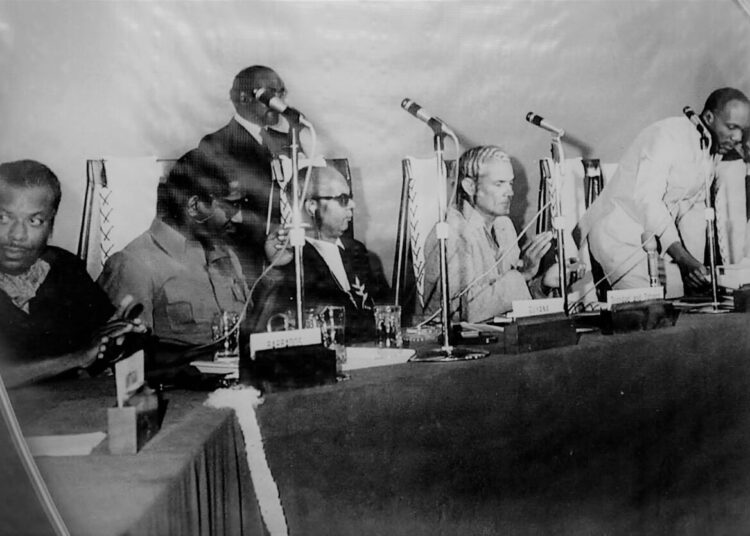
He was among the principal architects of Caribbean integration, helping transform CARIFTA into the Caribbean Community (CARICOM) and advocating consistently for greater political, economic and functional cooperation among Caribbean states.
His message to the region remains one of the most enduring statements ever made on Caribbean unity.
“Either we integrate or we perish.”
To Burnham, Caribbean integration was not an aspiration—it was a necessity.
He believed the region’s small states could secure prosperity, security and international influence only by acting together.

A Global Statesman
On the world stage, Burnham emerged as one of the developing world’s most respected voices.
He championed the Non-Aligned Movement, supported liberation struggles in southern Africa, condemned apartheid, defended the sovereignty of newly independent states and consistently advocated for a New International Economic Order that would give developing countries a fairer place in the global economy.
He argued that Guyana should never measure itself by its size but by the strength of its principles.

An Enduring Legacy
History continues to debate aspects of Burnham’s presidency, but history also records that few individuals have contributed more profoundly to the making of modern Guyana.
The institutions he established continue to serve the nation. The education policy he championed transformed generations. The regional movement he helped build remains the cornerstone of Caribbean cooperation. His call for self-reliance continues to resonate in an era of unprecedented economic opportunity.
Forty-one years after his passing, Burnham’s words still challenge the nation.
“All Guianese [Guyanese) are important and valued members of our community.”
In an age of renewed prosperity and heightened expectations, that vision remains unfinished.
It calls upon Guyanese to build a country where equality is reflected in practice, education expands opportunity, diversity is respected, and national development benefits all citizens.
Burnham’s enduring legacy extends beyond leading Guyana to Independence. It includes articulating a vision of nationhood founded on unity, equal citizenship and shared progress.
His dream was not merely to create a new state.
It was to create a confident people.