

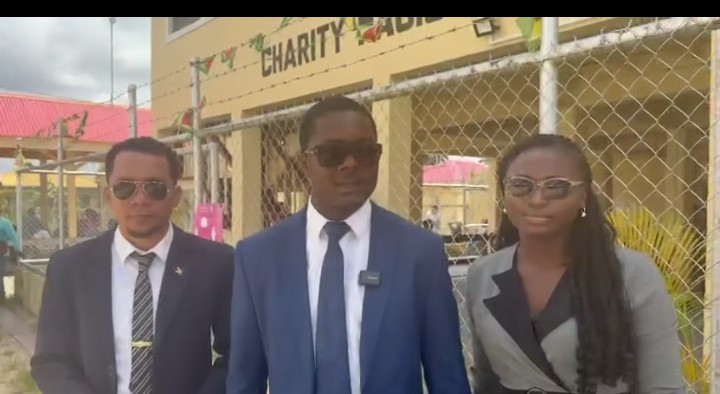
The three accused—two crew members and a Transport and Harbours Department employee—remained in custody after the matter was adjourned to September 7, by which time prosecutors are expected to provide the defence with full disclosure of the evidence they intend to rely upon at trial.
Speaking on behalf of a defence team comprising more than 15 attorneys-at-law, Attorney-at-Law Eden Corbin said the prosecution had complied with the court’s earlier direction by providing part of its case file.
“As requested on the last occasion, we received partial disclosure today, containing certain statements and evidence that the police intend to rely upon to support these charges,” Corbin told reporters outside the courthouse.
He said the defence now expects to receive the remaining evidence before the next hearing.
“The matter has been adjourned to September 7, when we are expecting full disclosure—that is, all of the evidence the police intend to rely upon in prosecuting these charges,” he explained.
Corbin also commended the prosecution for honouring its undertaking to begin the disclosure process.
“So far, we are pleased that the police kept their end of the arrangement by bringing the disclosure to court, and we hope they maintain that same momentum in providing the remaining material,” he said.
However, the veteran attorney declined to comment on the contents of the documents, noting that the legal team had only received them shortly before the hearing.
“It is far too early for us to comment on the disclosure. We have only just received it and need adequate time to carefully examine the material. Once that review is completed, we will be in a position to address the media and the public.”
Despite being represented by a defence team of more than 15 attorneys-at-law, no application for bail or constitutional relief was made on behalf of Granderson, Price or Roberts during Monday’s proceedings. The defence offered no explanation for its decision.
The absence of such an application has drawn attention because Guyana’s courts have, in appropriate circumstances, entertained constitutional challenges and granted relief in serious criminal matters, including murder cases. With the three men having remained behind bars since July 19 and now expected to remain incarcerated until at least September 7, when the matter resumes, questions are being raised as to why the defence has not sought to invoke legal precedents that have previously been relied upon to protect the constitutional rights of accused persons.
Granderson, Price and Roberts were jointly charged with murder following the July 18 sinking of the MV Barima, one of Guyana’s worst maritime disasters. They were not required to plead to the indictable charges when they first appeared before the court and remain on remand pending the continuation of the proceedings.
High Court Previously Protected Constitutional Rights in Serious Criminal Cases
The continued detention of the three accused has also drawn attention to established constitutional jurisprudence affirming the High Court’s authority to intervene where the constitutional rights of accused persons are alleged to have been infringed.
One of the leading authorities arose in 2012, when Senior Counsel Rex McKay successfully brought constitutional proceedings on behalf of former Commissioner of Police Henry Greene. The High Court affirmed that decisions of the Director of Public Prosecutions are subject to judicial review where constitutional rights are alleged to have been violated, reinforcing the principle that prosecutorial discretion is not beyond constitutional scrutiny.
Another significant precedent came in 2010 in the Dudson case, where the High Court granted constitutional relief to a murder accused after finding that prolonged delays in the criminal process violated his constitutional right to a hearing within a reasonable time. The ruling reinforced the principle that constitutional protections extend to every accused person, regardless of the seriousness of the offence.
Together, the Greene and Dudson decisions remain important authorities affirming the High Court’s constitutional role in ensuring that criminal prosecutions are conducted in accordance with the Constitution and that the fundamental rights of accused persons are protected.
Against that legal backdrop, the fact that no attempt has yet been made to invoke those established constitutional principles on behalf of Granderson, Price and Roberts is likely to attract continued public and legal scrutiny as the men remain incarcerated for nearly seven weeks—from July 19 to September 7—before their matter returns to court.






![The captain of a fishing boat sails off the coast while participating in the search for victims of a shipwreck in Guiria, Venezuela, on December 18 [File: Yuri Cortez/AFP]](https://villagevoicenews.com/wp-content/uploads/2020/12/fishing-boat.png)
