Thursday, October 29, 2026
Village Voice News
ADVERTISEMENT
  • Home
  • News
  • Sports
  • Editorial
  • Letters
  • Global
  • Columns
    • Eye On Guyana
    • Hindsight
    • Lincoln Lewis Speaks
    • Future Notes
    • Blackout
    • From The Desk of Roysdale Forde SC
    • Diplomatic Speak
    • Mark’s Take
    • In the village
    • Mind Your Business
    • Bad & Bold
    • The Voice of Labour
    • The Herbal Section
    • Politics 101 with Dr. David Hinds
    • Talking Dollars & Making Sense
    • Book Review 
  • Education & Technology
  • E-Paper
  • Contact Us
No Result
View All Result
Village Voice News
No Result
View All Result
Home News

IMF Report Shows Guyana’s Spectacular Growth—But Warnings Lurk Beneath the Praise

Staff Writer by Staff Writer
August 2, 2026
in News
0
SHARES
0
VIEWS
Share on FacebookShare on Twitter

By Our Business Correspondent

The International Monetary Fund has heaped praise on Guyana’s economic management, commending the government for “sustained prudent fiscal policies” and a borrowing strategy that keeps the country at the lowest possible risk of debt distress . With real GDP growth exceeding 19 percent in 2025 and oil production surpassing 900,000 barrels per day, the numbers are indeed spectacular .

READ ALSO

Guyana Abstains as United Nations Votes to Lift Cuba Embargo

AFC at 21: Resilience, Reflective and Responsive

But beneath the diplomatic language of the Fund’s 2026 Article IV Concluding Statement lies a more complicated picture—one of unresolved audits, institutional gaps, and warnings that the government’s celebratory reading may obscure .

The government has pointed to the IMF’s finding that Guyana “does not yet show clear symptoms of Dutch disease” as proof that the resource curse has been avoided. Yet the IMF’s own report makes clear that “the risk of this is high and there has to be careful monitoring” .

The Fund explicitly noted that “strong wage growth and wage-based real exchange rate indicators warrant close monitoring” —precisely the early pressure points that precede the loss of competitiveness in non-oil sectors.

While the IMF celebrates the non-oil economy’s 14 percent expansion, the report quietly reveals a deeper vulnerability; the non-oil primary deficit was equivalent to one-third of non-oil GDP . This means the government’s spending on the non-oil economy far exceeds its non-oil revenue; a structure that would look considerably less comfortable if petroleum revenues were to decline.

Construction remains the largest driver of non-oil growth , raising the question of whether the expansion is sustainable when the public investment cycle slows. The IMF repeatedly stresses the need for “productivity-enhancing” expenditure—diplomatic language for saying the money must produce durable economic capacity .

The IMF acknowledges the government’s efforts to resolve outstanding cost-oil audits, including through arbitration . But this acknowledgment is itself a warning; five years after auditors identified disputed expenses in ExxonMobil’s costs, the matter remains unresolved.

Bloomberg, in a recent analysis, warned that the “oil curse is hanging over” Guyana, noting that the country “falls short on structuring tax and contract terms to capture the full value of its resources” . The publication highlighted that Guyana’s 2016 Production Sharing Agreement with ExxonMobil charges just 2 percent royalty, compared with 6.25 percent in neighbouring Suriname .

The IMF calls for regular labour-force surveys and a new household budget survey . Since 2020, comprehensive labour-force reports have been virtually absent from the Bureau of Statistics website . The question raised by the Fund’s own recommendations is stark: how can a country determine whether its extraordinary growth is improving living standards and reducing inequality if its statistical systems lag behind its economic transformation?

The IMF’s central message is more nuanced than the government’s celebratory reading may suggest. Yes, debt distress is low, the banking system is well capitalised, and the outlook is favourable. But underneath those achievements lie questions about dependence on oil, the sustainability of public spending, foreign-exchange pressures, and the capacity of the state to manage unprecedented petroleum wealth .

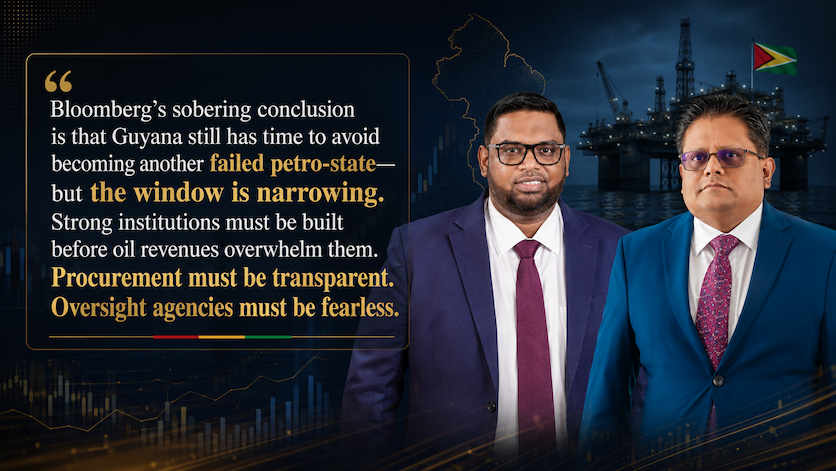
Bloomberg’s sobering conclusion is that Guyana still has time to avoid becoming another failed petro-state—but the window is narrowing . Strong institutions must be built before oil revenues overwhelm them. Procurement must be transparent. Oversight agencies must be fearless. History has already written the story of countries that ignored such warnings.
ShareTweetSendShareSend

Related Posts

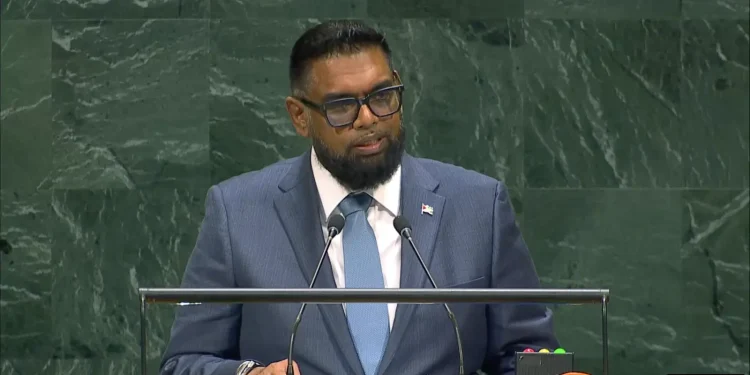
President Dr Irfaan Ali addressing the 81st Session of the United Nations General Assembly, September 24, 2026 (screengrab photo)
News

Guyana Abstains as United Nations Votes to Lift Cuba Embargo

by Admin
October 29, 2026

Guyana, under the Irfaan Ali administration, has abstained from a United Nations (UN) General Assembly resolution calling for an end...

Read moreDetails
News

AFC at 21: Resilience, Reflective and Responsive

by Admin
October 29, 2026

Today, as the Alliance For Change (AFC) marks its 21st anniversary, we reflect on a journey of triumphs and disappointments,...

Read moreDetails
Photo caption: From left, Dr. Kofi Dalrymple and Mahaicony/Abary NDC Vice Chairman Mr. Leon Wordsworth, with the graduates and lecturer Ms. Chandradai Devina Persaud, Regional Chairman Mr. Recardo Phillips, Regional Executive Officer Ms. Mary Samaroo, Mr. Hansen Elliot, Principal of the Kuru Kuru Cooperative College and Mr. Matthews representative of Kuru Kuru College
News

Fourteen graduate as Kuru Kuru Cooperative College marks first graduation in Region Five

by Admin
October 29, 2026

Fourteen students from the Mahaicony/Abary Neighbourhood Democratic Council area graduated from the Kuru Kuru Cooperative College’s Introduction to Computers programme...

Read moreDetails
Next Post

OP-ED: Have African Guyanese Surrendered to Oppression?


EDITOR'S PICK

Melissa Atwell "Melly Mell"

Melly Mell files transnational repression complaint with FBI, responds to cybercrime charges

July 18, 2023

CDC Establishes Shelter and Coordinates Relief for Families Displaced by Albouystown Fire

September 14, 2025

Public Education | APNU +AFC ministers account for their stewardship

August 14, 2021

Voting and elections: Start from scratch

September 3, 2022

© 2024 Village Voice

No Result
View All Result
  • Home
  • News
  • Sports
  • Editorial
  • Letters
  • Global
  • Columns
    • Eye On Guyana
    • Hindsight
    • Lincoln Lewis Speaks
    • Future Notes
    • Blackout
    • From The Desk of Roysdale Forde SC
    • Diplomatic Speak
    • Mark’s Take
    • In the village
    • Mind Your Business
    • Bad & Bold
    • The Voice of Labour
    • The Herbal Section
    • Politics 101 with Dr. David Hinds
    • Talking Dollars & Making Sense
    • Book Review 
  • Education & Technology
  • E-Paper
  • Contact Us

© 2024 Village Voice