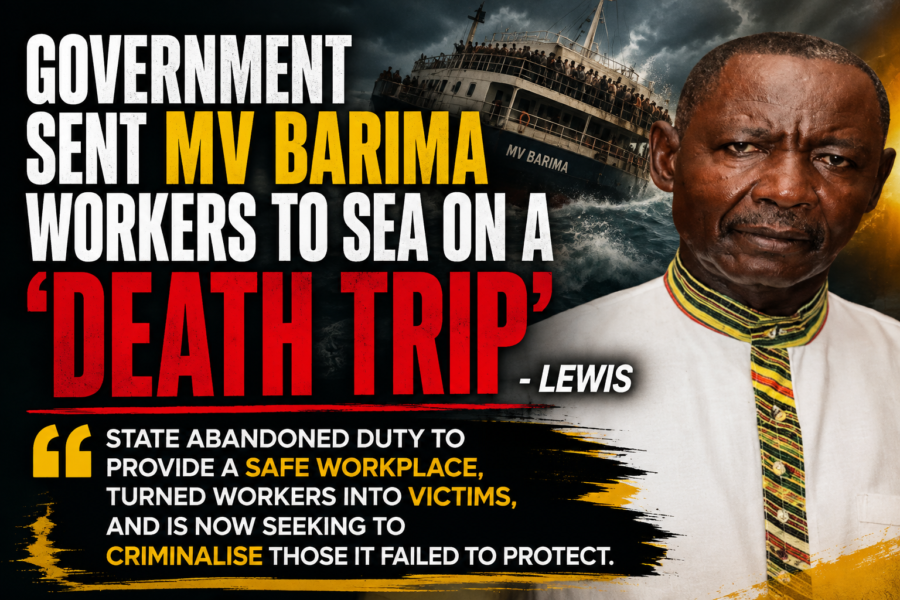
In a hard-hitting column published on July 26, 2026, titled “Every MV Barima Voyage Was a Death Trip: The Workers Were Victims Too,” Guyana Trades Union congress (GTUC) General Secretary Lincoln Lewis contends that the crew should be recognised not as the architects of the tragedy, but as workers forced to labour under conditions that no responsible employer should ever have permitted.
“Every voyage of the MV Barima was a gamble with life. Every departure from port was, in truth, a death trip waiting to happen,” Lewis wrote.
His comments come amid growing public outrage over the sinking of the state-owned ferry, which capsized while sailing from Georgetown to Port Kaituma. The Government initially reported that 116 passengers and 17 crew members—133 people in total—were aboard the vessel, but later revised that figure to 179. Even that number has been disputed, with some survivors, relatives and other observers believing the actual number of persons on board may have been higher. The uncertainty has been compounded by the Government’s decision not to raise the vessel from the seabed, a move critics argue could help establish the true number of passengers and crew aboard at the time of the disaster.
The tragedy claimed 53 lives, while 76 survivors have been officially verified. Dozens of bodies lying on the seabed after the Government decided against recovering the vessel despite mounting calls from grieving families, maritime stakeholders and Opposition Leader Azruddin Mohamed, who has publicly offered to raise the ferry at no cost to the State.
Lewis argues that the disaster did not begin on the night the vessel sank. It began years earlier when workers were repeatedly required to operate a vessel that, in his view, had already become a workplace death trap.
“The workers were operating a death trap. Like the passengers, their lives were placed at risk every time the vessel sailed. They had no special protection. No privileged escape. The only reason some survived is because they possessed one skill that many passengers did not—they could swim.”
Lewis described the sinking not simply as a maritime disaster but as a catastrophic failure of occupational health and safety.
According to him, the crew reported for duty each day knowing they were working in dangerous conditions, yet continued because their livelihoods depended on it.
“The workers were victims every bit as much as the passengers. They were compelled to earn a living under conditions that no responsible employer should ever have tolerated. They worked within a system that exposed them daily to unacceptable danger while asking them to carry out duties that increasingly compromised both their own safety and that of the travelling public.”
He argued that both workers and passengers ultimately became casualties of “an uncaring, careless and selfish regime.”
Lewis also alleged that safety measures once designed to protect both workers and passengers were dismantled after the change of Government in 2020.
He cited statements by former Minister of Public Infrastructure David Patterson, who recently said inspectors were assigned under the A Partnership for National Unity and Alliance for Change (APNU+AFC) administration to verify loading specifications and safety compliance before vessels departed. Patterson said those safeguards were removed after the People’s Progressive Party/Civic (PPP/C) returned to office.
Lewis further claimed workers have spoken of being instructed by higher authorities to continue loading vessels regardless of capacity.
“In today’s Guyana, where fear stalks the workplace and thousands struggle simply to provide for their families, refusing such instructions is easier said than done.”
“Many complied, not because they believed it was safe, but because they feared losing the jobs that fed their families. They complied under duress. In doing so, they placed their own lives at risk.”
Lewis said attention has now shifted from examining systemic failures to blaming workers.
He dismissed allegations that marijuana use by crew members contributed to the sinking, describing the narrative as an attempt to divert attention from the decisions that preceded the tragedy.
“That narrative is nothing more than a red herring.”
“The MV Barima did not capsize because workers were under the influence of marijuana. The vessel capsized under the crushing burden placed upon it. It collapsed beneath excessive weight, forced upon it by decisions made from above. It succumbed under the final instruction from higher authorities to continue loading cargo onto a vessel that should never have been operating under those conditions.”
Lewis noted that Prime Minister Brigadier (Ret’d) Mark Phillips has acknowledged that Government cargo was aboard the vessel and that there was a breakdown in the routine inspection process before it sailed.
“Those admissions should focus the national conversation where it belongs—not on scapegoating desperate workers, but on examining the decisions, policies and failures that created the conditions for this disaster.”
Lewis said the issue extends well beyond the MV Barima. He warned that prosecuting workers while failing to investigate those responsible for the system that placed them in danger sends a chilling message to employees throughout Guyana—that when public institutions fail, those with the least authority are the first to bear the blame.
“The dead deserve justice. The survivors deserve answers. The workers deserve protection—not persecution. They were not the architects of this tragedy. They were among its victims.”
Concluding his column, Lewis argued that Guyana cannot honour those who perished unless it confronts the systemic failures that led to the disaster.
“History must record this tragedy honestly. The MV Barima did not fail because ordinary workers failed. It failed because a system entrusted with protecting both workers and passengers abandoned its most fundamental duty: safeguarding human life. Only by acknowledging that uncomfortable truth can Guyana ensure that no worker is ever again forced to earn a living aboard a vessel that has already become a coffin waiting to close.”