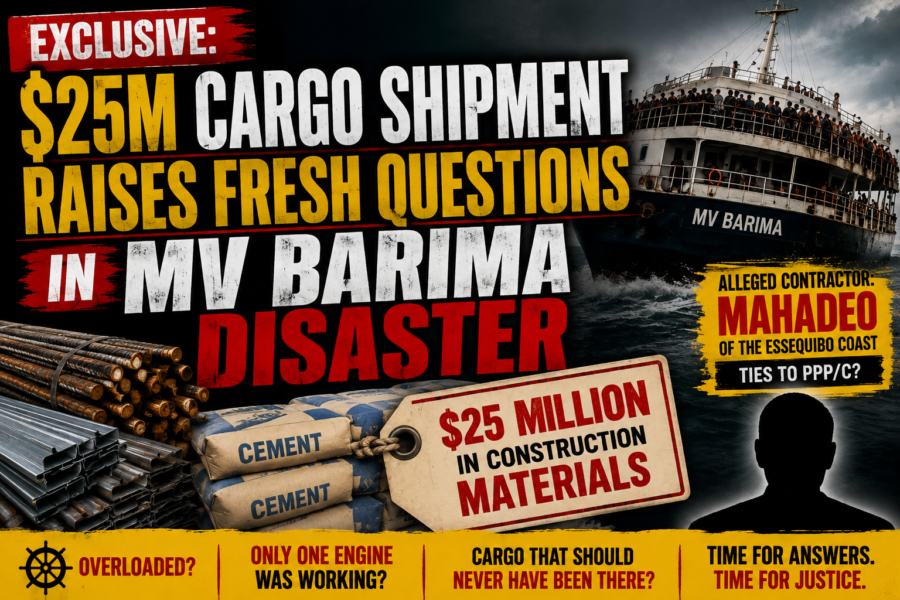
Village Voice News has received information pointing to what could become a critical new line of inquiry into the MV Barima disaster—a shipment of approximately $25 million in construction materials, allegedly destined for government projects in Region One, that sources say was loaded onto the ill-fated passenger ferry before its final voyage.
The information, which Village Voice News is continuing to independently verify, alleges the cargo belonged to Mahadeo, a contractor from the Essequibo Coast, who sources describe as an overnight contractor with close ties to the governing People’s Progressive Party/Civic (PPP/C).
If confirmed, the revelation is likely to intensify questions over whether commercial cargo was allowed to take precedence over passenger safety aboard the state-owned vessel.
Maritime sources told Village Voice News that cargo of that magnitude should ordinarily have been pre-booked and transported on a dedicated cargo vessel or private charter, rather than being loaded onto a passenger ferry carrying scores of civilians to the North West District.
The alleged shipment is also raising fresh questions about the vessel’s loading and stability.
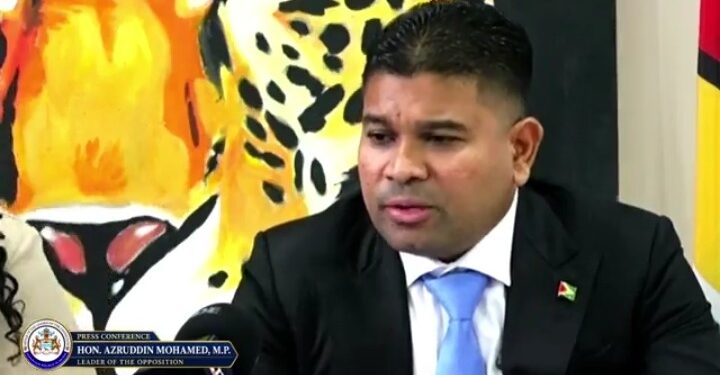
During a recent public meeting last Saturday in Port Kaituma, one resident, addressing Opposition Leader Azruddin Mohamed, claimed that Captain Kevin Price had expressed concerns before the vessel departed because of its heavy load and technical problems
According to the resident, the captain indicated that only one of the vessel’s engines was operational when it left Georgetown and that the ferry was heavily loaded.
On July 28, 2026, following his arraignment on 72 counts of murder, Captain Kevin Price told reporters outside the Georgetown Magistrates’ Court that the 87-year-old MV Barima was unfit for service. He alleged the vessel lacked operational radar, an EPIRB, a search-and-rescue transponder and a functioning anchor, while its life rafts had expired since 2022. Price said the ferry “had a lot of issues,” claiming the deficiencies endangered both the crew and passengers.
Government officials have already acknowledged that the MV Barima was carrying cargo and have admitted that failures occurred within the vessel inspection and oversight system before it sailed.
The 87-year-old MV Barima capsized on July 18 while sailing from Georgetown to Port Kaituma.
The Government initially reported that 116 passengers and 17 crew members were aboard the vessel. Days later, that figure was revised to 179. Survivors, relatives and other observers have continued to dispute even that revised number, maintaining that the actual number of people aboard may have been higher.
Government figures indicate 76 people survived, 53 bodies have been recovered, and one survivor has since died. Several people remain unaccounted for, making the tragedy one of the worst maritime disasters in Guyana’s history.
Despite repeated calls from victims’ families, maritime professionals, civil society organisations and the parliamentary opposition, the Government has maintained that the MV Barima will remain on the seabed.
Opposition Leader Azruddin Mohamed has publicly committed to financing and coordinating the recovery of the vessel if the Government grants the necessary permission, saying the operation is essential to uncovering the truth behind the disaster.
Families and maritime experts have argued that recovering the vessel is critical not only to establish the full circumstances surrounding the sinking but also to preserve vital physical evidence, including the cargo, loading arrangements, machinery and other technical evidence that could help investigators determine what caused the disaster.
Raising the vessel could also facilitate the recovery of any victims who may still be trapped inside, allowing their remains to be returned to grieving families and providing a measure of closure after the national tragedy.
The decision has also intensified demands for the preservation and public disclosure of all documentary evidence, particularly the July 18 passenger and cargo manifest, loading records, inspection reports, maintenance logs and communications made before the ferry departed Georgetown. Those records could prove crucial in establishing exactly who boarded the vessel, what cargo was loaded, whether the ferry exceeded safe operating limits, and whether loading practices contributed to the sinking.
The Government has since established a partisan Commission of Inquiry into the disaster and charged Captain Kevin Price, Chief Mate Rondell Dwayne Roberts, and Goods Superintendent Delon Granderson with 72 counts of murder.
However, the Government has yet to indicate whether it will also conduct a formal maritime casualty investigation—the internationally recognised technical inquiry designed to determine the causes of a marine accident through a scientific examination of evidence, including vessel stability, cargo distribution, machinery failures, weather conditions, human factors and regulatory compliance.
This is a developing story.