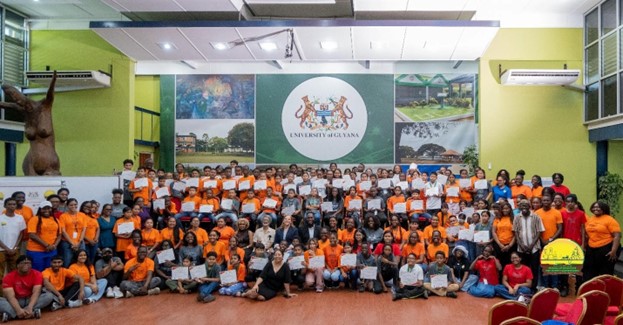
The University of Guyana’s Regional Accelerator for STEM Students Readiness (RASSR) Programme concluded its two-week camp for its second and newest cohort of students with a celebration of innovation and creativity on Sunday, July 19, 2026, at the University’s George Walcott Lecture Theatre (GWLT), Turkeyen Campus. The event showcased solutions developed by approximately 100 of Guyana’s top students following two weeks of intensive learning and mentorship.
The closing ceremony marked the culmination of the two-week programme, which began on July 6th 2026 and was designed to identify, mentor and accelerate the development of young people with strong potential in Science, Technology, Engineering and Mathematics (STEM).
The event brought together students, parents, teachers, mentors, volunteers, university officials, representatives from industry partners and other stakeholders to celebrate the achievements of the young STEM participants.
The ceremony followed the Grand Challenge and Exhibition, where students presented projects highlighting their understanding of science, technology, engineering and mathematics (STEM) concepts and their ability to apply knowledge to real-world challenges.
The RASSR Programme, launched in 2022, is an initiative of the University of Guyana in partnership with the Greater Guyana Initiative (GGI) which comprises ExxonMobil Guyana, CNOOC Petroleum Guyana Limited and Hess Corporation.
The programme was designed to identify, mentor and support students with strong potential in STEM fields while preparing them for future academic and career opportunities.
Throughout the camp, students engaged in activities focused on Mathematics, Chemistry, Biology, Physics, Integrated Science, Technology, Engineering, biodiversity and environmental stewardship. The curriculum aligns with Caribbean Examinations Council (CXC) standards while also developing critical thinking, teamwork, leadership and problem-solving skills through interactive learning.
During the closing ceremony, University of Guyana Vice-Chancellor Professor Paloma Mohamed Martin reminded students that their participation in the RASSR Programme represented an important step in their personal and academic development, while encouraging them to recognise their own abilities.
Reflecting on the achievements of the students and the work of those who supported the programme, Professor Mohamed Martin told participants that their success demonstrated the importance of recognising talent and providing opportunities for young people to grow. “When we see the results, and we see what we saw yesterday, it tells us that we have geniuses among us,” she said.
He Vice-Chancellor encouraged the students to have confidence in themselves and their ability to shape their futures. She also reminded them of the responsibility they have in making decisions that support their growth and future success.
Professor Mohamed Martin also recognised the extensive support network behind RASSR, thanking the staff, volunteers, lecturers, medical personnel, security teams, cleaning staff and partners who contributed to the successful execution of the programme.
Meanwhile, ExxonMobil’s Socioeconomic Manager and representative of the Greater Guyana Initiative (GGI), Ms Susan Scott, congratulated students on completing the programme and highlighted the importance of investing in young people.
Ms. Scott said the students’ experience represented more than academic development, noting that the programme also helped them build confidence, resilience and important life skills. “Over the past two weeks, you’ve demonstrated enthusiasm, curiosity, creativity, I understand a bit of precociousness, and a willingness to change yourselves,” Scott said. “These qualities are just as important as academic achievement. And they will continue to serve you well throughout your educational journeys and beyond,” she added.
Ms. Scott explained that GGI’s support reflects a commitment to providing young people with opportunities to discover their talents and strengthen their abilities. She told the students that their learning extended beyond the classroom, as they developed the ability to think critically, communicate effectively and work collaboratively. “STEM focuses on the science, technology, engineering, and mathematics. But it’s also about developing the mindset to ask questions, seek solutions, embrace innovation, and never, ever stop learning,” she said.
She encouraged students to maintain the relationships formed during the programme and continue exploring new ideas.
Meanwhile, the Grand Challenge and Exhibition was one of the highlights of the programme, allowing students to apply knowledge gained during the camp to create innovative concepts based on future challenges.
The students were divided into 10 groups, each challenged to develop innovative solutions centred on themes such as renewable energy, sustainable communities, environmental protection and the future relationship between humans and technology. Group 5, Kool Kidz, claimed first place with “Hydro Pulse,” a project that envisioned a future city powered by renewable energy through the sustainable use of water resources. Group 2, The Champions, secured second place with “Futuristic Farms in 2080,” which explored how innovation and technology could transform agriculture to meet future food demands. Group 1, Cypher the Decypherers, placed third with “STEM Save the World,” examining the effects of pollution on human health and aquatic ecosystems while proposing renewable energy solutions to create cleaner, healthier communities.
Other groups also impressed the judges with creative ideas and forward-thinking solutions. Group 3, RASSR Warriors, presented “A Smart Sustainable City,” envisioning an environmentally conscious community where renewable energy, technology and sustainable infrastructure improve quality of life. Group 9, Future Champions, showcased “Champion Factory,” while Group 7, STEM Stars, explored sustainable agriculture through “Smart Farm.” Group 8, Shining Stars, imagined “World in 2080,” and Group 10, Star Wars, concluded with “Future Harmony Model,” highlighting how humans and technology could work together to build a more connected and innovative society.
The Grand Challenge evaluation was judged by Dr Patrick Ketwaru, with Ms Crystal Jaundoo and Ms Iyanna Butts also serving as judges.
The ceremony concluded with a vote of thanks delivered by one of the campers, who expressed appreciation to the University, partners, mentors, volunteers, parents and supporters who contributed to the RASSR experience.
With the completion of the first 2026 cohort, students now leave the programme with practical STEM experiences, new friendships and a greater understanding of the opportunities available in science, technology, engineering and mathematics.