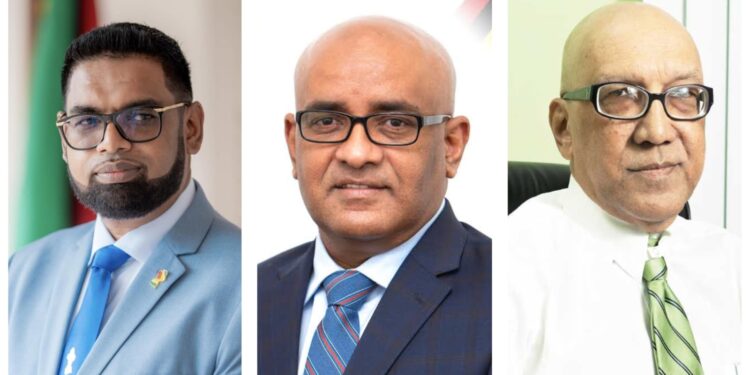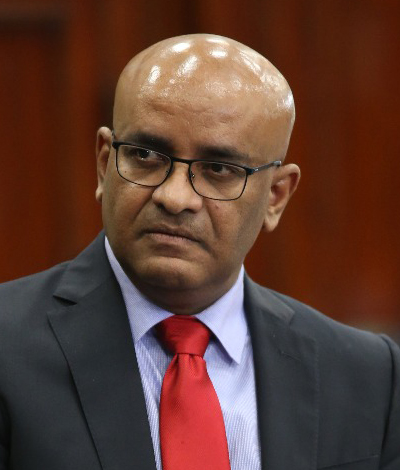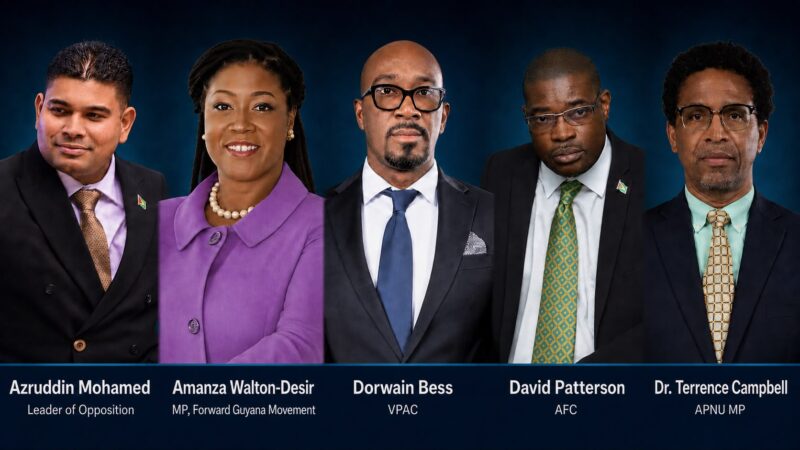
For the first time since the September 2025 General and Regional Elections, Guyana’s opposition—both inside and outside Parliament—has united behind a single national cause, mounting a coordinated challenge to the Government’s handling of the MV Barima disaster and warning that President Irfaan Ali’s newly announced Commission of Inquiry (COI) must not become a substitute for parliamentary accountability or an independent international marine safety investigation.
President Ali announced the Commission on Saturday afternoon, stating that its composition, terms of reference and other operational details would be made public today.
In a joint statement issued on Saturday, July 25, the We Invest in Nationhood (WIN), A Partnership for National Unity (APNU), Forward Guyana Movement (FGM), Alliance For Change (AFC) and the Vigilant Political Action Committee (VPAC) welcomed the establishment of a Commission of Inquiry but questioned both the manner in which it was constituted and the timing of its announcement.
The rare show of Opposition unity marks the first coordinated political response by the five opposition grouping since the 2025 elections, underscoring the national significance of what has become Guyana’s deadliest maritime disaster.
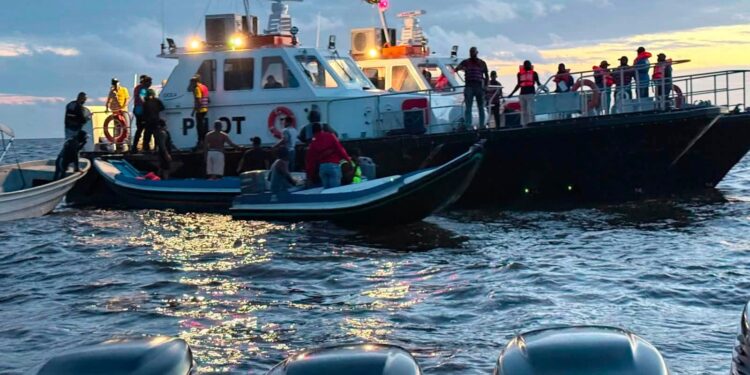
The MV Barima, an 87-year-old passenger ferry built in 1939 and widely regarded as being in urgent need of major repairs, capsized on July 18 after transmitting a distress signal near Iron Punt off the Pomeroon River while sailing from Georgetown to Port Kaituma. The disaster claimed more than 100 lives, devastating families across Guyana and exposing serious questions about the vessel’s seaworthiness, inspection regime, regulatory oversight, emergency preparedness, and the Government’s continued reliance on an ageing ferry fleet.
“The victims deserve justice, their loved ones deserve answers, and Guyana deserves a thorough, transparent, credible, and independent examination of how this catastrophe occurred,” the Joint Opposition declared.
The parties, however, argued that the Government missed an opportunity to build national confidence by failing to consult either the parliamentary opposition or other key stakeholders before appointing the Commission.
More significantly, they pointed to the sequence of events leading to the President’s announcement.
President Irfaan Ali announced the Commission of Inquiry only after the Joint Opposition had publicly unveiled its parliamentary strategy on July 22 and one day after formally submitting three motions to Speaker Manzoor Nadir on July 24. Those motions seek an urgent parliamentary debate on the tragedy, a no-confidence motion against Public Works Minister Juan Edghill and Minister Deodat Indar, who has responsibility for the Maritime Administration Department (MARAD), and an independent international marine safety investigation. The National Assembly is scheduled to meet on Monday, July 27.
The timing prompted the Opposition to question whether the Commission’s announcement was intended to pre-empt parliamentary scrutiny.
While stopping short of making that allegation directly, the parties insisted that a Commission of Inquiry cannot replace Parliament’s constitutional duty to hold the Executive accountable or diminish ministers’ responsibility to answer before elected representatives.
The coalition also argued that the Government cannot satisfy its international obligations through a Commission of Inquiry alone.
As a member of the International Maritime Organisation (IMO) and a signatory to the International Convention for the Safety of Life at Sea (SOLAS), Guyana is required to conduct a technical marine casualty investigation into very serious maritime disasters.
The Opposition noted that the Marine Casualty Investigation is fundamentally different from a Commission of Inquiry.
A COI examines issues of governance, public administration and accountability. A marine safety investigation, by contrast, assembles specialists—including marine engineers, naval architects, accident investigators, vessel stability experts, master mariners, emergency response professionals and human factors experts—to determine scientifically how and why a vessel was lost and to recommend internationally recognised safety reforms aimed at preventing future tragedies.
Without such an investigation, the coalition warned, Guyana risks never fully understanding the technical failures that caused the disaster.
The parties also argued that the Commission’s mandate must extend beyond the vessel’s final voyage to examine ministerial oversight, regulatory enforcement, administrative decision-making, emergency preparedness, allocation of public resources and any systemic failures within Government that may have contributed to the sinking.
“No office or public official should be beyond scrutiny where the evidence warrants examination,” the statement said.
The Joint Opposition further expressed concern over the appointment of the Commission’s Secretary, warning that public confidence depends not only on the independence of the commissioners but also on an administrative process free from actual or perceived conflicts of interest.
It also called for transparent procedures that encourage public participation, allow unrestricted witness testimony and ensure all relevant documents are produced before the Commission.
The coalition renewed its demand that Juan Edghill and Deodat Indar resign or, at minimum, proceed on leave pending the outcome of the investigations.
According to the parties, allowing ministers whose portfolios may become the subject of inquiry to remain in office risks undermining public confidence in both the independence and credibility of the investigative process.
The statement transforms the MV Barima disaster from a maritime tragedy into what is now shaping up to be a defining constitutional and political test. With Parliament convening on Monday, the Government is poised to face its first coordinated challenge from a united Opposition since the 2025 elections—one demanding not only answers for the loss of more than 100 lives, but accountability at every level of the State.