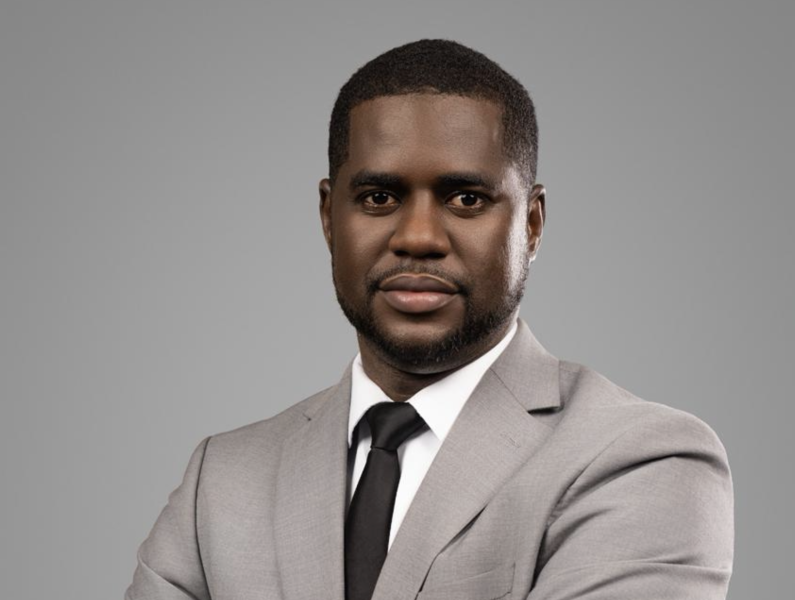
Attorney-at-law Darren Wade has declared that President Irfaan Ali—not Public Works Minister Juan Edghill—bears the ultimate constitutional responsibility for the MV Barima catastrophe, accusing the Government of presiding over a system that has repeatedly failed to prevent avoidable national tragedies.
In a strongly worded statement issued as Guyana continues to mourn the victims of the country’s deadliest maritime disaster in decades, Wade said attempts to focus public attention on the ferry’s captain or crew miss the central issue: why an ageing state-owned vessel remained in operation despite longstanding concerns about its condition.
The MV Barima capsized late on Saturday, July 18, while travelling from Georgetown to Port Kaituma, sinking approximately 10 nautical miles off the Essequibo Coast. The vessel’s official manifest listed 116 passengers and 17 crew members, for a total of 133 people. However, authorities later acknowledged the manifest was inaccurate, with officials estimating that as many as 179 people were actually aboard after dozens of survivors were found not to have been listed. As of Wednesday, 57 bodies had been recovered and 77 people rescued, leaving dozens still unaccounted for as recovery efforts continued.
Against that backdrop, Wade argued that constitutional responsibility cannot be shifted.
“Is Juan Edghill the Head of State or the Head of Government? He is neither,” he wrote.
“In our constitutional system, the ultimate responsibility for the actions and omissions of the Executive rests with the President, who is both the Head of State and Head of Government, together with the Cabinet.”
While acknowledging that Edghill, as Minister of Public Works, shares responsibility for the transport sector, Wade maintained that executive accountability ultimately rests with the President.
He also dismissed what he described as efforts to redirect public attention toward reports that the ferry’s captain and a crew member allegedly tested positive for narcotics.
“Let us not be distracted by reports that the Captain and a crewman tested positive for narcotics. The MV Barima sank because of a systemic failure.”
According to Wade, the real question is why the Government continued operating an ageing ferry that had reportedly experienced previous safety concerns.
“That ferry had no business remaining in service,” he said. “The Barima is a national ferry, and the responsibility and accountability for its condition ultimately rest with the Government. Full stop.”
The attorney argued that the tragedy exposes a wider failure of governance, questioning why one of the world’s fastest-growing economies continues to rely on transport infrastructure dating back to the colonial era.
“Why are we still relying on a ferry system that traces its origins back to the colonial era, slavery and indentureship?” he asked.
“Why, in 2026, are Guyanese still forced to use ageing ferries and outdated infrastructure when our country is experiencing unprecedented economic growth?”
He said Guyana’s oil wealth should have been used to build modern ferry terminals, replace obsolete vessels with purpose-built ferries meeting international safety standards, and strengthen emergency response capabilities.
Instead, Wade said, the country continues to invest in vessels that many Guyanese have little confidence in.
He argued that the MV Barima disaster is not an isolated incident but part of a disturbing pattern in which major tragedies are followed by public outrage but little lasting accountability.
Among the incidents he cited were the Mahdia Secondary School dormitory fire, which claimed the lives of 20 children in 2023; the deaths of children at Bachelor’s Adventure; fatal fires at children’s homes; repeated mining pit collapses; and the continuing loss of life involving heavy-duty trucks on Guyana’s roads.
“These heartbreaking events should not simply become part of our national memory before we move on to the next tragedy,” Wade said.
He also renewed criticism of the Government’s settlement with families affected by the Mahdia fire, describing the compensation process, facilitated through the Guyana Bar Association, as “one of the most unconscionable settlement processes in our nation’s recent history.”
While placing primary responsibility on the Government, Wade said the parliamentary Opposition also has a constitutional duty to expose failures and press for reform. He challenged opposition parties to identify what concrete steps they have taken over the past six years to address deficiencies in the transport sector.
“The Opposition cannot be entirely absolved simply because it is not in government,” he wrote.
Wade concluded by acknowledging what he described as his own share of responsibility, saying that, like many Guyanese, he had accepted a political culture in which preventable failures become normalised rather than challenged.
“If we fail to insist on accountability, transparency and meaningful reform after every major incident, we should not be surprised when history repeats itself,” he said.
“Our focus must remain on saving lives, supporting the affected families, demanding accountability, and ensuring that tragedies like these never happen again.”