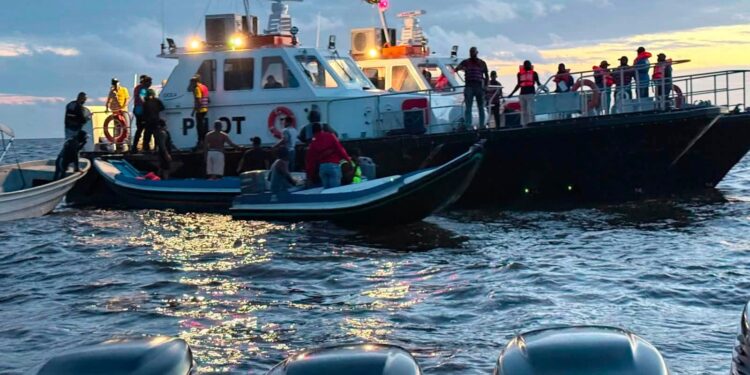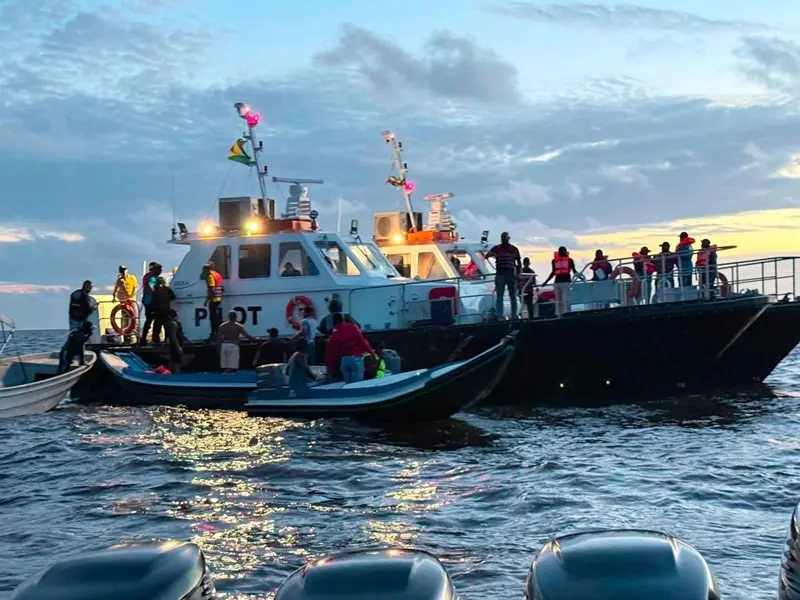
The human toll from the MV Barima disaster continues to mount, with the government reporting that 40 bodies have now been recovered from the sunken ferry as the search and recovery operation enters another grim phase.
Opposition Leader Azruddin Mohamed, who has mounted a parallel search effort using privately mobilized resources, said his team has recovered eight bodies, all of which were handed over to the Guyana Police Force at Charity, Essequibo, for official processing and identification.
The latest developments underscore the scale of what is now regarded as the worst maritime disaster in Guyana in decades.
The MV Barima, an 87-year-old ferry built in 1939, capsized late Saturday night while travelling from Georgetown to Port Kaituma. Initial official reports stated that 116 passengers and 17 crew members were aboard. However, authorities later acknowledged that the passenger manifest was fundamentally flawed after discovering that dozens of survivors were never listed, making it impossible to determine the exact number of people who were on the vessel. Investigators have since indicated that 179 people are now believed to have been aboard.
The discovery of the vessel on the seabed by a survey vessel operated by VEHSI, working alongside ExxonMobil Guyana and local fisherman Naresh Singh, shifted the operation from an urgent rescue mission to an increasingly difficult recovery effort.
As the death toll rises, so too does public outrage.
The government’s unfulfilled promises are now under intense scrutiny. In 2023, Public Works Minister Juan Edghill announced that a new ferry was on its way to replace the ageing MV Barima. Three years later, that promise remains unfulfilled. Instead, the 87-year-old vessel continued transporting passengers, vehicles and cargo along one of Guyana’s most challenging maritime routes until it sank beneath the Atlantic.
That broken promise has become a focal point of national anger.
As families continue to await news of missing loved ones, attention has increasingly shifted from the tragedy itself to the government’s handling of both the disaster and the years leading up to it. The political opposition, the Institute for Action Against Discrimination (IFAAD) and several civil society organisations have called for the resignation of Public Works Minister Juan Edghill, arguing that public confidence in the Ministry of Public Works’ stewardship of the country’s maritime sector has been irreparably damaged.
Adding to the controversy are questions surrounding the vessel’s condition before it sailed. Procurement documents revealed that another major rehabilitation project, estimated at approximately G$124.5 million, had already been planned for the MV Barima this year, following repairs reportedly undertaken in 2024. While Edghill insists no inspection declared the vessel unseaworthy, opposition parties, maritime observers and civil society groups argue that only the public release of the ferry’s maintenance records, inspection reports and seaworthiness certifications will determine whether the vessel should have remained in service.
Meanwhile, investigations continue into the circumstances surrounding the disaster. Authorities have confirmed that the captain and another crew member tested positive for marijuana, and investigators are examining the accuracy of the passenger manifest, cargo loading, safety procedures and possible operational failures.
With every body recovered from the Atlantic, pressure continues to mount on the government—not only to account for those who perished, but to answer the increasingly urgent question being asked across Guyana: Could this tragedy have been prevented?