In his July 5 Eye on Guyana column, “Workers Must Wake Up Before They Become Strangers in Their Own Country,“ published by Village Voice News, Lewis contends that the People’s Progressive Party/Civic (PPP/C) Government has failed to deliver on its promise that Guyanese workers would be the principal beneficiaries of the nation’s petroleum wealth.
“The wealth generated from Guyana’s oil must improve the lives of Guyanese workers first,” Lewis wrote. “Development cannot be measured solely by economic growth statistics or impressive infrastructure. It must also be measured by whether workers enjoy secure jobs, fair wages, safe workplaces and the protection of their rights.”
Guyana has become one of the world’s fastest-growing economies since first oil in December 2019, generating billions of US dollars in petroleum revenues and financing record national budgets. Yet Lewis argues that the prosperity celebrated in government reports has not translated into meaningful improvements for the country’s working class.
While salaries and the national minimum wage have increased in recent years, many workers say those gains have been eroded by rising prices for food, transportation, housing and other essentials. Independent studies have also continued to point to persistent poverty and inequality despite the country’s unprecedented economic growth.
Lewis said the widening gap between oil wealth and workers’ realities vindicates years of warnings from the Guyana Trades Union Congress (GTUC).
Before returning to office in 2020, he noted, the People’s Progressive Party/Civic (PPP/C) repeatedly promised to renegotiate what it called the lopsided ExxonMobil Production Sharing Agreement and ensure Guyanese would no longer be spectators in their own economy.
“Many workers believed those promises,” Lewis wrote.
Today, however, he posed what he called the defining question: “Have those promises been fulfilled?”
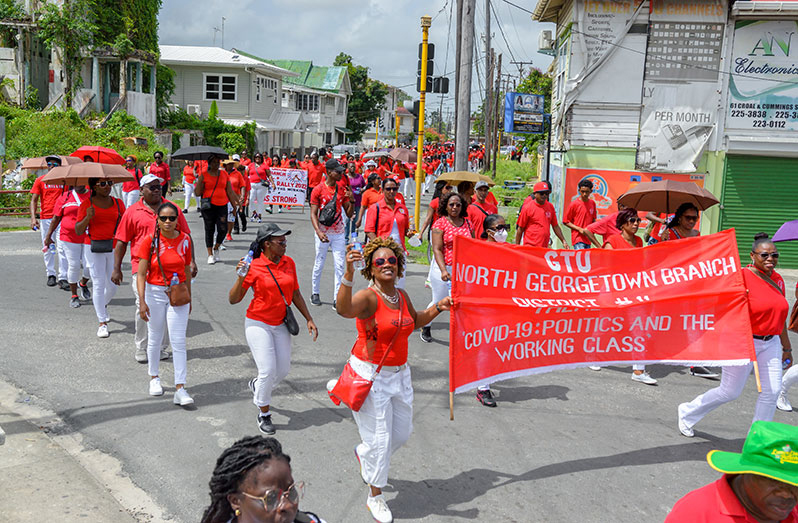
Lewis said the GTUC has consistently argued that local content must extend beyond contracts and procurement to include decent jobs, trade union representation, collective bargaining rights, skills development and meaningful participation by Guyanese workers in the country’s fastest-growing industries.
Instead, he argues, many Guyanese workers and businesses are being pushed to the margins.
“Across the country, we have witnessed Guyanese-owned businesses… disappear from the commercial landscape,” he wrote. “Along the East Coast Demerara corridor and in other communities, properties once occupied by local businesses are now rented to persons who have come here to do business.”
He said the same concerns extend to the oil and gas industry itself.
More than six years after first oil, workers in the petroleum sector still lack meaningful trade union representation despite being employed in one of the richest industries in Guyana’s history.
Lewis cited the unsuccessful efforts of the Guyana Bauxite and General Workers Union (GB&GWU) to secure recognition as the bargaining agent for oil and gas workers, arguing that employees continue to be denied an effective collective voice.
He also raised concerns about the growing reliance on foreign labour, warning that reports of workers operating without proper safety equipment raise serious questions about labour standards and enforcement.
“When employers can recruit workers prepared—or forced—to work under poorer conditions and for lower wages, it creates downward pressure on labour standards for everyone,” Lewis cautioned.
He stressed that the issue is not nationality but ensuring that every worker is protected by fair wages, safe workplaces and equal enforcement of the law.
Lewis also challenged the trade union movement to modernise its organising strategies, saying unions cannot confront a rapidly changing oil economy with approaches developed decades ago. At the same time, he urged workers to unite instead of dismissing labour’s warnings as anti-development.
“The time has come for workers to organise, to stand together and to insist that development serves the people whose labour built this country,” he declared.
Warning that Guyana is at a defining moment in its history, Lewis said workers cannot afford to remain spectators while others determine the future of an economy built on their country’s natural resources.
“If we fail to do so,” he cautioned, “we risk creating a Guyana where our people become strangers in their own economy—watching prosperity pass them by while others determine their future.”
He concluded with a reminder of labour’s enduring role: “Workers have always been the architects of progress. Now they must become the defenders of their own future.”