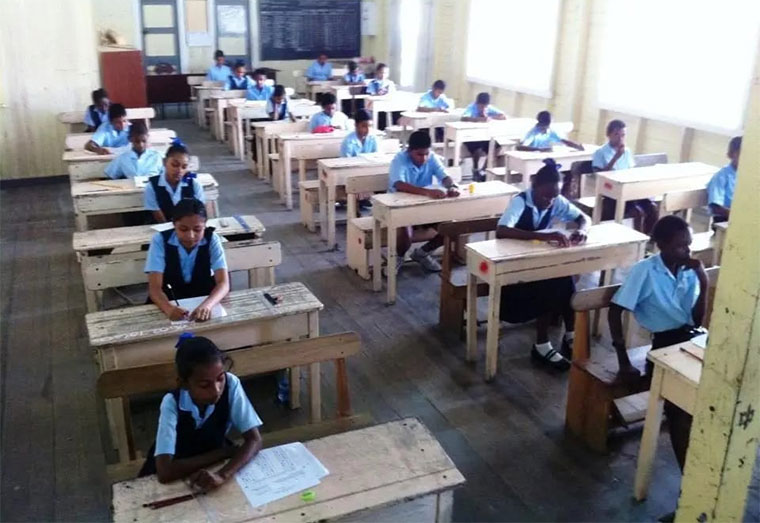
While the Government has celebrated the 20 students who shared the top position in this year’s National Grade Six Assessment (NGSA), the overall results have also renewed focus on persistent disparities in educational outcomes across Guyana.
The top-performing students each earned a score of 484.52, a result the Ministry of Education described as historic. Officials have also highlighted improvements in pass rates across several core subjects.
However, a closer examination of the results shows that many students continue to struggle, particularly in some of the country’s most remote regions, raising questions about equity, transparency and the effectiveness of efforts to improve learning outcomes nationwide.
Of the 15,813 pupils registered for the 2026 NGSA, 15,497 sat the examination. While attention has centred on record performances at the top of the merit list, the results also point to thousands of students who did not achieve the same level of success.
Regional disparities persist
The regional distribution of the results reflects longstanding disparities in educational performance.
Regions Three, Four, Five and Six produced the strongest performances and are among Guyana’s most populous and economically developed administrative regions.
By contrast, Regions One, Seven, Eight and Nine—predominantly hinterland regions with large Amerindian populations—recorded the weakest performances. None of those regions produced a student in the national Top 20.
Region 10, which has one of the country’s largest student populations outside Georgetown, also ranked in the lower half of the national performance table.
Education specialists have long argued that student performance is influenced by factors extending beyond classroom instruction, including access to qualified teachers, school infrastructure, learning materials, transportation, internet connectivity, nutrition and parental support.
The disparities highlighted in this year’s results are therefore likely to renew debate over whether students across the country are receiving equal educational opportunities.
Questions over NGSA scoring
Beyond regional performance, questions have also been raised about how NGSA scores are calculated.
A primary school headteacher, who spoke to Village Voice News on condition of anonymity, said many parents—and some teachers—do not fully understand how final scores are derived.
Unlike the former Common Entrance Examination, where results reflected marks earned on the examination itself, the Ministry of Education has stated that NGSA scores incorporate students’ performances at Grades Two and Four, with Grade Six carrying the greatest weighting.
The educator said uncertainty remains over how raw examination marks are converted into the final scores issued to students.
“Whether marks are adjusted based on the difficulty of the paper, the performance of the cohort, or some other statistical process—that is where the real uncertainty begins,” the headteacher said.
One example cited by the educator was the maximum score awarded in 2024, which was reported as 504.24 rather than a whole number. According to the educator, that suggests the final result may be derived through statistical calculations rather than a straightforward tally of examination marks.
Assessment specialists note that statistical scaling and normalization are commonly used in modern education systems. However, they also argue that such methods require transparency so that parents and educators understand how results are produced and whether scores can be compared meaningfully across different years.
Pass rates and regional comparisons
The issue of transparency has also arisen in relation to the Ministry’s reporting of improved pass rates.
Government officials have highlighted significant increases in Mathematics, English and Science, presenting them as evidence that learning outcomes have improved.
Mathematics, for example, reportedly rose from approximately 40 per cent of students achieving a passing grade in 2024 to 55 per cent in 2025.
While the Ministry has announced a range of education initiatives in recent years, it has not publicly released technical analyses showing the extent to which those reforms, changes in examination design or scoring methodologies contributed to the reported improvements.
Additional questions have emerged following the Government’s assertion that Guyana exceeded the Caribbean’s regional benchmark in primary education.
The claim has drawn scrutiny because Guyana does not participate in the Caribbean Primary Exit Assessment (CPEA), the standardised examination administered by the Caribbean Examinations Council (CXC) to participating territories.
To date, the Ministry of Education has not publicly released the methodology used to compare Guyana’s NGSA results with regional benchmarks.
Looking beyond the merit list
Education analysts say the NGSA should be viewed as more than a ranking exercise.
They argue that while the achievements of the country’s highest-performing students deserve recognition, the broader results provide an opportunity to examine whether educational opportunities are being distributed equitably across regions and whether students in disadvantaged communities are receiving the support needed to succeed.
With Guyana seeking to transform its economy through unprecedented oil revenues, the quality of its education system is increasingly viewed as critical to developing the skilled workforce needed for long-term national development.
The achievements of this year’s Top 20 performers have also brought renewed attention to broader questions of educational equity, assessment transparency and regional disparities that are likely to remain central to the national conversation.