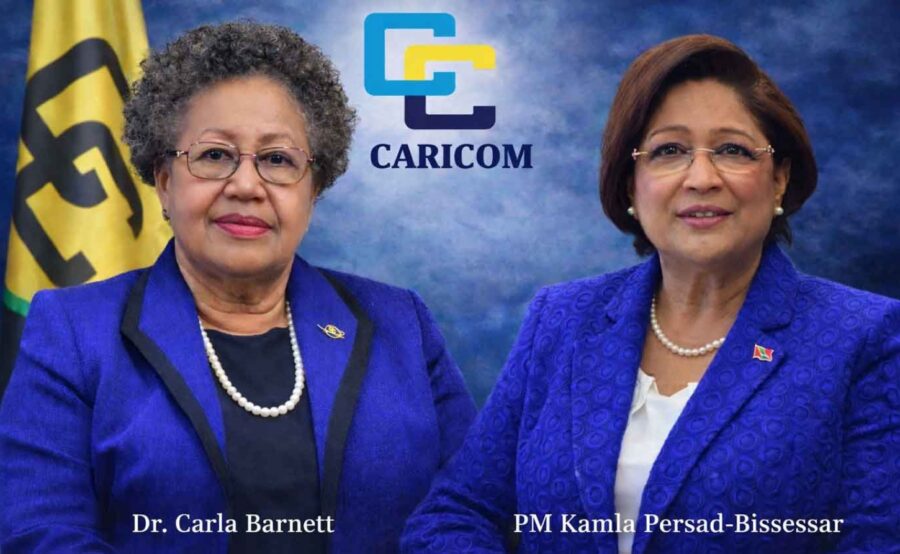
Trinidad and Tobago Prime Minister Kamla Persad-Bissessar has succeeded in persuading Caribbean leaders to break with CARICOM’s longstanding practice on the reappointment of its Secretary-General, securing agreement to refer the controversial process that granted Dr. Carla Barnett a second term to the Caribbean Court of Justice (CCJ) for an advisory opinion.
The decision marks a significant political victory for Persad-Bissessar, who has waged a sustained campaign against the process used to renew Barnett’s appointment, arguing that it breached the governance provisions of the Revised Treaty of Chaguaramas. While her government has insisted its objection is procedural rather than personal, the referral effectively places Barnett’s second term under legal scrutiny and reopens an issue that had appeared settled following the February Conference of Heads of Government.
Announcing the decision on Tuesday, Persad-Bissessar said CARICOM Heads unanimously accepted Trinidad and Tobago’s proposal to seek the CCJ’s interpretation under Article 212 of the Revised Treaty of Chaguaramas.
“I am pleased to announce that today [Tuesday, July 7] the Heads of Government of the Caribbean Community (CARICOM) accepted and approved my proposals relating to issues surrounding the Re-appointment of the Secretary-General,” she said.
Barnett, a Belizean economist, became CARICOM’s eighth Secretary-General in August 2021. Earlier this year, Heads of Government agreed to renew her appointment for a second five-year term, continuing what has long been an established practice within CARICOM of extending the tenure of serving Secretaries-General by consensus.
That convention, however, came under challenge after Persad-Bissessar’s return to office in Trinidad and Tobago. Her administration objected to the manner in which Barnett’s reappointment was approved during the February Heads of Government meeting in St. Kitts and Nevis, contending that the issue was discussed during a private retreat after Trinidad and Tobago’s delegation had departed and without adhering to the formal procedures prescribed by the treaty.
During Monday’s Heads of Government retreat in Saint Lucia, Persad-Bissessar said she “steadfastly maintained Trinidad and Tobago’s objections to the process used in the reappointment of the Secretary-General” and urged leaders to seek the CCJ’s guidance.
Article 212 of the Revised Treaty of Chaguaramas allows CARICOM to request advisory opinions from the CCJ on questions involving the interpretation and application of the treaty.
The decision represents an unprecedented step for the regional bloc. Rather than allowing the reappointment to stand under established convention, Heads of Government have agreed to invite the CCJ to determine whether the procedures used complied with the treaty, a move that could redefine how future appointments to CARICOM’s highest administrative office are handled.
Persad-Bissessar has repeatedly maintained that her objection is directed at the process rather than Barnett herself, arguing that adherence to the Community’s legal framework is essential to preserving confidence in its institutions.
Barnett’s reappointment also attracted concern from Jamaica, with Prime Minister Andrew Holness writing to CARICOM Chairman Philip J. Pierre urging that procedural questions be addressed to safeguard the credibility of the regional body. While Jamaica did not oppose Barnett’s continued tenure, Holness argued that the issues raised warranted careful consideration in the interest of institutional integrity.
Persad-Bissessar thanked her regional counterparts for supporting Trinidad and Tobago’s proposal.
“I wish to thank my fellow Colleague Heads for supporting Trinidad and Tobago’s proposals which were viewed as consistent with CARICOM’s commitment to the highest standards of good governance and institutional improvement; principles which I have always championed as necessary for the future of CARICOM.“
She also praised CARICOM Chairman and Saint Lucia Prime Minister Philip J. Pierre for steering leaders toward consensus.
“This outcome is a testament to the Chairmanship of CARICOM by the Honourable Philip J. Pierre, Prime Minister of Saint Lucia, who facilitated consensus and the opportunity for the region to move forward in unity, to advance the well-being of all the people of CARICOM.”
The referral to the CCJ marks a significant departure from how leadership transitions have traditionally been managed within CARICOM. For decades, appointments and reappointments of Secretaries-General have largely been resolved through political consensus among Heads of Government. By agreeing to seek judicial interpretation of the treaty, regional leaders have elevated what began as a procedural disagreement into a legal question with potentially far-reaching implications for CARICOM’s governance.
Whatever the CCJ ultimately decides, the court’s opinion is expected to establish an important precedent for the interpretation of the Revised Treaty of Chaguaramas and the future appointment of the Community’s senior officials. The ruling could not only determine the legality of the process that secured Barnett’s second term but also reshape the balance between political consensus and treaty compliance within CARICOM’s decision-making framework.