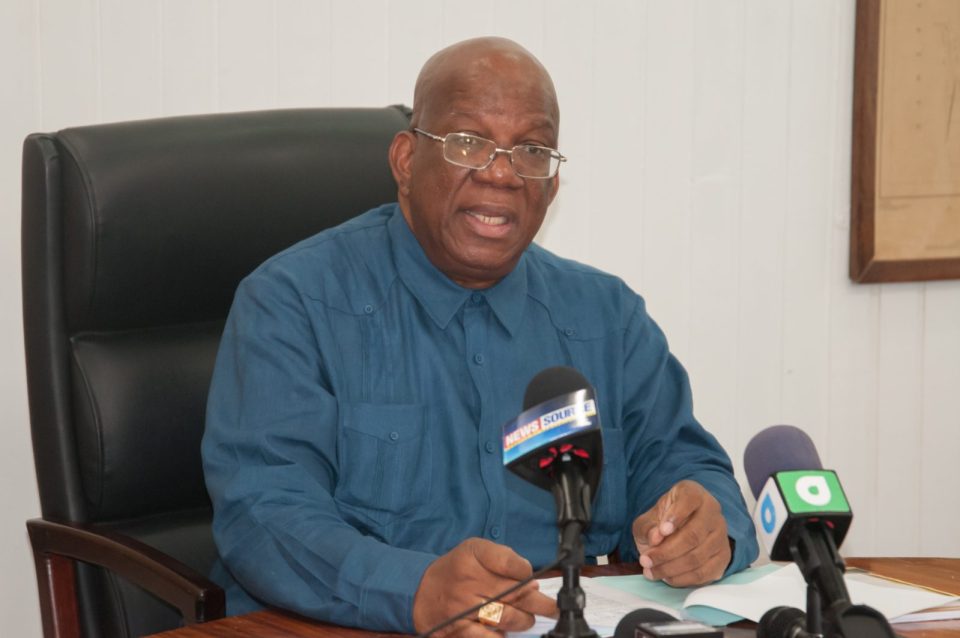
Former Finance Minister Winston Jordan has warned that Suriname’s rapidly expanding oil industry, coupled with what he described as increasingly assertive actions over long-disputed border issues, should serve as a wake-up call for Guyana, arguing that the country cannot rely primarily on foreign allies to safeguard its territorial integrity and national interests.
Jordan, who served as Finance Minister under the A Partnership for National Unity and Alliance For Change (APNU+AFC) administration from 2015 to 2020, was the architect of Guyana’s original Natural Resource Fund (NRF) Act, legislation designed to establish strict parliamentary and institutional oversight over the receipt, management and expenditure of the country’s oil revenues.
However, following its return to office in 2020, the governing People’s Progressive Party/Civic (PPP/C) repealed and replaced the legislation, dismantling several key oversight mechanisms—including the Public Accountability and Oversight Committee—and granting the executive greater discretion over withdrawals from the Fund.
Turning to the broader regional implications of oil wealth, Jordan argued that Suriname’s rapidly expanding petroleum sector fundamentally alters the strategic landscape, making recent developments along the shared border impossible for Guyana to ignore.
“In light of Suriname’s recent posturing—regarding both the New River Triangle and the Corentyne River—demands that Guyana treat these economic developments with the utmost seriousness,” Jordan said.
“What is emerging from the Paramaribo government should not incite panic, but it absolutely warrants vigilant, strategic attention.“
His comments come days after Suriname announced that estimated recoverable offshore oil reserves have now exceeded one billion barrels, following additional discoveries by Petronas and TotalEnergies. Production from the country’s first major offshore development is expected to begin later this decade, positioning Suriname alongside Guyana as one of the world’s newest oil-producing states.
Jordan believes that economic transformation could strengthen Paramaribo’s confidence in pursuing long-standing territorial claims.
Guyana and Suriname have disputed sovereignty over the approximately 15,000-square-kilometre New River Triangle since the 19th century. Although the two countries settled their maritime boundary through international arbitration in 2007, the land boundary remains unresolved.
More recently, Suriname has reportedly incorporated the New River Triangle into its official maps, indicated its intention to require Guyanese fishermen to pay fees for operating on the Corentyne River, and announced plans to independently proceed with construction of a bridge linking the two countries.
Jordan argued these developments should not be dismissed as unrelated events.
“Like Venezuela, Suriname has now incorporated the New River Triangle into its official maps. It has signaled its intent to impose fees on Guyanese fishermen operating in the Corentyne River, and most recently, announced it will proceed unilaterally with the proposed bridge project.”
“These are not random provocations—they are calculated moves designed to establish economic leverage over the Courantyne, and potentially, to pave the way for territorial ambitions over the New River Triangle.“
His warning comes as Guyana continues defending its sovereignty against Venezuela’s claim to the Essequibo region before the International Court of Justice (ICJ). While Guyana has consistently relied on international law and diplomatic support from allies, Jordan cautioned that changing global realities suggest legal rulings alone may no longer guarantee compliance.
“We are living in an era where international treaties, UN charters, and even ICJ rulings are increasingly disregarded—as we are witnessing in the Middle East and elsewhere,” he said.
“The global precedent is troubling, and we would be naive to assume it cannot happen in our own backyard.”
Jordan also questioned what he sees as Guyana’s growing dependence on external security guarantees.
“What concerns me most is that this economic boom will only embolden Suriname, while we appear to be placing our defensive hopes almost exclusively in the U.S. basket.“
“Reliance on external partners is not a substitute for national vigilance, preparedness, and a coherent, self-determined strategy.“
Guyana has significantly expanded defence cooperation with the United States in recent years through military exercises, security agreements and high-level engagements, particularly as tensions with Venezuela have intensified. The government has maintained that these partnerships strengthen the country’s defence capabilities while complementing its commitment to peaceful resolution of border controversies under international law.
Jordan, however, argued that international partnerships must complement—not replace—a robust national security strategy.
“We cannot afford to be reactive. The time for quiet observation is over—it is time for Guyana to act with clarity, assertiveness, and foresight.”
His intervention comes as Guyana and Suriname stand at the centre of one of the world’s fastest-growing offshore petroleum basins. While successive governments have spoken of closer economic cooperation, Jordan’s warning suggests that rising oil wealth may also reshape regional power dynamics, making it increasingly important for Georgetown to match its economic success with a coherent long-term strategy to defend its sovereignty, protect its natural resources and preserve its territorial integrity.