The legislation establishing Guyana’s Constitution Reform Commission (CRC) has become the focal point of the controversy surrounding the exclusion of the main parliamentary opposition, We Invest in Nationhood (WIN), from the body overseeing the country’s constitutional reform process.
At the heart of the debate is the Constitution Reform Commission Act of 2022, which fixes the Commission’s membership in law by specifically identifying the political parties and organisations entitled to representation. The Act provides for five nominees from the People’s Progressive Party/Civic (PPP/C), four from A Partnership for National Unity and Alliance For Change (APNU+AFC), and one jointly nominated by the Liberty and Justice Party, A New and United Guyana, and The New Movement. It also provides for representatives from several civil society organisations, including the Guyana Bar Association, the National Toshaos Council, the labour movement, religious organisations, women’s groups, youth organisations and the private sector.
Because the Commission’s composition is prescribed by statute, any addition or removal of political parties or organisations can only be effected through an amendment to the legislation rather than by a decision of the Commission itself.
That legal reality has come under renewed scrutiny following the Commission’s launch of the public consultation phase of the constitutional reform process.
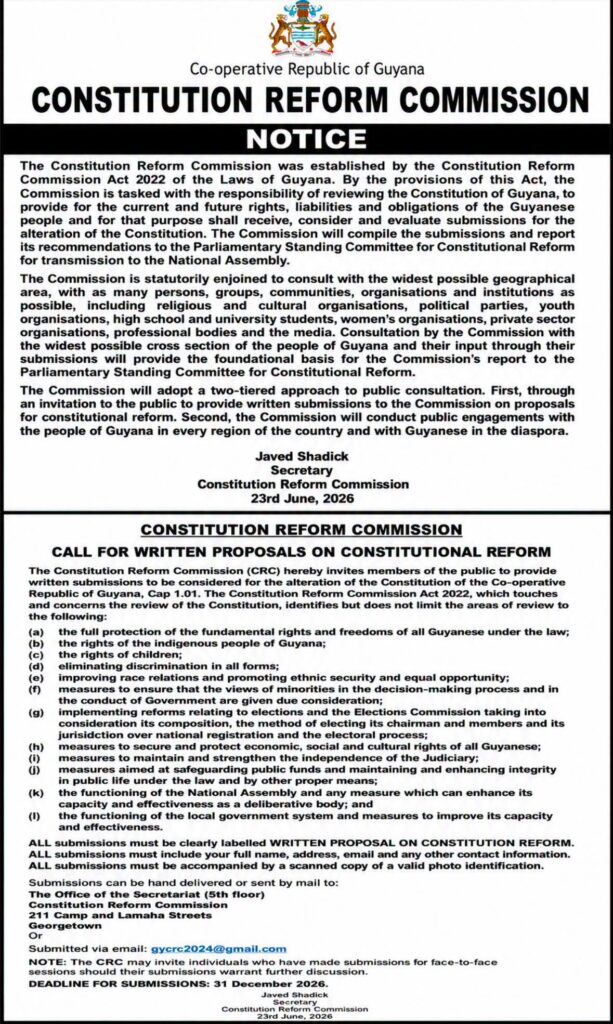
In a public notice published on Wednesday, the Commission invited Guyanese at home and abroad to submit written proposals as part of its review of the Constitution.
The Commission said it was established under the Constitution Reform Commission Act 2022 and is mandated to review the Constitution to ensure it provides for the current and future rights, liabilities and obligations of the Guyanese people. It will receive, consider and evaluate proposals for constitutional amendments before preparing recommendations for the Parliamentary Standing Committee on Constitutional Reform for transmission to the National Assembly.
According to the notice, the Commission is legally required to consult “the widest possible geographical area” and engage “as many persons, groups, communities, organisations and institutions as possible,” including political parties, religious and cultural organisations, youth organisations, high school and university students, women’s organisations, professional bodies, the private sector and the media. It said those consultations will form the foundation of its final report.
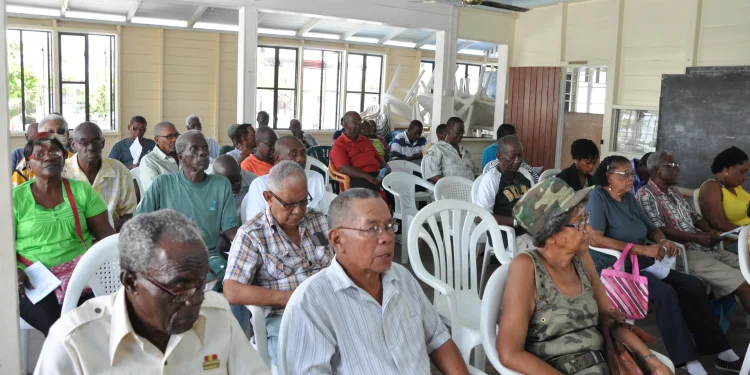
The consultation exercise will be conducted in two phases. The first involves written submissions from the public, followed by face-to-face consultations in all 10 administrative regions and with members of the Guyanese diaspora.
Among the areas identified for review are the protection of fundamental rights and freedoms, the rights of Indigenous peoples and children, eliminating discrimination, improving race relations and promoting equal opportunity, electoral reform and the functioning of the Guyana Elections Commission (GECOM), strengthening judicial independence, safeguarding public funds and integrity in public life, improving the effectiveness of Parliament and local government, and protecting the economic, social and cultural rights of Guyanese. The Commission noted, however, that those areas do not limit the scope of the constitutional review.
Written submissions will be accepted until December 31, 2026.
The consultation process has also renewed calls for WIN to be represented on the Commission.
WIN emerged from the 2025 General and Regional Elections as the country’s largest opposition party, securing 16 of the Opposition’s 29 seats in the 65-member National Assembly. Its leader, Azruddin Mohamed, subsequently became Leader of the Opposition.
Despite that electoral mandate, WIN has no representative on the Commission because the Constitution Reform Commission Act was enacted on November 7, 2022, nearly three years before the party entered Parliament.
Retired Justice Carl Singh, Chairman of the Commission, addressed the issue in an interview with the Sunday Stabroek last September, making it clear that the Commission has no authority to alter its own composition.
“If you look at the Act, the Act names specific parties as having representatives on the Commission,” Singh said.
“That’s not a matter for us to decide, because this Commission was put together by the President.”
He stressed that any change rests with those responsible for enacting the legislation.
“It is entirely a matter for the people who have put the Constitutional Reform Commission together to decide on the question of reconstituting the Commission.”
Acknowledging the political changes following the 2025 elections, Singh added that recognising “the reconfiguration that we are going to see in the National Assembly” would likewise require legislative action.
“So the political parties are specifically identified in the legislation. So I’m not sure how the politicos are going to deal with that, but it’s not a matter for the Commission,” Singh stated.
WIN Member of Parliament and Opposition Chief Whip Tabitha Sarabo-Halley has argued that public consultation cannot substitute for direct participation in the Commission’s deliberations.
“There is a fundamental difference between being consulted and being represented,” she said.
Sarabo-Halley disclosed that the Opposition has already drafted amendments to the Constitution Reform Commission Act that would replace references to named political parties with institutional categories—the Government, the Official Opposition and the other parliamentary opposition parties represented in the National Assembly.
She said the proposal is “not about WIN” but about ensuring that future commissions automatically reflect the composition of Parliament following every General and Regional Election.
Support for WIN’s inclusion has also come from Alliance For Change Chairman and Interim Leader David Patterson, who has argued that all parliamentary stakeholders should be represented on the Commission since constitutional amendments require the support of a two-thirds majority in the National Assembly.
Patterson also disclosed that AFC representative Nigel Hughes resigned from the Commission following the 2025 elections to allow the Leader of the Opposition to nominate a replacement, noting that the vacancy remains unfilled.
However, APNU Member of Parliament and Commission member Ganesh Mahipaul has maintained that WIN has not been excluded from the constitutional reform process because it is represented on the Parliamentary Standing Committee on Constitutional Reform, which considers the Commission’s recommendations before they are proceed to the National Assembly.
Meanwhile, Attorney General Anil Nandlall has urged Guyanese to participate in the consultation process, saying public submissions will shape the Commission’s recommendations. He said the views expressed during the consultation process will inform the constitutional amendments eventually proposed by the Commission.