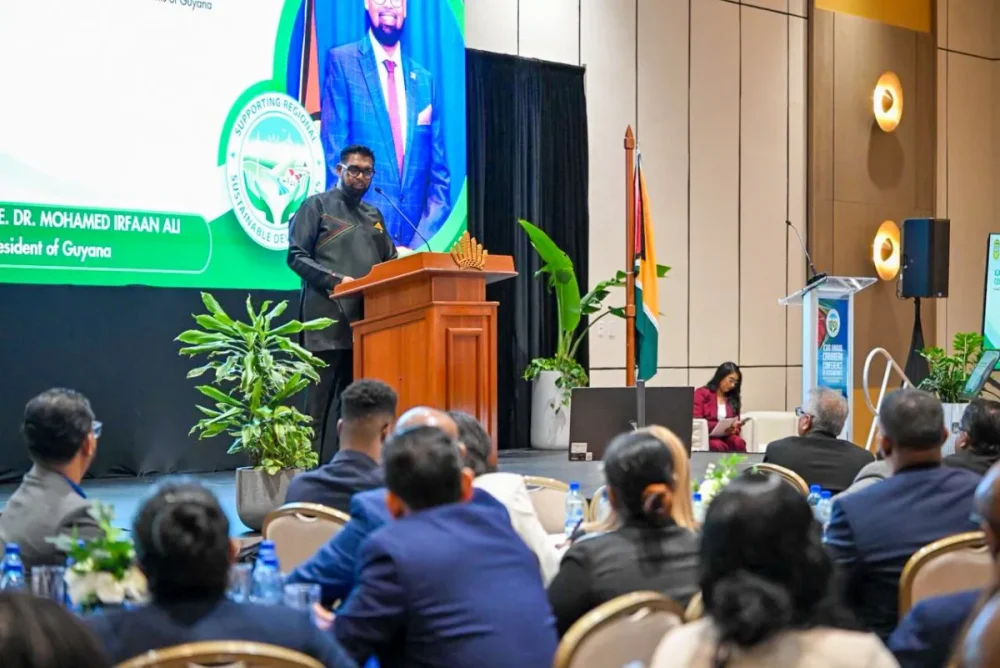
President Irfaan Ali has urged accountants across the Caribbean to embrace artificial intelligence (AI), climate finance and data-driven decision-making, declaring that the profession must evolve or risk becoming obsolete. Yet while the vision mirrors global trends, it also exposes a familiar gap between ambition and Guyana’s on-the-ground realities.
Addressing more than 300 delegates Friday at the opening of the 43rd Annual Conference of the Inter-American Accounting Association (ICAC), President Ali said accountants can no longer limit themselves to preparing financial statements and balancing books.
Instead, he argued, they must become strategic advisers capable of interpreting AI-generated data, shaping public policy and developing innovative financing models to meet emerging economic and environmental challenges.
“Professions around the world are changing because of systems…we have to decide whether people drive systems or the system is driving people,” the President told delegates.
Central to his address was the transformative role of artificial intelligence.
“AI is a tool to help us, but if we allow AI to be the tool that directs us, then we will have challenges,” Ali said, encouraging accountants to move beyond routine accounting functions and embrace analytical and policy-driven roles.
He urged conference organizers to focus less on theoretical discussions and more on practical solutions capable of addressing regional challenges, including climate financing, biodiversity valuation and expanding access to investment capital.
“We are definitely the most impacted and affected when it comes to climate change. A body like this…must be able to develop a monetised, market-based model that can be shared across the region,” he said.
Ali also pointed to Guyana’s exploration of diaspora bonds and investment vehicles designed to allow ordinary citizens to participate in major economic projects.
Using his administration as an example of technological change, the President said AI-powered dashboards are already helping government monitor delayed projects and cost overruns.
“If a system can generate all the numbers, then what becomes the role of the accountant? The accountant of the future must use the data…not simply generate it.“
He further challenged universities to modernize curricula to reflect the demands of the changing economy, commending the partnership between the University of Guyana and the Association of Chartered Certified Accountants (ACCA).
“You can’t be inward looking…education must prepare students for absorption into the economy,” he said.
The President’s remarks reflect a growing global consensus that artificial intelligence will fundamentally reshape the accounting profession. Around the world, AI is increasingly automating bookkeeping, auditing, tax preparation and financial analysis, forcing accountants to develop stronger analytical, technological and advisory skills.
However, the transition also raises complex questions that extend well beyond the accounting profession.
Artificial intelligence depends on reliable electricity, high-speed internet connectivity, secure digital infrastructure, robust cybersecurity systems and a workforce equipped with digital literacy and specialized technical skills. Those prerequisites remain unevenly developed in Guyana.
Despite unprecedented oil revenues, businesses and households continue to grapple with frequent power outages that disrupt commerce, education and public services. Outside the coastland, internet access remains inconsistent in several communities, while many small and medium-sized enterprises have yet to complete even basic digital transformation.
Within the public sector, many agencies still rely heavily on paper-based filing systems, manual record keeping and fragmented databases—conditions that make widespread AI deployment considerably more difficult.
Equally significant is the human dimension.
The President urged accountants to become data analysts and strategic advisers, but that transition will require substantial investment in retraining, university curriculum reform and continuing professional education. AI does not simply replace routine work; it changes the skills professionals need to remain competitive. Without sustained investment in human capital, many workers risk being displaced rather than empowered.
His call for accountants to develop market-based climate financing and biodiversity valuation models is equally ambitious. While natural capital accounting is gaining international traction, such systems require sophisticated legal frameworks, internationally accepted valuation standards, scientific data collection, financial regulation and institutional capacity—areas that remain works in progress across much of the Caribbean.
Similarly, proposals for diaspora bonds and broader citizen investment vehicles will ultimately depend less on technology than on strong governance, regulatory oversight and public confidence that investments will be managed transparently.
None of these challenges diminish the importance of preparing Guyana for an AI-driven future. If anything, they underscore the urgency of doing so. But they also highlight the difference between articulating a vision and building the foundations necessary to achieve it.
As Guyana’s economy expands on the strength of oil revenues, the country undoubtedly has an opportunity to leapfrog technologically. Whether it can seize that opportunity will depend not simply on speeches about artificial intelligence, but on solving more fundamental problems—modernizing public institutions, strengthening education, ensuring reliable electricity, expanding digital connectivity and building public confidence in the systems AI is expected to enhance.
Without those building blocks firmly in place, critics may argue that the administration risks putting the proverbial cart before the horse—promoting an AI-powered future before fully addressing the infrastructure, institutional capacity and human capital needed to make that future a practical reality.