The Government of Guyana’s flagship Guyana Online Academy of Learning (GOAL) programme has awarded 54,793 scholarships since its launch in 2021, more than double its original target of 20,000 scholarships over a five-year period, according to Senior Minister in the Office of the President with responsibility for Finance, Dr Ashni Singh.
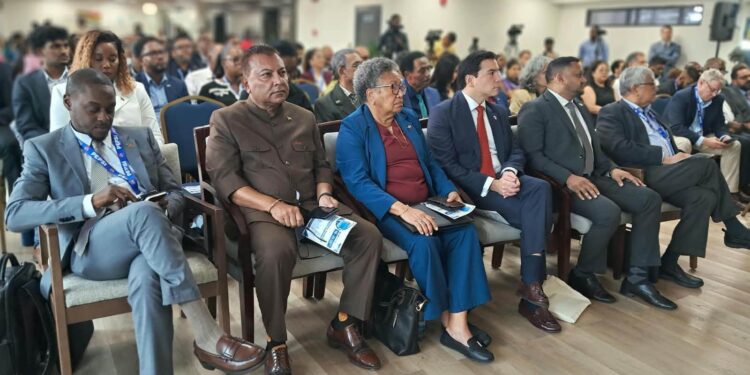
Speaking at the afternoon session of the fourth GOAL graduation ceremony at the National Cultural Centre on Tuesday, Dr Singh hailed the programme as a transformative initiative that has expanded access to tertiary and postgraduate education for thousands of Guyanese.
The latest graduating class comprised 3,876 students, including 2,858 women. Among the graduates were 836 master’s degree recipients and 35 doctorate graduates—the first batch of PhD holders produced through the GOAL programme. Another 1,150 persons completed the GROW programme, which provides an alternative pathway to university education.
“Today we are witnessing transformation in action, but not only national transformation, not only macro transformation, but transformation of individual lives and individual families by the creation of opportunities for personal upliftment,” Dr Singh told graduates.
The minister noted that GOAL was created to remove barriers that historically prevented many Guyanese from pursuing higher education, including financial constraints, geographical limitations, family responsibilities, and work commitments. Through online learning platforms, students have been able to pursue studies from their homes across Guyana.

“The future of Guyana is not something you inherit. The future of Guyana is something you will be helping to create,” he said.
Dr Singh also highlighted GOAL as part of a broader government strategy to expand educational opportunities, alongside free tuition at the University of Guyana, expanded technical and vocational training through the Board of Industrial Training, and efforts to achieve a fully trained teaching service.
While government officials continue to tout the programme’s numerical achievements, questions remain about its overall effectiveness, quality assurance, and long-term impact on employment and economic advancement.
Since its launch, GOAL has faced criticism over the accreditation status of some overseas institutions initially included in the programme. Concerns were raised by educators and sections of the public regarding whether all partner institutions were properly accredited and whether qualifications earned would be recognised internationally and within Guyana’s professional sectors.
The programme has also faced scrutiny over reports that some scholarship recipients completed courses but experienced delays in receiving certificates or official documentation needed to verify their qualifications. In previous years, questions were raised publicly about graduates who reported difficulties obtaining proof of programme completion and whether all programmes offered met expected academic standards.
Beyond the scholarship numbers, there has been little publicly available data detailing the employment outcomes of graduates.
With nearly 55,000 scholarships awarded and thousands of graduates produced since 2021, questions persist about how many participants have secured employment, received promotions, started businesses, or otherwise improved their economic circumstances as a result of the programme.
There is also limited public information regarding the sectors in which GOAL graduates are currently employed, the number who have transitioned into entrepreneurship, or the extent to which the qualifications obtained align with the needs of Guyana’s rapidly expanding economy.
These questions have become increasingly relevant as Guyana continues to experience unprecedented economic growth fueled by its oil and gas sector. Employers across multiple industries have repeatedly cited shortages of skilled labour, while government has consistently promoted GOAL as a key mechanism for developing the country’s human capital.
The emergence of the programme’s first 35 PhD graduates and hundreds of master’s degree holders is likely to intensify calls for greater transparency regarding outcomes and impact.
As the programme moves beyond its initial expansion phase, attention is expected to shift from the number of scholarships awarded to the measurable benefits generated for participants and the wider economy.
For now, government officials point to the programme’s growth as evidence of success. However, observers argue that the next stage of the conversation must focus on outcomes: where the graduates are, what qualifications they actually received, whether those qualifications are fully recognised, and how many have translated their studies into meaningful employment, professional advancement, or successful business ventures.
Those answers may ultimately determine whether GOAL’s legacy is defined not merely by the number of scholarships awarded, but by the opportunities and prosperity created for the thousands of Guyanese who enrolled.