The five sugar workers shot dead by colonial police at Plantation Enmore on June 16, 1948 are today revered as the Enmore Martyrs, symbols of workers’ rights, sacrifice and resistance to oppression. But their elevation to martyrdom was neither immediate nor accidental. It was the result of sustained efforts by the labour movement, particularly the Guyana Trades Union Congress (GTUC), and later formal recognition by the Forbes Burnham administration.
The five men—Rambarran, Pooran, Lallabagee Kissoon, Surujballi (Dookie) and Harry—were killed during a strike by sugar workers protesting poor wages, harsh working conditions and the controversial “cut and load” system. The workers were also fighting for the right to be represented by a union of their choice.
The shooting transformed a labour dispute into a defining moment in Guyana’s history. Thousands joined the funeral procession from Enmore to Georgetown, and the tragedy became a rallying cry for labour rights, trade union recognition and political change.
Throughout the 1950s, 1960s and early 1970s, the memory of the five workers was kept alive primarily by the labour movement, trade unions and political organisations, particularly those associated with the sugar workers’ struggle. Dr. Cheddi Jagan and his party, the People’s Progressive Party (PPP), frequently referenced the Enmore Five as part of the broader working-class movement that emerged after 1948.
However, while political parties have long associated themselves with the Enmore legacy, it was the trade union movement, with the support of a worker-friendly government, that ensured the five workers would be remembered as martyrs rather than simply victims of colonial violence.
The GTUC lobbied internationally for the five to be recognised as martyrs. A major milestone came in 1976 when, through the efforts of the late GTUC General Secretary Joseph Pollydore, the five received international recognition at the Continental Conference of the national affiliates of the World Peace Council in Bogotá, Colombia.
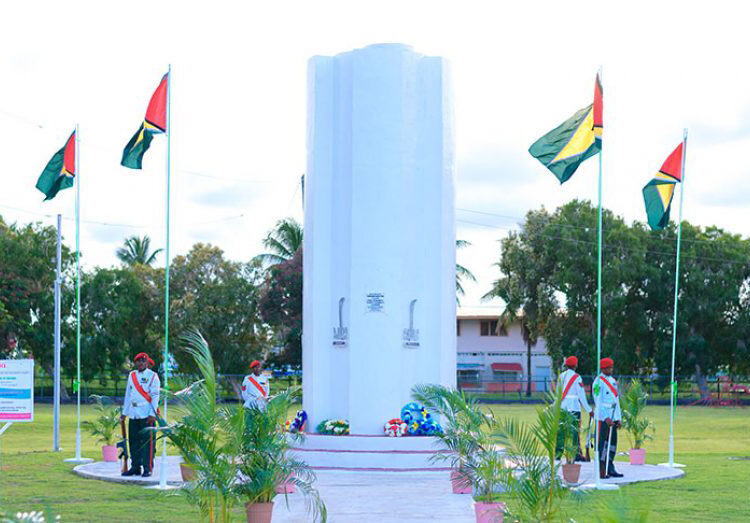
The following year, the People’s National Congress (PNC) government led by Forbes Burnham unveiled the Enmore Martyrs Monument at Enmore. The monument, commissioned on June 16, 1977, was designed by renowned Guyanese artist Dennis Williams, with a plaque by Stanley Greaves. Its five towering structures symbolise the five slain workers and transformed the Enmore Martyrs into a permanent part of the national landscape and historical narrative.
In 1977, the Burnham administration also placed the Enmore Martyrs on the national calendar, ensuring that the annual observance of their sacrifice became part of Guyana’s official national commemorations.
The monument and official observances were not gifts bestowed by the State, but the culmination of years of advocacy by trade unions and workers, coupled with the willingness of a worker-friendly government to ensure that the sacrifice of the five men would not be forgotten.
However, the commemoration of the Enmore Martyrs has itself become the subject of controversy.
The GTUC, despite being one of the principal organisations responsible for preserving and promoting the legacy of the Enmore Martyrs, has been excluded from official observances under successive post Jagan People’s Progressive Party (PPP) administrations.
GTUC General Secretary Lincoln Lewis revealed in 2015 that the federated body not been invited to address the official Enmore Martyrs ceremony for 13 years under the previous PPP government. In June 2015 the A Partnership for National Unity and Alliance For Change (APNU+AFC) government was in office.
The pattern re-emerged after the PPP/C returned to office in August 2020. Since 2021, under the administration of President Irfaan Ali, the GTUC has once again been excluded from official Enmore Martyrs commemorative activities, despite being the organisation that fought for decades to secure recognition of the five workers and institutionalise their place in Guyana’s history.
It should be remembered, however, that during the funeral procession and at the graveside of the five slain workers, Dr. Jagan pledged to dedicate his life to the cause of the working class.
Nearly eight decades after the shooting, the Enmore Martyrs remain among the most powerful symbols in Guyana’s labour and political history. Their legacy is claimed by governments, political parties and trade unions alike. But the historical record shows that it was the GTUC—supported by the Burnham government’s decision to erect the monument and institutionalise the observance—that played the decisive role in transforming five slain sugar workers into national martyrs whose sacrifice continues to resonate across generations.