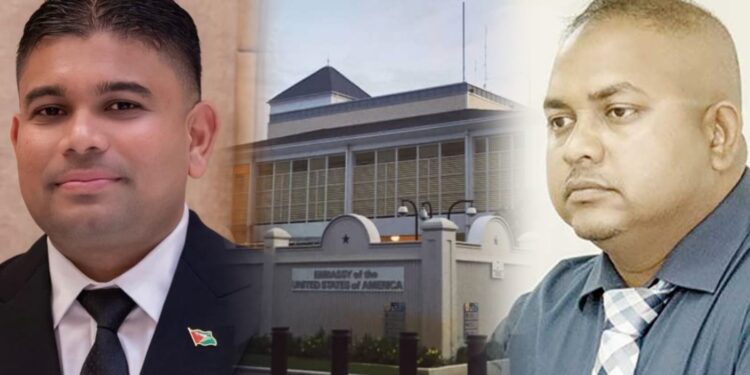
By Mark DaCosta- In a significant ruling on June 19, 2026, the High Court dismissed a constitutional challenge filed by Dr. Terrence Campbell, a Member of Parliament from A Partnership for National Unity (APNU), regarding the legality of appointments to the Teaching Service Commission (TSC). Justice Damone Younge presided over the case, which pitted Dr. Campbell against Attorney General Anil Nandlall S.C, affirming the government’s stance that the appointments made by President Mr. Irfaan Ali were constitutional despite the absence of an Opposition Leader.
The basis of Campbell’s legal action stemmed from allegations that the President’s appointment of members to the TSC was unconstitutional, primarily due to the failure to consult the Leader of the Opposition — a process mandated under Article 207(2)(d) of the Constitution.
Dr. Campbell contended that decisions made without this essential consultation could not be considered legitimate, thus rendering the appointments invalid. However, the court ruled in favour of the government, that the lack of an elected Opposition Leader made meaningful consultation impracticable at that time, an assertion grounded in the ongoing political malaise that has left our country without a fully functional parliamentary opposition.
In her judgement, Justice Younge supported the Attorney General’s argument that the President had acted within his legal rights. The court highlighted that the vacancy in the Opposition Leader’s office stemmed from a failure of the National Assembly to convene and elect a new leader, a situation not exacerbated by the President’s actions but rather a result of the existing political dynamics. Observers suggest that the judicial ruling reflects a broader pattern of executive overreach, where constitutional processes are compromised for political expediency.
The individuals appointed to the Teaching Service Commission include prominent figures such as Doodmattie Singh, who chairs the commission, alongside colleagues Shafiran Bhajan, Joan Davis-Monkhouse, Lancelot Baptiste, Satti Jaisierisingh, Mayda Persaud, and Saddam Hussain. These positions are critical, given that the TSC plays a pivotal role in the administration of education for public schools, overseeing key functions such as the appointment, promotion, and disciplinary actions of teachers.
The TSC’s very structure is anchored in constitutional mandates designed to ensure democratic processes are upheld. Fundamental to its operation is the expectation of bipartisan consultation, a mechanism aimed at safeguarding the commission from political biases and fostering an environment of trust within the educational framework. Yet, the court’s ruling, which underscores the government’s capability to ignore this principle under dire circumstances, raises serious concerns among commentators about the future integrity of such independent bodies.
Critics point out that the ruling allows the governing party to circumvent necessary checks and balances intended to maintain the impartiality of critical constitutional commissions. This perspective is further bolstered by an analyst who noted that the continued absence of an Opposition Leader illustrates a growing malaise within our democratic processes, wherein the ruling government may prioritise political advantage over institutional integrity. The analyst warned that failing to uphold meaningful consultation could lead to perceptions that appointments are politically motivated rather than based on merit, thus eroding public confidence in the TSC.
The implications of this decision cannot be overstated. With significant influence over the professional lives of educators, the manner in which the TSC is constituted directly affects the quality of education available to our children. A lack of legitimacy in the commission undermines its ability to operate effectively, which could mean indefinite delays in promotions, unresolved disciplinary issues, and an overall stagnation in the education sector, all of which ultimately affect the nation’s youth.
In the context of ongoing political strife, some analysts argue that the ruling party’s dismissal of constitutional requirements is emblematic of a broader tendency to sideline democratic norms. This observation calls into question the commitment of the governing administration to uphold the Constitution’s principles and protect the integrity of its institutions. Commentators suggest that such actions risk creating a constitutional crisis that could further destabilise governance and lead to public disillusionment with the state apparatus.
While the High Court’s ruling supports the government’s decisions, it simultaneously illuminates the fragility of our constitutional frameworks, especially when political interests dictate the interpretations of the law. This case serves as a stark reminder of the critical importance of maintaining checks and balances within our governance structures to uphold the very foundations of democracy in the face of considerable challenges.