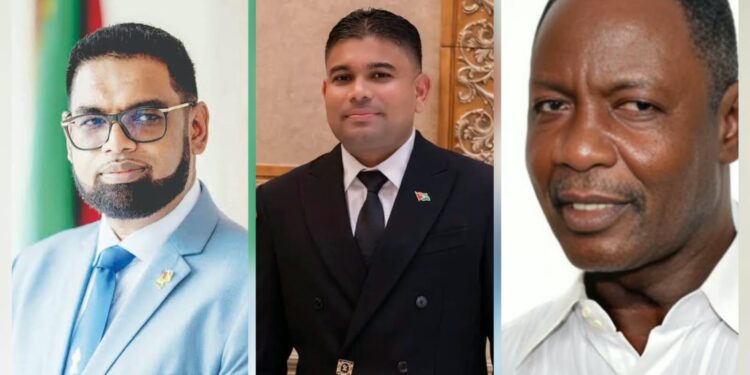
Forward Guyana Movement (FGM) leader and the party’s lone Member of Parliament, Amanza Walton-Desir, has nominated Nigel London for appointment as an Opposition-nominated Commissioner on the Guyana Elections Commission (GECOM), while proposing what she describes as a balanced approach to renewing Opposition representation on the electoral body.
The nomination was submitted to Opposition Leader Azruddin Mohamed as part of consultations on Opposition appointments to GECOM following the 2025 General and Regional Elections.
London’s nomination is significant not only because of the constitutional importance of the position but also because he has already been identified by FGM to serve part of the party’s term in the 13th Parliament, replacing Walton-Desir under the party’s rotational representation arrangement.
In her response to Mohamed, Walton-Desir proposed retaining one of the current Opposition-nominated commissioners for a transitional period of two years while engaging the remaining outgoing commissioners as remunerated advisers to the Office of the Leader of the Opposition to assist in transferring institutional knowledge to incoming appointees.
The proposal seeks to preserve the experience accumulated by current Opposition-nominated Commissioners Vincent Alexander, Charles Corbin and Desmond Trotman while facilitating a gradual renewal of Opposition representation on the Commission.
Rather than embracing either wholesale retention or wholesale replacement, Walton-Desir advanced a middle-ground approach intended to maintain continuity while introducing fresh perspectives.
Explaining her nomination of London, Walton-Desir argued that public engagement is an essential component of meaningful electoral reform.
“At a time when meaningful electoral reform requires not only institutional change but genuine public engagement, Mr. London’s ability to break down complex concepts and bring the Guyanese people into the conversation is precisely the quality the Commission needs,” she stated.
She added that London would bring an independent and questioning mindset to the Commission’s work.
“He is also not someone who will simply go along. He will ask difficult questions, engage critically with the work of the Commission, and hold the institution to account from within,” Walton-Desir said.
Her submission followed a request from Mohamed, who recently wrote to Walton-Desir and Aubrey Norton, Leader of the People’s National Congress Reform (PNCR) and Chairman of A Partnership for National Unity (APNU), which contested the 2025 General and Regional Elections, seeking recommendations on Opposition representation at GECOM.
While nominating London, Walton-Desir also addressed reports that Mohamed is considering Senior Counsel Roysdale Forde, attorney-at-law Siand Dhurjon and Damien Da Silva for appointment as commissioners.
Although she expressed respect for all three attorneys, Walton-Desir argued that because they currently form part of Mohamed’s legal team in ongoing court proceedings, “the nomination process ought to avoid circumstances that give rise to avoidable perceptions of a conflict of interest.”
That observation has itself generated discussion in legal and political circles, particularly because it came from a fellow attorney.
Some observers have questioned the basis of the argument, noting that legal representation of a client does not, in itself, create a conflict of interest that would preclude an attorney from serving on a constitutional body. On the contrary, lawyers with expertise in election law are often regarded as particularly well-suited for institutions such as GECOM because of their understanding of electoral legislation, constitutional principles, judicial precedents and the legal safeguards necessary to ensure free, fair and credible elections.
The criticism is especially noteworthy given the credentials of those identified.
Forde, who served as Shadow Attorney General during the 12th Parliament, has been one of Guyana’s most prominent advocates for electoral reform. He has written extensively on constitutional governance, electoral accountability, voter verification and biometric safeguards, and has appeared in numerous election-related court matters, including cases involving GECOM. He is widely regarded as one of Guyana’s foremost constitutional jurists and among the country’s leading legal voices on electoral matters.
Dhurjon and Da Silva likewise bring legal expertise that supporters argue could strengthen the Commission’s ability to navigate complex constitutional, statutory and procedural questions.
Their supporters contend that such experience would be particularly valuable at a time when concerns have repeatedly been raised by political parties, election observers and civil society groups about GECOM’s adherence to electoral laws and established procedures.
Questions surrounding voter registration, verification systems, transparency, accountability and compliance with statutory requirements have featured prominently in public discourse over successive election cycles. Against that backdrop, some argue that the presence of experienced legal minds on the Commission could help reinforce respect for the rule of law, protect citizens’ constitutional right to vote and strengthen public confidence in the electoral process.
They further contend that safeguarding the integrity of elections requires vigilance at every stage of the process—from voter registration and verification to polling, ballot counting and the declaration of results in accordance with constitutional and legal requirements.
For that reason, some legal and political observers contend that Walton-Desir’s concerns identify no actual conflict of interest and instead rest largely on questions of perception and political optics. Given that GECOM commissioners are selected through an inherently political process and are expected to bring different experiences and perspectives to the Commission’s deliberations, they argue that legal representation alone is an insufficient basis on which to question a nominee’s suitability.
Beyond the issue of appointments, Walton-Desir reiterated her long standing view that Guyana’s electoral challenges cannot be resolved merely by changing the individuals who sit on the Commission.
“The question before us is not only who should sit at the table, but whether we are prepared to improve the table itself.”
She called for greater attention to GECOM’s governance structure, accountability mechanisms and public confidence challenges as part of a broader electoral reform agenda.
“The question cannot be reduced to a simple choice between retaining all existing Commissioners and replacing all existing Commissioners,” Walton-Desir said, arguing that the current impasse “does a disservice to the people of Guyana, who are entitled to institutions that function effectively and inspire public confidence.”
While acknowledging that reasonable people may disagree on constitutional questions concerning the continued tenure of the current commissioners, she maintained that constructive engagement offers a more productive path forward than refusing to participate in consultations.
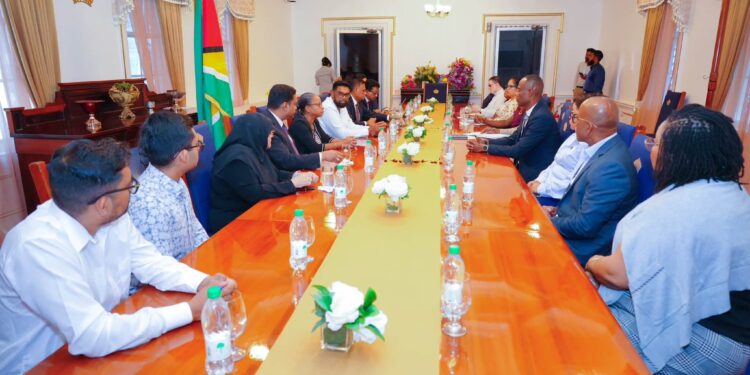
Walton-Desir has confirmed that she will attend the consultative meeting convened by Mohamed on June 23.
London’s nomination has emerged as one of the more consequential developments in the debate over Opposition representation on GECOM. The nomination not only places the prospective parliamentarian in contention for a key constitutional role, but also underscores the broader questions confronting the Opposition—whether the Commission’s future is best served through continuity, renewal, legal expertise, or a combination of all three. At stake is more than the composition of GECOM; it is the credibility of the institution entrusted with safeguarding the integrity of elections and maintaining public confidence in Guyana’s democratic process.