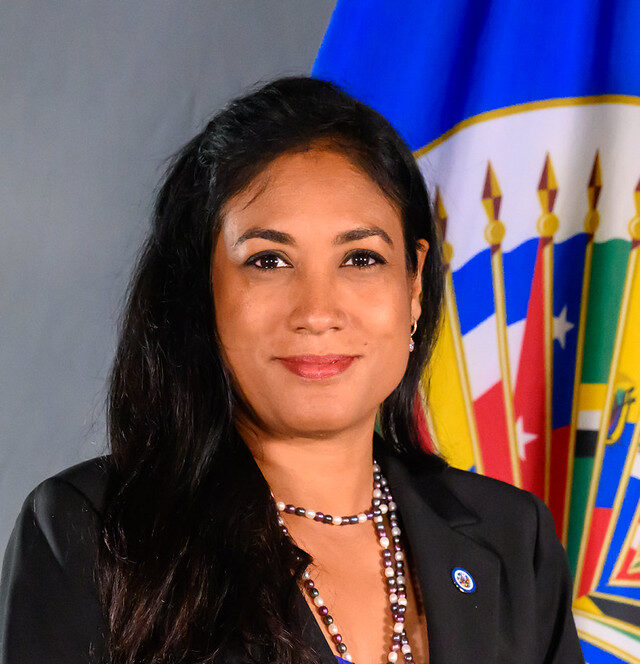
A senior Surinamese official serving in the upper ranks of the Organisation of American States (OAS) has resigned after the United States revoked her diplomatic visa amid reports linking her to an ongoing corruption investigation in Suriname.
Xaviera Jessurun, Chief of Staff to OAS Secretary-General Albert Ramdin, stepped down from her position this month after U.S. authorities withdrew the visa that permitted her to reside and work in the United States, according to reports and diplomatic sources familiar with the matter.
The move has attracted attention across diplomatic circles in the Caribbean and the wider hemisphere, given Jessurun’s prominent role within the OAS and her close professional association with Ramdin, the former Surinamese foreign minister who assumed leadership of the hemispheric body earlier this year.
The OAS, headquartered in Washington, D.C., is the principal political forum of the Americas, bringing together 34 independent states to address issues ranging from democracy and human rights to security and development.
As Chief of Staff, Jessurun occupied one of the most influential administrative positions within the Office of the Secretary-General, helping to coordinate policy and management functions at the organisation. Official OAS records listed her among the senior leadership team supporting Ramdin’s administration.
According to reports, Jessurun’s departure had been anticipated even before the U.S. visa revocation became public. Sources familiar with discussions inside the organisation indicated that growing scrutiny surrounding allegations in Suriname had made her continued presence increasingly difficult.
While U.S. authorities have not publicly detailed the reasons for the visa revocation, reports in regional and international media have linked Jessurun to an ongoing corruption investigation in Suriname involving allegations of corruption, fraud and money laundering. No criminal conviction against Jessurun has been publicly reported, and details of the investigation remain limited.
Neither the U.S. State Department nor the OAS has issued a detailed public statement explaining the circumstances surrounding the decision.
The revocation of a diplomatic visa is a significant step. Such visas are generally reserved for accredited diplomats and officials serving in international organisations and can be withdrawn when the host government determines that an individual no longer satisfies the conditions under which the visa was granted.
Jessurun’s rise to one of the OAS’s most senior staff positions was closely tied to Ramdin’s ascent to the organisation’s top office. A former activist, businesswoman and political figure in Suriname, she previously served as an adviser to Ramdin during his tenure as Suriname’s Minister of Foreign Affairs, International Business and International Cooperation. She later joined him in Washington after his election as OAS Secretary-General.
Her appointment had already generated discussion in some diplomatic and political circles. Reports published last year questioned aspects of personnel decisions within the OAS and raised concerns about governance and transparency within the organisation, though no formal findings have been made public.
The latest development comes at a sensitive time for the OAS, which has faced growing scrutiny over governance, financial management and institutional reform. Earlier reports suggested that U.S. officials were seeking greater transparency and accountability regarding administrative and financial practices within the organisation under its new leadership.
Although there is no indication that Jessurun’s resignation is tied to any internal OAS investigation, the loss of a senior official so soon after Ramdin assumed office is likely to intensify attention on the institution’s management and personnel decisions.
Neither Jessurun nor Surinamese authorities had issued a comprehensive public response regarding the visa revocation or her resignation at the time of reporting.
Questions also remain about whether the investigation in Suriname could lead to further legal or administrative action. It is unclear whether prosecutors in Suriname intend to bring charges or whether additional measures could follow from U.S. authorities.
For now, the resignation removes one of the most visible Surinamese officials from the leadership structure of the OAS. Yet the circumstances surrounding her departure continue to raise questions for both the regional organisation and the government of Suriname.
With limited official information available, diplomatic observers are expected to continue watching developments closely as investigators in Suriname pursue broader inquiries into alleged corruption and governance issues within public institutions.