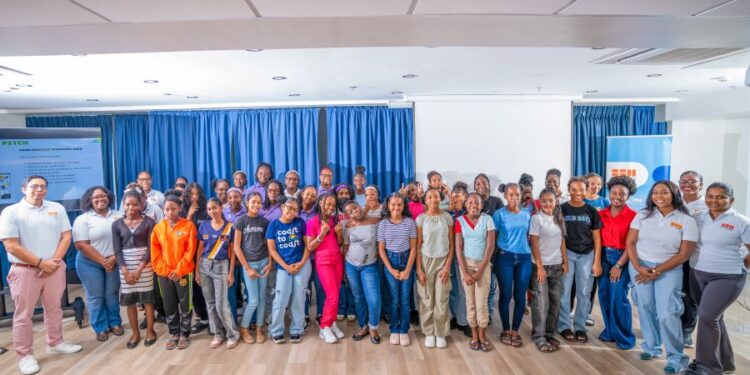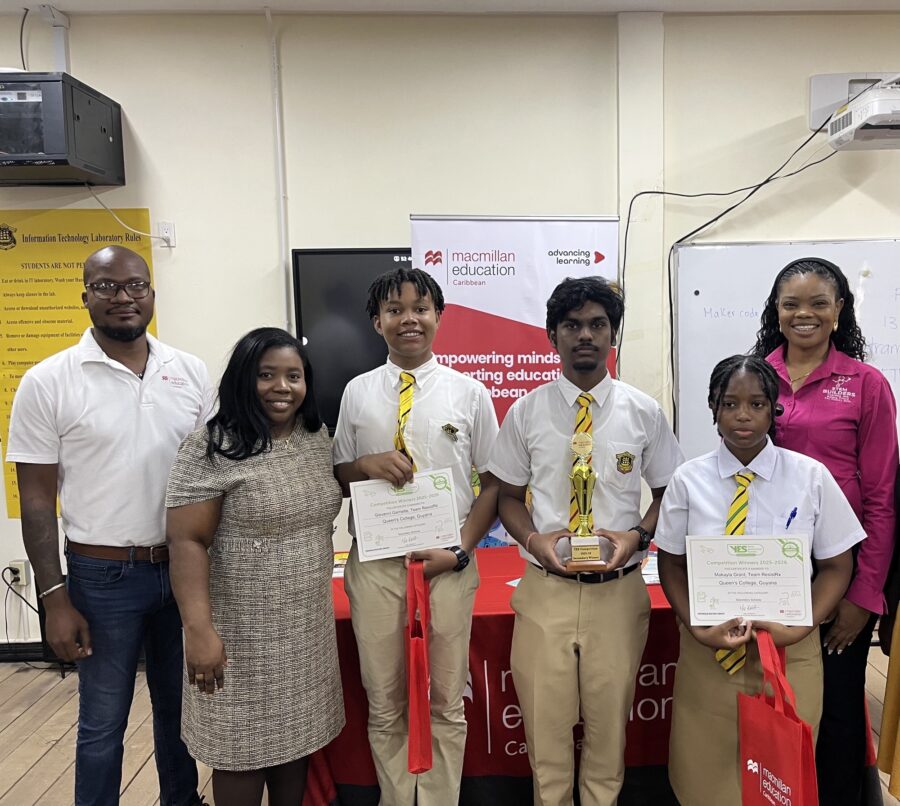
More than 35 students from Queen’s College participated on Wednesday, in an interactive STEM workshop led by Jamaican science educator and entrepreneur Kavelle Hylton, following the school’s first-place finish in the secondary category of the 2025–2026 Young Environmental Scientists (YES) Competition.
The workshop, which engaged students from Grades 7 to 12, introduced participants to the world of coding, robotics and emerging technologies through hands-on activities using micro:bit devices. Students learned the fundamentals of programming while exploring how technology can be applied to solve real-world challenges.
Recognising the importance of agriculture to Guyana’s economy, Hylton tailored the session to demonstrate how coding and robotics can be used to monitor weather patterns, temperature and environmental conditions within agricultural settings. Students were shown how simple programmable devices can support smarter farming practices, improve decision-making and contribute to sustainable agricultural development.
The session formed part of the prize package awarded to Queen’s College after its team, ResistRx, captured first place in the regional secondary category of the YES Competition. The winning project examined the environmental impact of improper antibiotic disposal and proposed practical solutions to help reduce antimicrobial resistance in soil ecosystems.
Hylton, who serves as Chief STEM Ambassador and is the founder and Chief Executive Officer of STEM Builders Learning Hub, encouraged students to view science and technology as tools for innovation and problem-solving. Through a series of practical exercises, students gained firsthand experience in coding and robotics while developing a greater appreciation for the role of STEM in addressing challenges facing their communities.
The workshop was attended by Principal Mrs. Donna Lewis-Isles, along with the school’s three deputy principals, who joined students in observing the activities and interacting with facilitators. Also present was Ms. Terry Andrews, the liaison between Queen’s College and Macmillan Education Caribbean, who played a key role in supporting the planning and execution of the workshop.
Representing Macmillan Education Caribbean was Regional Officer Alex Holder, who commended the enthusiasm and engagement demonstrated by the students throughout the session.
Speaking after the workshop, Hylton praised the students for their curiosity and willingness to embrace new technologies.
“Today’s students are tomorrow’s innovators,” she said. “By introducing them to coding and robotics in ways that connect directly to industries that matter to their country, such as agriculture, we help them see how STEM can be used to create meaningful solutions and drive future development.”
The workshop was well received by students and staff alike, further reinforcing the value of hands-on STEM learning experiences. Organisers noted that initiatives such as the YES Competition and associated enrichment activities help to inspire the next generation of scientists, engineers and innovators across the Caribbean.
The Young Environmental Scientists Competition is hosted annually by Macmillan Education Caribbean and challenges students to identify environmental issues within their communities and develop innovative, science-based solutions that can create positive change.