Rooted in Resilience: Vincentian Women Turn Survival into a Thriving Agribusiness Movement
When the 2023 volcanic eruption threatened food security in Saint Vincent and the Grenadines, a group of women – administrators, teachers, bankers, nurses, housewives, and grandmothers—came together in the kitchen of the Kingstown Baptist Church to prepare meals for displaced families. Concerned about worsening food shortages, they began planting vegetable crops and soon organised themselves into a work team, transforming once derelict spaces at the Botanical Gardens and the Intermediate High School into thriving community gardens. Planting cash crops including tomatoes, sweet and flavour peppers, broccoli, celery, spinach, beans, ochres and potatoes, the ladies employed sustainable growing methods learned through technical guidance from the St. Vincent and the Grenadines Conservation Fund (SVGCF) and other trained practitioners.
What began as community response has since evolved into the Eco Home Gardens (EHG) Project—a growing women-led agribusiness initiative building the capacity of more than 100 women in organic farming—meeting food needs within their homes and respective communities.
“We started because we were afraid—afraid there wouldn’t be enough food. We knew nothing about farming, but we knew we had to do something. So, we came together, we learned, and now we’re producing—not just for ourselves, but for others as well,” shared Bernadette Duncan, President of the Eco Home Gardens Project.
A New Chapter Begins
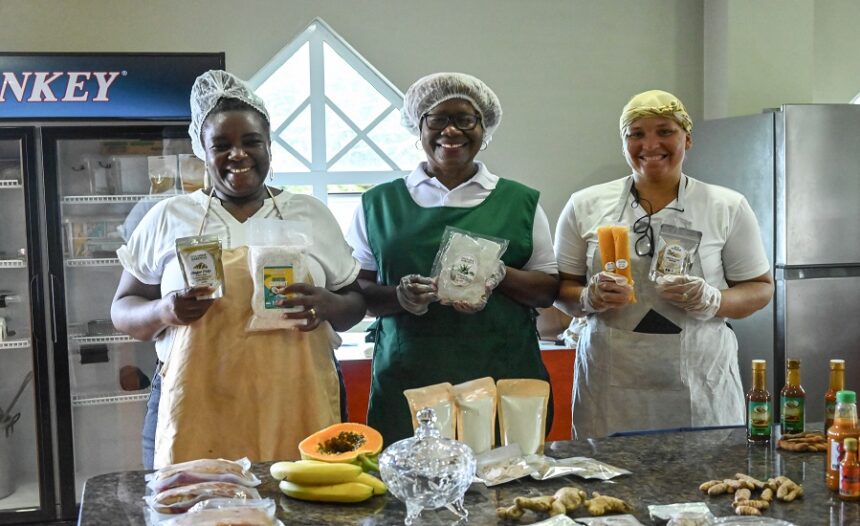
Through an investment of approximately EC$54,000 from the Sandals Foundation, participants received commercial agro-processing support with the provision of a dehydrator, industrial stove, refrigerator, slicer and grinder, along with requisite training.
The equipment has enabled the ladies to transform surplus harvests from their communities into value-added products including ginger and turmeric powders, grated coconut and fruit blends—preparing to enter formal retail markets. One standout product—crystallized ginger—is already gaining traction locally and internationally both as a snack and for its medicinal benefits.
“I started making the crystallized ginger because I was ill and couldn’t find it anywhere when I needed it. Now it’s helping people with sinus issues, colds, and coughs—and they’re buying it, even taking it overseas. That’s when I realized this was bigger than just us,” said Duncan.
Beyond value-added production, the support from the Sandals Foundation has placed strong focus on standards and market readiness. Through capacity building trainings in food safety, product development, branding, marketing, and product labelling—the ladies ensure that they are in alignment with the requirements of the St. Vincent and the Grenadines Bureau of Standards.
“We didn’t just learn how to grow—we learned how to present, how to package, how to meet standards. That changed everything. Now we’re ready for supermarket shelves, not just stalls,” noted Sylvia Richards, who leads agro-processing efforts within the group.
For Richards, the shift is also about rethinking value at its core: “There’s so much produce here that goes to waste—tomatoes, ginger, everything. You see it spoil, and you know it could be something more. Now, we’re taking what would have been lost and turning it into products people actually want and need.”
Organic Farming at its Core
As the team looks towards supplying the local and international markets, at its core is a commitment to growing foods organically. Over the years, its success has been largely attributed to the implementation of smart climate farming techniques that enable their crops to thrive.
“With guidance from facilitators through the SVG Conservation Fund, we learned practical techniques that helped the garden thrive, even in difficult conditions. Through sponsorship from the New Zealand High Commission, we installed drip irrigation, are harvesting water from the school’s roof, and using coconut coir to help keep the soil moist during the heat,” said Mrs. Duncan.
For Odini Sutherland, that approach has built her confidence as a new farmer. “I’m a fashion designer—I’ve never farmed a day in my life, but being part of this has changed how I think about food, about sustainability, about what we can create for ourselves.” It showed me that you don’t have to start as an expert—you just have to start.”
Heidi Clarke, Executive Director at the Sandals Foundation, says initiatives like Eco Home Gardens represent more than agricultural support—they represent food security, resilience and the power of communities to rebuild themselves.
“What these women have built is powerful. They have taken a moment of uncertainty and turned it into opportunity—not just for themselves, but for their communities. This is what moving hope forward looks like—creating systems that sustain livelihoods, strengthen food security, and empower people to shape their own futures.”
Across the Caribbean, the Sandals Foundation supports people-first solutions that strengthen food security and expand economic opportunities for women and other marginalized groups in Grenada, Jamaica, Turks & Caicos Islands, Antigua, Barbados, and The Bahamas.
In St. Vincent, that future for the Eco Home Gardens team is shaping up to be limitless as affirmed by President Duncan, “We don’t just want to make products—we want to build a business. We test, we learn, we improve. We’re ready.”
St. Vincent Times