by Edward Meertins-George, Esq.
The rapid decline of Guyanese society under the PPP administration of President Mohamed Irfaan Ali demands immediate, unflinching scrutiny. While Guyana sits on the cusp of unprecedented oil wealth, the reality for the average citizen is a grim landscape of rampant inflation, state capture, institutional paralysis, and systemic corruption.
A Foundation of Legal Contradictions
President Ali’s tenure began under a cloud of legal controversy, rooted in nineteen fraud charges regarding the undervalued sale of state lands. Although these charges were inexplicably dropped after he assumed the presidency, the cloud of institutional compromise remains. This initial conflict set a dangerous precedent, signaling that accountability would be secondary to political power.
Institutionalized Corruption and Executive Inaction
Under Ali’s leadership, the executive branch has consistently failed to investigate serious allegations of corruption within its own ranks.
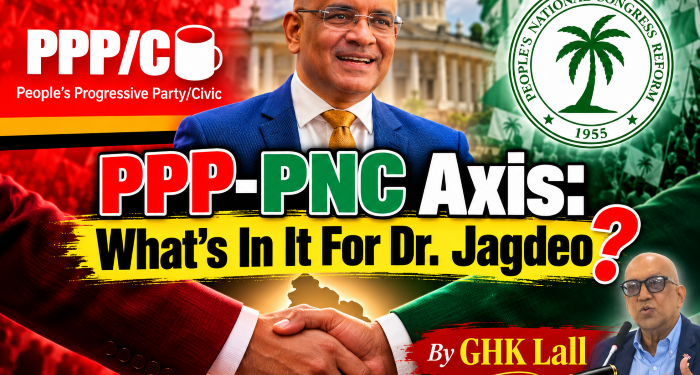
- Vice President Bharrat Jagdeo: Credible, publicly aired allegations of corruption and bribery have met with absolute inaction and stone-walling.
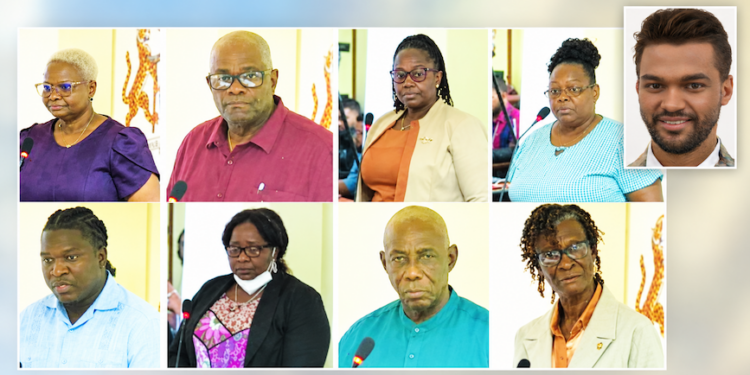
- Cabinet Accountability: Ministers, including Susan Rodrigues, Zulfikar Mustapha, Deodat Indar, and Juan Edgehill remain insulated from accountability despite widespread public concern over the management of state resources, infrastructure contracts, and agricultural allocations.
This pervasive inaction has fostered what citizens openly describe as a “family of government grifters,” where public office is treated as a mechanism for private enrichment rather than public service.
Intellectual Deficit, Performative Governance, and Economic Failure
There is a stark disconnect between President Ali’s public persona and the reality of his administration. Ali frequently engages in highly rehearsed, performative discussions regarding international matters, such as the Low Carbon Development Strategy (LCDS) and carbon management. However, this rhetorical varnish vanishes when facing internal crises. The administration displays a total inability to deliver structural solutions to the skyrocketing cost of living and the severe financial and affordability issues crushing ordinary Guyanese families. The presidency operates on optics, substituting international climate speeches for concrete domestic economic relief.
The depth of this domestic failure is explicitly captured by current data from Statistics Guyana and the International Monetary Fund, which pinpoints local food inflation driving overall consumer price increases. Concurrently, real unemployment persists as a systemic burden. The tragedy of Guyana’s oil boom is that while the country registers staggering GDP growth, the wealth remains concentrated at the top. The ordinary Guyanese public worker earns an average gross monthly salary of approximately G$100,000 (roughly $478 USD). This stands in humiliating contrast to the regional standard of administrative achievement demonstrated in Barbados under Prime Minister Mia Mottley, where the average monthly gross salary hovers around $1,950 USD—a 4-to-1 baseline earnings gap. Despite Guyana’s vastly superior GDP per capita (PPP) due to its oil boom, the wealth fails to reach public servants, and the general laboring class proving that the Ali administration favors elite enrichment over the economic security of its workforce.
Geopolitical Collusion and the Extradition Calculus
The lengths to which this administration will go to protect its network of illicit enrichment have now spilled into the geopolitical arena. Rather than facing domestic justice, there is a clear, calculated collaboration with external actors, specifically US Secretary of State Marco Rubio’s circle, to orchestrate the extradition and removal of prominent figures like Nazar and Azruddin Mohamed from the political and economic calculus. By utilizing international security apparatuses and high-level political alignments with US figures, the Ali government is actively clear-cutting internal competition and eliminating liabilities and challenges to its exclusive autocratic political power. These tactical maneuvers ensure that the massive flows of state contracts, gold extraction, and oil logistics remain entirely within the hands of the ruling family of grifters, friends and favourites completely insulated from local oversight, challenge or dissent.
Policies of Marginalization and Tokenism
The administration’s approach to governance has exacerbated deep-seated ethnic and social divisions. Rather than fostering genuine national unity, the State stands accused of pursuing policies of economic exclusion and marginalization. To deflect from these systemic inequities, the administration has utilized political tokenism—recruiting and rewarding a select few Afro-Guyanese allies to serve as the public face of an administration that systematically diverts resources away from the targeted African and Indigenous marginalized communities.
ExxonMobil and the Capture of the State
Nowhere is State capture more evident than in the government’s complete alignment with ExxonMobil. The judiciary and regulatory bodies appear entirely subservient to foreign oil interests. The Ali government appears to be actively colluding with ExxonMobil to shield them from full liability and the consequences of its abuses and reckless disregard of its economic, and environmental responsibilities contracted in their initial agreements/s, refusing to enforce robust guarantees for full-parent company coverage in the event of a catastrophic oil spill. This alliance ensures the unrestricted plunder of Guyana’s natural wealth while leaving the local population to bear the entirety of the environmental and financial risk.
Dismantling the Kleptocracy: A Blueprint for Total Stamping Out of Corruption
When theft, graft, and administrative dysfunction permeate every layer of government, standard political mechanisms fail. Accountability cannot be achieved through a compromised judiciary or partisan oversight bodies.
Restoring Guyanese society requires immediate, draconian legislative and systemic interventions:
- Mandatory Property Seizure Laws: Implementation of aggressive Unexplained Wealth Orders (UWOs). Any current or former minister, public official, or close associate whose lifestyle or asset portfolio cannot be mathematically justified by their official government salary must face immediate, mandatory seizure of those properties and assets, with funds redirected directly to public sector salary stabilization.
- Strict Criminal Liability Penalties for Ministers: Introduction of mandatory minimum 20-year prison sentences for public officials found guilty of bribery, procurement fraud, or collusion with foreign entities to undersell state resources, with no executive pardons.
- Independent International Oversight: The establishment of an extra-governmental, internationally backed anti-corruption commission with the power to independently investigate and prosecute the theft of state resources.
- Civic Mobilization and Constitutional Reform: A unified, cross-ethnic civil society movement dedicated to restructuring the constitution to dilute executive overreach and guarantee absolute judicial independence.
- Oil Contract Renegotiation: A transparent auditing of all petroleum agreements, demanding strict environmental liability and equitable wealth distribution.
- And, Concrete Citizens actions: Most, importantly, direct public action by the citizenry to register its dismay and rejection of the current status quo , to shift the current deceptive and distressing narratives, and to ensure lasting policy changes that guarantee them a livable and viable actuality, and future
Guyana cannot survive a trajectory where state resources are weaponized against its own people to benefit a corrupt political elite and multinational corporations. The preservation of the republic depends on the collective refusal of its citizens to accept state capture as the status quo.