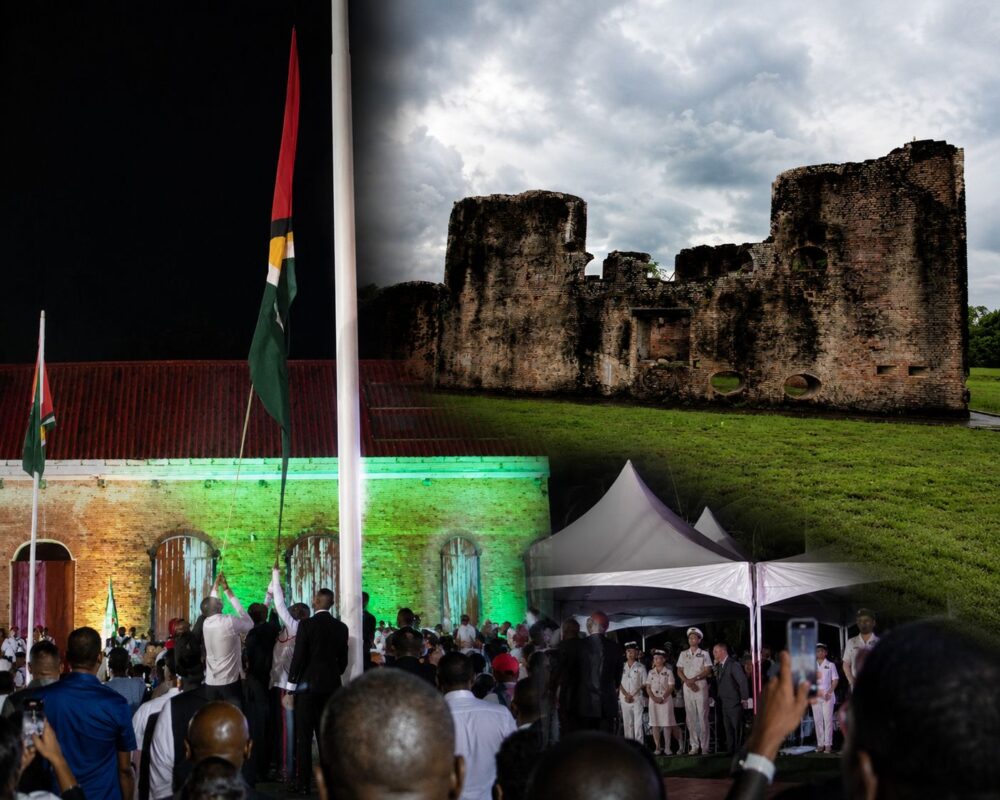
What was intended to be a triumphant celebration of Guyana’s 60th Independence Anniversary became one of the most discussed moments of the night when the Golden Arrowhead refused to rise above half-staff at Fort Zeelandia on Fort Island in the Essequibo River.
Minutes after President Irfaan Ali declared that Essequibo “is and will remain Guyanese,” soldiers of the Guyana Defence Force repeatedly attempted to hoist the national flag atop a towering flagstaff. Despite more than 30 minutes of effort, the halyard remained entangled and the Golden Arrowhead could rise no higher than just below half-staff—a position traditionally associated with mourning.
Eventually, a smaller flag was raised on a substitute pole at 12:43 a.m., allowing the ceremony to proceed. Yet for many observers, the symbolism of the moment proved impossible to ignore.
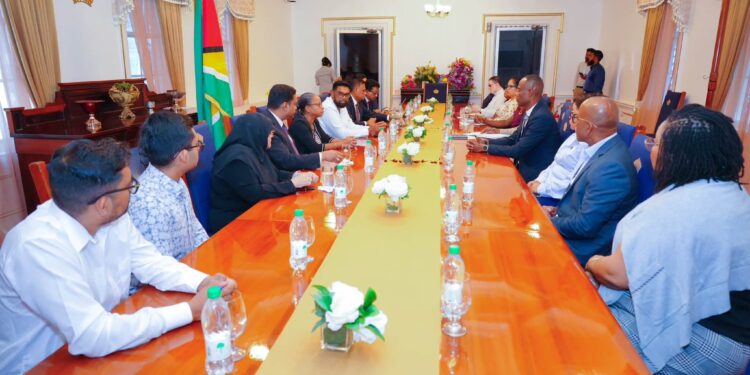
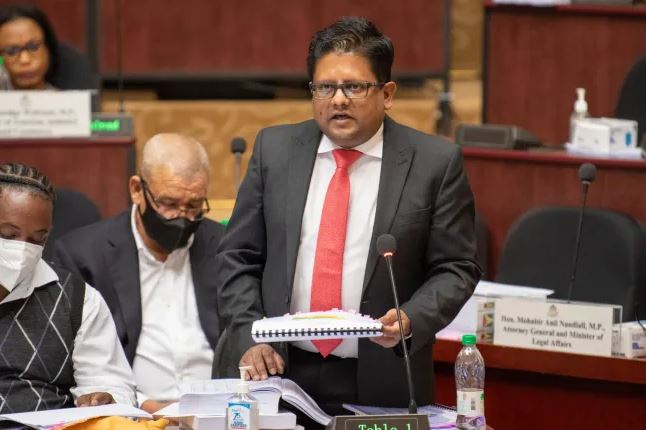
The ceremony itself was attended by government officials, diplomats, members of the disciplined services and specially invited guests. Notably absent, however, were many of the institutions and individuals whose struggles helped make Independence possible. Opposition leaders, representatives of organised labour and several surviving independence-era contributors were not invited to participate in the national observance, despite their roles in the long struggle for political rights, universal adult suffrage, internal self-government and eventual independence.
The irony was heightened by the location itself.
Standing on the banks of the Essequibo River, Fort Zeelandia is one of Guyana’s oldest surviving colonial structures and a powerful reminder of the country’s Dutch past. Built by Dutch settlers in the mid-eighteenth century, the fort served as the administrative centre of the colony of Essequibo. Constructed from bricks imported from the Netherlands, it was designed to protect Dutch interests and secure control over trade and settlement along the river.
But Fort Zeelandia’s history extends far beyond military defence and colonial administration. It is also deeply connected to the system of African enslavement that underpinned the colony’s economy. Hundreds of enslaved Africans lived and laboured on plantations throughout the Essequibo region, producing sugar, coffee, cotton and other commodities that enriched the colonial powers. Colonial laws governing slavery were administered from centres of authority such as Fort Island, making the fort a symbol of power in a society built on forced labour and racial hierarchy.
Many enslaved Africans resisted that oppression through escape, rebellion and acts of defiance. Their courage and determination became part of the broader struggle for freedom and dignity that helped shape the nation that would eventually emerge centuries later.
After the British assumed control of the Dutch colonies in the early nineteenth century, Fort Zeelandia gradually lost its military significance but remained an important administrative centre. Today it stands as one of the finest surviving examples of Dutch colonial architecture in Guyana and a monument to a complex and often painful history.
Yet history is not the only legacy associated with Fort Zeelandia.
For generations, Guyanese folklore has linked old Dutch settlements, plantations and colonial sites to stories of restless spirits. Local legends tell of the ghosts of enslaved Africans and others who suffered tragic deaths during the colonial period, lingering in search of justice for wrongs committed against them. Tales of strange sounds, unexplained sightings and supernatural encounters have long surrounded places connected to Guyana’s colonial past.
The fort’s story also intersects with wider folklore surrounding the Bacoo, a mischievous spirit often described as a small, child-like being capable of bringing wealth and good fortune to its owner but causing chaos when neglected. Stories of spirits, curses and supernatural vengeance have become intertwined with many former Dutch settlements, reflecting memories of suffering, injustice and unresolved grievances.
One folklorist said many Guyanese would inevitably interpret the flag incident through that cultural lens.
“Old people used to say that spirits do not forget,” the folklorist remarked. “When those who fought, sacrificed and helped secure freedom are excluded from commemorating that achievement, some would say the spirits are avenging the wrongdoing and reminding us that history cannot be ignored.”
Whether viewed as a technical malfunction, an unfortunate coincidence or a moment rich in symbolism, the image of the Golden Arrowhead stranded below full mast on Guyana’s Diamond Jubilee will likely endure long after the fireworks faded. To many Guyanese, it was a reminder that Independence was achieved through the sacrifices of workers, trade unionists, political leaders and ordinary citizens from every community, and that those contributions deserve recognition in any celebration of the nation’s freedom.