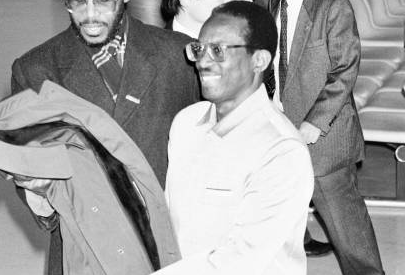
For several moments during his address this week, Hamilton Green was no longer speaking as a politician.
He was speaking as one of the last surviving witnesses to the emotional birth of modern Guyana.
Recounting the midnight moment of May 26, 1966, Green painted a vivid picture of the lowering of the Union Jack and the raising of the Golden Arrowhead, a moment he described with reverence and sorrow.
“As the Golden Arrowhead reached the top of the flagpole,” Green recalled, “the flag danced to the winds of the northeast trade winds.”
For Green, those winds carried more than symbolism. They carried memory.
He reminded listeners that they were the same winds that once brought slave ships to the Caribbean, carrying Africans into bondage and suffering. In Green’s telling, Guyana’s independence was not merely constitutional change, but part of a much larger historical struggle stretching across centuries.
Throughout the speech, Green framed Guyana’s modern challenges through the lens of historical continuity. Slavery, colonialism, exploitation, betrayal, and resistance were not distant events, he suggested, but living forces still shaping the country’s politics and psychology.
He warned that younger generations risk becoming detached from the sacrifices that built the nation.
“Spend as much time as you can talking to our young people,” Green urged the audience.
The former Prime Minister repeatedly returned to the idea that freedom is fragile unless defended by an informed and courageous citizenry.
Quoting from Shakespeare’s Julius Caesar, Green challenged Guyanese to reject political submission and dependency.
“The fault, dear Brutus, is not in our stars, but in ourselves, that we are underlings,” he recited.
The speech blended history lesson, political warning, and moral appeal. Green referenced the 1763 Berbice slave rebellion, the 1823 uprising, the independence negotiations of the 1960s, and even World War II, weaving them together into a larger argument about vigilance, sacrifice, and national dignity.
At several points, his remarks took on the tone of an elder statesman worried not merely about elections or political parties, but about the character of the nation itself.
He expressed concern that Guyana’s newfound oil wealth could leave future generations poorer in spirit and opportunity if resources are exploited recklessly.
“What will they say about us?” he asked, speaking about environmental destruction and the rapid extraction of wealth.
Green closed by urging Guyanese to resist fear, materialism, and political dependency, while recommitting themselves to the unfinished work of independence.
For many in attendance, it was less a political speech than a plea from one generation to another: remember the struggle, defend the nation, and do not surrender the meaning of freedom.