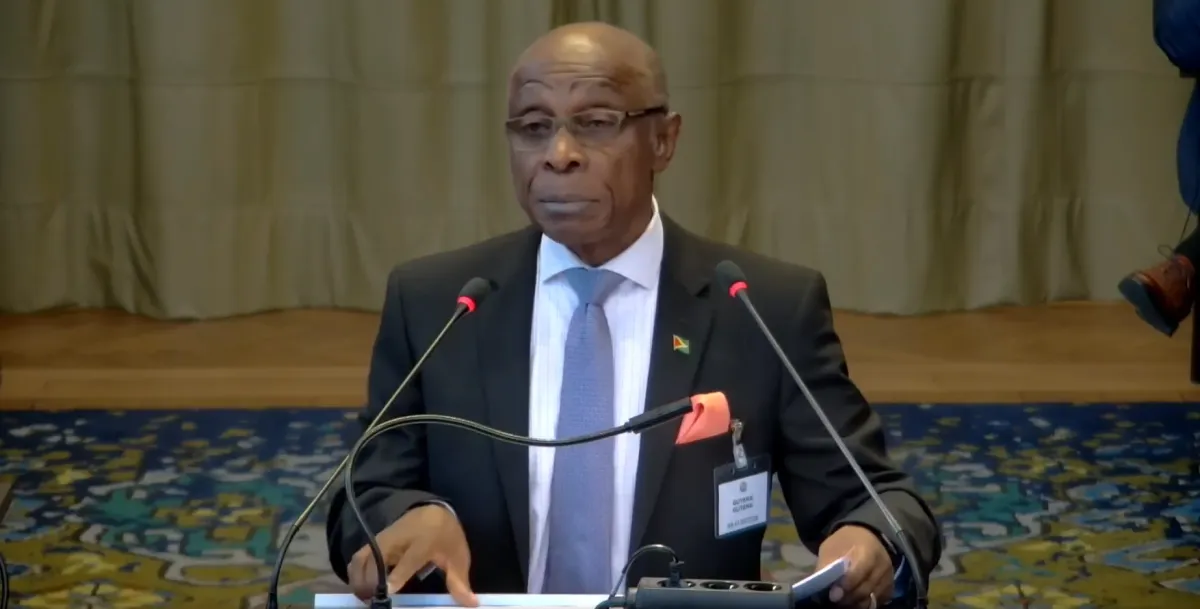
Former Foreign Affairs Minister Carl Greenidge has told the International Court of Justice (ICJ) that historical evidence clearly shows it was Venezuela—not Britain—that pushed for arbitration to resolve the decades-old territorial controversy between the two countries.
Greenidge, who previously served as Guyana’s foreign secretary, presidential advisor on borders, and Agent in the border case before the ICJ, used his presentation to trace the historical origins of the dispute and Venezuela’s role in initiating the arbitration process that resulted in the 1899 Arbitral Award.
“The history is clear, and established by the evidence before the court,” Greenidge told the judges. “It was Venezuela that insisted on arbitration.”
The border controversy centers on the validity of the 1899 Arbitral Award, which settled the boundary between then-British Guiana and Venezuela, awarding the territory west of the Essequibo River to British Guiana. The award stood unchallenged for more than six decades until Venezuela declared it null and void in 1962, reviving its claim to nearly two-thirds of Guyana’s territory.
The matter was formally taken to the ICJ in 2018 by the APNU+AFC government under then President David Granger, following a decision by the United Nations Secretary-General to refer the controversy for judicial settlement under the 1966 Geneva Agreement. Greenidge was appointed Guyana’s lead agent in the proceedings and has played a central role in presenting the country’s case.
In his submission, Greenidge argued that after years of failed diplomatic negotiations with Britain, Venezuela itself proposed arbitration in 1883 as the means to settle the controversy.
According to him, Venezuela sought a binding decision from an arbitrator jointly chosen by both parties.
Britain initially rejected that proposal, objecting to the scope of the territory to be considered.
But Greenidge said Venezuela intensified its efforts.
After severing diplomatic ties with Britain in 1887, Venezuela sought support from the United States to pressure Britain into accepting arbitration.
“It was Venezuela that brought the United States into the picture to help it obtain the arbitration agreement with Great Britain that it was unable to obtain on its own,” Greenidge said.
He explained that Venezuela lobbied Washington to use its diplomatic influence to secure arbitration over the full territory between the Essequibo and Orinoco Rivers.
That diplomatic push resulted in the 1897 Treaty of Washington, which formally committed both sides to arbitration.
“And, ultimately… Venezuela secured the arbitration agreement on which it had been insisting for more than a decade,” Greenidge said.
He told the court that Venezuela not only accepted the treaty but celebrated it as a diplomatic victory and publicly thanked the United States for its role in achieving the agreement.
“Venezuela heralded and celebrated the treaty as the accomplishment of its long-sought objective,” Greenidge noted.
He added that Venezuela maintained that position for decades after the 1899 award, raising no formal objections to either the treaty or the arbitral process.
“It neither questioned, challenged, nor criticised the treaty,” Greenidge said.
He argued that Venezuela’s current challenge before the ICJ represents a complete reversal of the very process it once demanded.
“In these proceedings, Venezuela takes exactly the opposite position,” he said, noting that Caracas is now seeking to discredit the arbitration agreement it fought to secure.
Greenidge rejected Venezuela’s current claims as legally baseless and historically inconsistent.
His presentation also placed the territorial controversy within a broader historical context, outlining Guyana’s territorial administration from Dutch to British control.
He told the court that Dutch settlements and administration existed in the territory as early as the 17th century, evidence of which remains visible through geographical names and records.
By contrast, Greenidge argued there is no historical evidence of Spanish settlement or administration east of the Orinoco River—an argument that undermines Venezuela’s claim to historical ownership.
“What Venezuela does not say, and what it cannot say, is that there was any Spanish settlement or administration in this territory,” Greenidge said.
He further explained that Britain assumed control of the Dutch colonies in the early 19th century, eventually consolidating them into British Guiana.
As part of that administration, British surveyor Robert Hermann Schomburgk conducted boundary surveys that later informed Britain’s territorial claims and became central to the arbitration process.
The resulting Schomburgk Line formed a major basis for the 1899 tribunal’s deliberations.
Greenidge said while Venezuela objected to that line at the time, it failed to produce evidence of effective occupation or administration of the disputed territory.
Instead, he said, Venezuela relied largely on colonial-era assertions, including references to papal decrees, rather than demonstrable state control.
In closing, Greenidge reaffirmed Guyana’s position that Venezuela’s challenge to the arbitral process contradicts its own historical conduct and acceptance of the award.
He maintained that the documentary record before the court demonstrates Venezuela actively sought arbitration, embraced the treaty that created it, and accepted its outcome for decades.
Guyana’s legal team is expected to continue its submissions before the ICJ as the proceedings move into further arguments on jurisdiction and the substantive validity of the 1899 Award.