The Iwokrama International Centre (IIC) has been in continual discussions since 2024 with the Academy of Natural Sciences of Drexel University based in Philadelphia, USA for collaborations in research and training.
The first collaboration has kicked off with a six-day training in Birding Tour Guide training course held at the Iwokrama River and Surama Eco Lodges in January 2026.
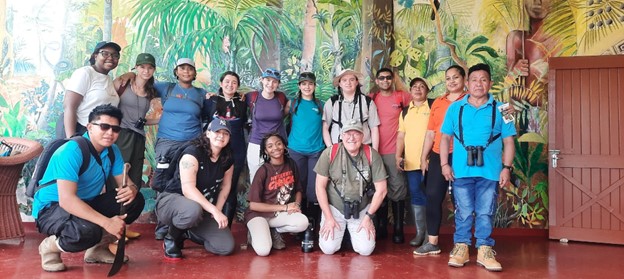
In March 2026, nine undergraduate American students representing several areas including biology, environmental sciences, engineering and political science, visited Iwokrama and Surama Village on an Intensive Course Abroad (ICA).
The ‘Tropical Field Studies’ Course is an intensive field-based ecology course. Emphasis is placed on student experience with diverse tropical ecosystems, assessing abiotic factors and their effects on habitat structure and biodiversity, learning about important biological interactions, and consideration of human impacts on tropical forests.
The students were exposed to various aspects of Iwokrama’s work including the monitoring system, forestry and tourism operations inclusive of some of the popular tours. They also were able to do birdwatching with Fair View Wildlife Club youth and had a try at making the local dish – roti. They also visited the Bina Hill Youth Learning Centre for a student exchange. They were further immersed in Indigenous culture in Surama Village where they did activities such as farming, hiking and had cultural exchanges with the Surama cultural group. Additionally, experiencing another ecological landscape, the Rupununi Savannahs offered new biodiversity sighting opportunities.
Iwokrama Director, Resource Management and Training, Dr Raquel Thomas expressed that ‘Study Abroad Programmes at Iwokrama offer a great opportunity for students and others to learn about conservation in the context of how Iwokrama manages the one-million-acre Iwokrama Forest where the focus is on natural resource use but in a sustainable way. Additionally, the people-first approach showcased by our partnerships especially with the 20 Indigenous Communities via the North Rupununi District Development Board are crucial to Iwokrama’s success’.
Professor Sean of Drexel University shared that ‘The chance to visit and compare riverine, wet forest and savannah ecosystems was a fantastic opportunity for the students. Iwokrama was an excellent base for exploration and learning, and our community hosts at Surama were incredibly generous and welcoming in teaching us about their culture.’
One Student Peyton Holmes further shared that ‘On March 17, 2026 my journey into ecological studies began when I stepped foot in Iwokrama River Lodge. I was greeted by the wonderful Dr. Raquel and her Field Ranger Beckey. As we embarked on our field studies I was taught, in a highly immersive way how to identify certain organisms by their look, feel and sound. Arriving in Iwokrama, I couldn’t tell you what brown sand, laterite, or white sand was and what makes them different. Nor could I identify a Screaming Piah or Blue Heron. Upon leaving Iwokrama, I could. The examples given above are only the tip of the ice berg for what I learned. This course led by Iwokrama staff allowed me to expand my knowledge and experience, thus making me a well rounded student and a novice ecologist’.
Some students were also able to experience the Mahaica River tour which took them to a different ecosystem (Coastal) and where they were able to see Guyana’s national bird, the Canje Pheasant (Hoatzin). Additionally, they were given a tour of the University of Guyana by students of the University of Guyana Student Society (UGSS).
In June 2026, another Drexel University team will arrive to explore possible research collaborations.
On another note, this year, 2026, is yet another special year for Iwokrama- Iwokrama will be celebrating 30 years since the passage of the Iwokrama Act, which was assented to by Dr Cheddie Jagan in May 1996. The media will be kept updated on activities planned to celebrate this important milestone.