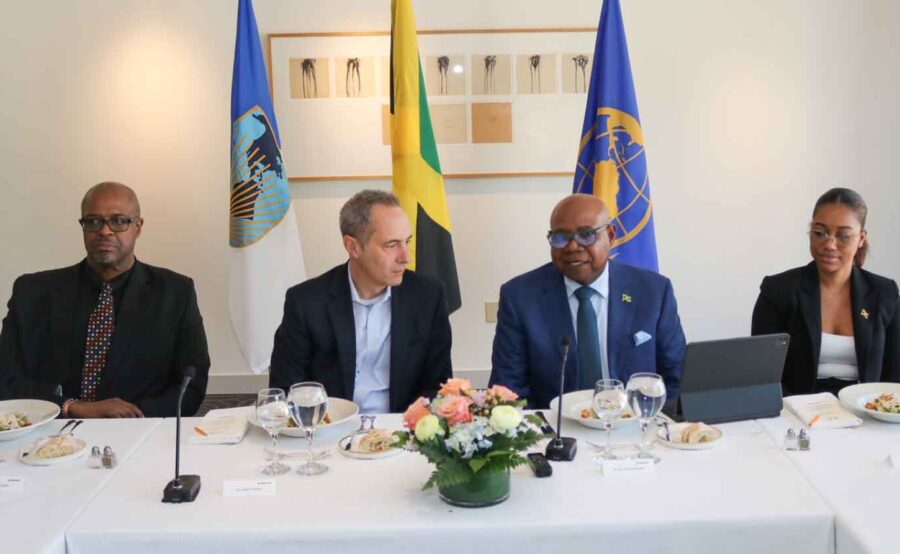
Jamaica’s Tourism Minister calls for new Caribbean financial architecture while Afreximbank’s $5 billion CARICOM facility — ratified by Kingston only after years of delay — sits largely untapped for tourism development.
By Calvin G. Brown (WiredJA)–Jamaica’s Tourism Minister Edmund Bartlett stood before the Inter-American Development Bank’s Board of Directors and declared, with the confidence of a man who has never doubted his own argument, that “the time has come for a regional financial institution dedicated to tourism in the Caribbean.
He said we needed a ‘Tourism Bank’ where products can be crafted and developed that are responsive to tourism’s demands and supply dynamics.”
It was a compelling pitch, fluently delivered. But it raised an uncomfortable question that the room apparently did not press: Minister, what about the five billion dollars that is already on the table?
The African Export-Import Bank (Afreximbank) has extended credit lines to the Caribbean Community (CARICOM), where Caribbean governments, and the tourism sector in particular, are actually drawing on what is now a US$5 billion facility.
The Speech That Impressed — And Glossed Over
To be fair to Bartlett, much of what he told the IDB was correct and long overdue. He named the elephant in the room that Caribbean ministers rarely name in polite multilateral company: that the region’s ambivalence about tourism investment is partly psychological — a residue of colonialism that has confused service with servitude.
“There is a degree of psychological decolonization that is necessary,” he said, invoking a frame that belongs more naturally to a CARICOM platform than a Washington luncheon. He spoke of tourism as a transformative, community-building force — one that builds roads, brings electricity, and changes sleepy fishing villages into economic engines. None of that is wrong.
But Bartlett’s pitch to the IDB for a new dedicated Caribbean Tourism Bank — however visionary — was made in a vacuum that his own government helped create. And it is a vacuum worth examining.
“Afreximbank raised its CARICOM financing limit to US$5 billion in March 2026 — a decision Jamaica only made possible by finally ratifying its membership in mid-2025, after sitting on the agreement for the better part of three years.”
The $5 Billion That Bartlett Didn’t Mention
At the 50th CARICOM Heads of Government Meeting in Basseterre, St. Kitts and Nevis, on March 2, 2026 — barely weeks before Bartlett’s IDB address — Afreximbank President Dr. George Elombi announced that the Pan-African Multilateral Bank was expanding its CARICOM financing cap from US$3 billion to US$5 billion. This was not a pledge for the distant future.
The bank has already disbursed more than US$750 million across the Caribbean and maintains a live project pipeline exceeding US$2 billion across sectors including tourism, energy, healthcare, agriculture, and infrastructure. The Caribbean Eximbank — a permanent regional institution Afreximbank has committed to helping establish — has been explicitly framed by its architects as the kind of vehicle that could make “the difficult investments necessary to change the structure of our economies.”
That sounds, to any serious observer, remarkably like the Tourism Bank that Bartlett was describing to the IDB. With one critical difference: the Afreximbank model is rooted in African-Caribbean solidarity, diasporic self-determination, and South-South finance — not a Washington institution with its own geopolitical and conditionality architecture.
Jamaica’s Costly Hesitation
The indictment against Jamaica’s handling of the Afreximbank opportunity is written plainly in the dates. The Africa-Caribbean partnership framework was formally established at the inaugural AfriCaribbean Trade and Investment Forum (ACTIF) in Bridgetown, Barbados, in September 2022. It took Jamaica — the region’s largest CARICOM economy by some measures, and the country that most loudly champions Caribbean sovereignty — until July 11, 2025, to officially accede to Afreximbank’s Establishment Agreement.
Jamaica became the 13th CARICOM member state to sign, nearly three years after the framework was laid. In that interval, Barbados, St. Lucia, Suriname, Grenada, The Bahamas and others had already unlocked trade financing, SME facilities, infrastructure support, and development capital from the institution.
What did Jamaica’s delay cost? That is a calculation the Ministry of Tourism has not been asked to make publicly. But it is a fair question when the same minister now stands before the IDB proposing the creation of new financial architecture, apparently unaware — or unwilling to acknowledge — that a parallel architecture already exists, is capitalized to the tune of five billion dollars, and was waiting on Jamaica’s signature for the better part of three years.
Tourism routinely accounts for between 25 and 60 percent of GDP across member states, and the question of how much of Afreximbank’s facility has specifically earmarked for the sector is not a trivial one.
The Real Question Is Political Will, Not Capital
Bartlett is right that the Caribbean suffers from a financing gap in tourism development. He is right that a dedicated regional financial institution could transform the sector. But the minister’s address to the IDB — an institution embedded in the inter-American financial system — while a South-South alternative sits underutilized in the Caribbean’s own backyard, reflects a habit of mind that his own decolonization rhetoric should challenge.
The region’s “ambivalence,” as he put it, is not only about tourism. It is about whether Caribbean governments will commit, with the same energy they devote to Western financial partners, to the institutions they have helped build under their own terms.
Tourism contributes roughly 35 percent of Jamaica’s GDP and supports more than 300,000 workers. In the aftermath of Hurricane Melissa — which knocked an estimated three percentage points off Jamaica’s 2025 growth — the need for resilient, dedicated tourism financing has never been more acute.
The money, it turns out, is not the problem. The question is whether the Holness government — and Bartlett’s ministry in particular — will now move with the same urgency on Afreximbank’s $5 billion as they showed in travelling to Washington to ask for something that already exists.