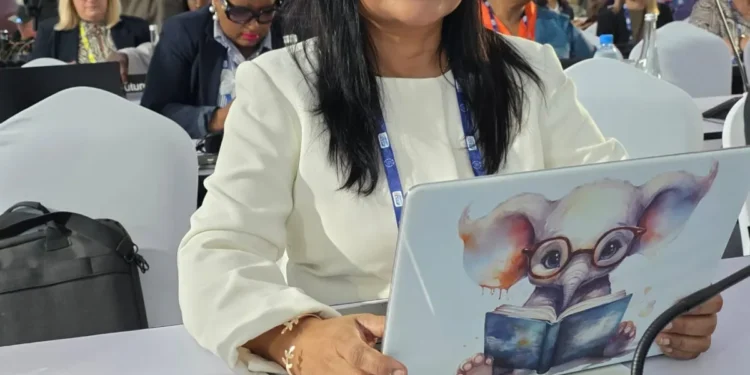
Education advocate Karen Abrams is cautioning that Guyana must move urgently to prepare its workforce and education system for the accelerating impact of artificial intelligence (AI), warning that delays could leave young people unprepared for a rapidly changing global labour market.
In an op-ed published in Kaieteur News on March 1, 2026, Abrams described the pace of technological change as both immediate and transformative.
“In a recent conversation about artificial intelligence, one line stayed with me. The change ahead is not like a light switch. It is like realizing the water has been rising around you and is now at your chest,” she wrote.
Abrams, a doctoral candidate in education and Founder and Executive Director of STEMGuyana, outlined how quickly AI capabilities have advanced in recent years.
“In 2022, AI could not reliably multiply simple numbers. By 2023, it was passing professional exams. By 2024, it was writing working software and explaining graduate-level science,” she noted. “This year, engineers at top firms openly admit they are handing most of their coding work to AI systems. Not in ten years but now!”
She stressed that this transformation is not gradual.
“The acceleration is not linear. It is exponential. And Guyana cannot afford to treat it as background noise,” Abrams stated.
According to Abrams, the shift is not only about improved performance but also autonomy, with AI systems now capable of completing complex tasks with minimal human input.
“These systems are no longer waiting patiently for a prompt. They can be instructed to build an entire software application, test it, debug it, refine it, and return with a completed product,” she wrote, adding that in some cases such systems can operate continuously for extended periods.
She warned that these developments are already reshaping hiring patterns globally, particularly affecting entry-level roles.
“Companies will not hire based on sympathy. They will hire based on cost and productivity,” Abrams said. “If one AI agent can do the work of ten entry level staff, entry level roles disappear first.”
Abrams raised concerns about the implications for Guyana’s graduates.
“We must ask ourselves a difficult question. What happens to our young graduates if the jobs they are preparing for are compressed or automated within five years?” she asked.
While noting that Guyana is still largely in an exploratory phase—experimenting with AI tools and discussing digital transformation—she warned that industries abroad are already restructuring.
“The most dangerous mistake we can make …is assuming that because we do not yet feel the full impact locally, we have time. The water does not announce when it reaches your chest,” she said.
Despite the risks, Abrams emphasised that she remains optimistic about AI’s potential benefits across sectors, including education, agriculture, healthcare and government services.
“I am a technology optimist. AI can transform education… It can support small entrepreneurs… It can increase productivity and reduce inefficiency in government systems,” she wrote, while cautioning that the transition period will be disruptive.
“Even in the best case scenario, rapid change destabilizes societies. People lose jobs. Anxiety rises. Political tensions increase. Communities fracture,” Abrams added.
She argued that the central challenge is preparedness.
“The issue is not whether AI is good or bad. The issue is whether we prepare our people psychologically, educationally, and economically for accelerated change,” she stated.
Against the backdrop of Guyana’s economic expansion, driven by oil revenues and increased investment, Abrams said the country must align its education system with future workforce demands.
“If the future workforce is one where individuals conduct AI systems rather than compete with them, then our education system must shift from memorisation to creation,” she wrote.
She called for a balanced approach that combines strong academic foundations with AI literacy and practical application.
“We cannot retreat into pen and paper nostalgia as a defence against AI. Nor can we allow unchecked digital dependency that erodes thinking skills,” Abrams said. “The path forward requires balance. Strong foundational knowledge combined with AI fluency and project based application.”
Abrams also warned of widening inequality if access to AI tools and skills is uneven, stressing the need to ensure inclusive opportunities.
“As AI accelerates, we must ask how we maintain dignity in work… and how we prevent a widening divide between those who can leverage AI and those who cannot,” she wrote.
She pointed to Guyana’s size and ongoing development as potential advantages if decisive action is taken.
“Guyana has a rare advantage. We are small. We are growing… If we act decisively, we can build an education and workforce model that integrates AI intelligently rather than reacting to it defensively,” Abrams stated.
Abrams’ warning lands at a critical moment for a country experiencing rapid economic change but facing an even faster technological shift. Her message underscores that the issue is no longer whether AI will transform the world of work, but whether Guyana will prepare its people in time to meet it. As she cautions, the danger is not the technology itself, but delay. “The water is rising,” she wrote, “The future will not wait for us to feel ready.”